
Stay-Stoic
  • 🏛️
  • New Posts
  • Philosophy
    • Stoic foundations
    • Four cardinal virtues
      • Stoic wisdom
      • Stoic justice
      • Stoic courage
      • Stoic moderation
    • Stoicism Today
    • Stoic practices
    • Stoic Topics
  • Inspiration
    • Stoic philosophers
    • Stoic wisdoms
    • Stoic quotes
    • Symbolism & Symbols
    • Stoic Glossary
    • About Stay-Stoic
  • German
  • Click to open the search input field Click to open the search input field Search
  • Menu Menu
  • Link to X
  • Link to Instagram
  • Link to Pinterest
You are here: Home1 / Great Philosophers of Stoicism 🌟2 / Medius: The Soul and Its Eight Parts 🔥
Stoicism: Wisdom and virtues such as tranquility, inspiration, and quotes from the Stoa, presented on Stay-Stoic.

Medius: The Soul and Its Eight Parts 🔥

Medius (fl. c. 250 AD) was a Stoic philosopher who engaged deeply with Stoic soul theory. In a notable debate with Longinus, he defended the Stoic idea that the soul consists of eight parts and is governed by the fiery Pneuma.
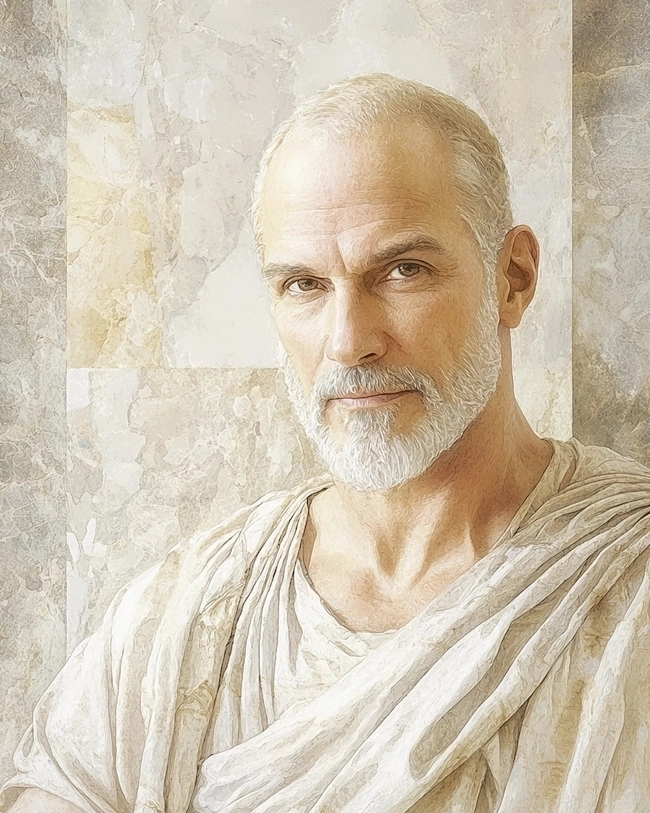
Stylized depiction of Medius, a little-known Stoic who contributed to early Stoic philosophy.

Historical Context and Influence

Medius lived during a time when Stoicism was in intellectual competition with emerging Neoplatonism. His debate with Longinus illustrates how Stoics resisted the Platonic notion of an immaterial and immortal soul. Instead, Medius argued that the soul was physical, structured, and governed by the pervasive force of Pneuma. More on the history of Stoicism

Why Is Medius Still Relevant Today?

The discussion on the nature of the soul is timeless. While modern neuroscience explores the physicality of the mind, Medius defended the idea of a structured, material soul centuries ago. His arguments provide insight into how the Stoics understood the relationship between the mind and the body. More on modern Stoicism

The Eight Parts of the Soul

Medius defended the Stoic theory that the soul consists of eight parts:

  • Hegemonikon: The “ruling faculty” in the heart, seat of reason.
  • Vision: The power of sight, controlled by Pneuma in the eyes.
  • Hearing: The ability to perceive sound, regulated by Pneuma.
  • Speech: The capacity for language, directly linked to the Hegemonikon.
  • Touch: Sensory perception distributed throughout the body.
  • Taste: The recognition of flavors, centered in the tongue.
  • Smell: The perception of scents, connected to the nose.
  • Reproductive faculty: The life force enabling procreation, governed by Pneuma.

More on Stoic principles

Legacy

  • Medius defended the Stoic materialist theory of the soul against Platonic influences.
  • His debate with Longinus highlights the philosophical struggles of his time.
  • He preserved a crucial aspect of Stoic thought that has regained significance in modern discussions on mind-body relations.

Virtues Embodied

  • Wisdom: His detailed arguments on the soul reflect deep philosophical insight.
  • Courage: He challenged the dominant Platonic view of his time.
  • Justice: He defended the Stoic understanding of natural law and order.
  • Temperance: He remained committed to rational analysis rather than metaphysical speculation.

Quotes from Medius

“The soul is not a divine mystery but a structure of nature.”

“What governs us is not a metaphysical idea but a fiery principle within.”

“To understand the soul, one must understand the body.”

More Stoic wisdom: Stoic Quotes

Please Note

Stoic exercises and practices are meant to inspire, not instruct. For personal guidance, please consult an expert. Stoic Practices: Disclaimer

Learn More About Stoicism

  • The Four Cardinal Virtues
  • Recommended Reading
  • Other Stoics and Their Teachings
Back to the content:
I Medius: The Soul and Its Eight Parts 🔥
II Historical Context and Influence
III Why Is Medius Still Relevant Today?
IV The Eight Parts of the Soul
V Legacy
VI Virtues Embodied
VII Quotes from Medius
VIII Learn More About Stoicism
  • Share on Facebook
  • Share on X
  • Share on WhatsApp
  • Share on Pinterest
  • Share on LinkedIn
  • Share on Tumblr
  • Share on Reddit
  • Link to Instagram
Search Search

Latest articles

  • Symbolic article image on Sun Tzu in everyday life, orientation instead of control, and reality as shifting terrain
    Φ ⋮ Sun Tzu in Everyday Life: Orientation, Not Controlby: Stay-Stoic
  • Atmospheric hero image for equanimity, unagitated sovereignty, and quiet presence in a culture of visible agitation
    Φ ⋮ Equanimity in an Age of Constant Agitationby: Stay-Stoic
  • Symbolic image about inner interpretation, cognitive bias, and how small events continue unfolding in the mind.
    Φ ⋮ When Interpretation Turns Events Into Storiesby: Stay-Stoic
  • Conceptual image about self-presentation, visibility, and the quiet exhaustion of constant readability.
    Φ ⋮ Self-Presentation and the Fatigue of Showingby: Stay-Stoic
  • Aging as maturity and life review, focusing on experience, inner clarity, and the yield of lived life
    Φ ⋮ Aging as the Harvest Time of Lifeby: Stay-Stoic

Legal information

· Disclaimer

· Copyright & Protection

· Data privacy statement

· Imprint

Stay-Stoic

· About Stay-Stoic

· Author Profile

· Contact

· Support

· Recommend

Stoic Reflections

· Symbolism & Symbols

· Stoic Affirmations

· Tenets of the Stoa

· The Stoic Signpost

Stores & Reading

· Store for Stoics

· Stoic Literature

· Stoic Glossary

· Read a random article

Copyright by Stay-Stoic | All Rights Reserved
  • Link to X
  • Link to Instagram
  • Link to Pinterest
Scroll to top Scroll to top Scroll to top