
Stay-Stoic
  • 🏛️
  • New Posts
  • Philosophy
    • Stoic foundations
    • Four cardinal virtues
      • Stoic wisdom
      • Stoic justice
      • Stoic courage
      • Stoic moderation
    • Stoicism Today
    • Stoic practices
    • Stoic Topics
  • Inspiration
    • Stoic philosophers
    • Stoic wisdoms
    • Stoic quotes
    • Symbolism & Symbols
    • Stoic Glossary
    • About Stay-Stoic
  • German
  • Click to open the search input field Click to open the search input field Search
  • Menu Menu
  • Link to X
  • Link to Instagram
  • Link to Pinterest
You are here: Home1 / Great Philosophers of Stoicism 🌟2 / Persaeus: Bridging Philosophy and Politics 🏛️
Stoicism: Wisdom and virtues such as tranquility, inspiration, and quotes from the Stoa, presented on Stay-Stoic.

Persaeus: Bridging Philosophy and Politics 🏛️

Persaeus (306–243 BC) was a Stoic philosopher, close friend, and student of Zeno of Citium, the founder of Stoicism. But unlike many of his contemporaries, he did not confine himself to intellectual debates—he actively engaged in politics and military affairs.
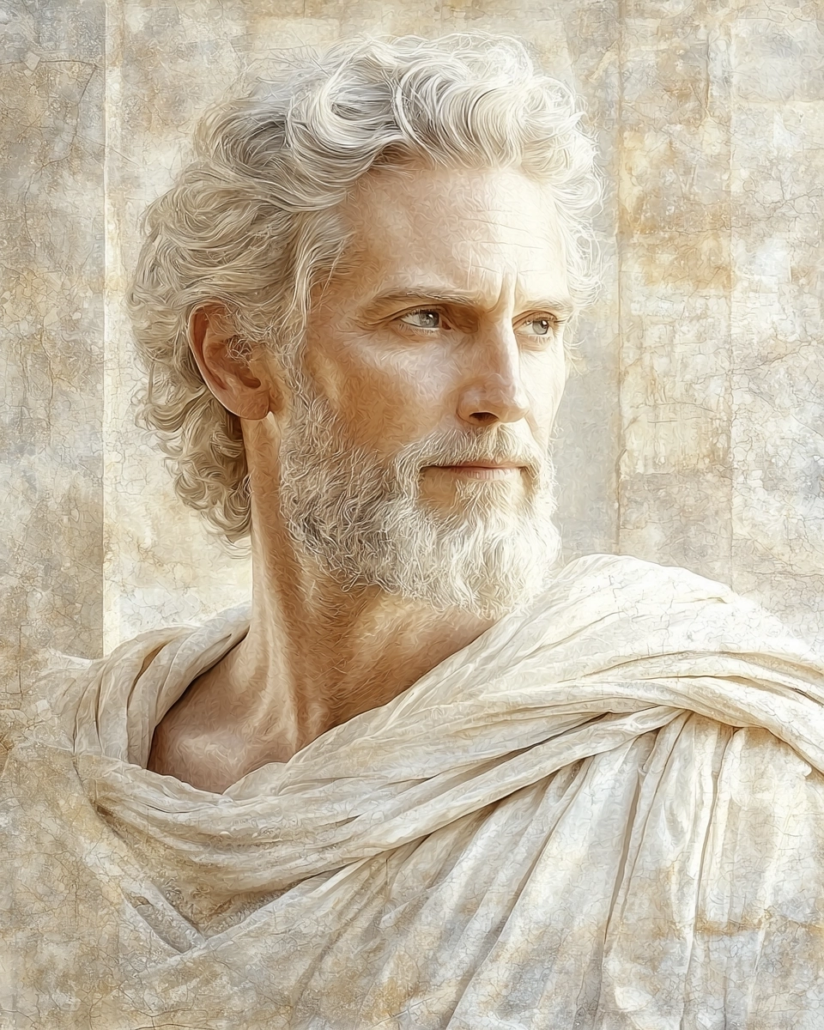
Stylized depiction of Persaeus, a student and close friend of Zeno of Citium, known for his Stoic teachings.

Historical Context and Influence

Persaeus lived in an era where philosophy and politics were deeply intertwined. As a trusted disciple of Zeno, he was closely involved in shaping early Stoicism. Later, he became an advisor to the Macedonian king Antigonus II Gonatas and was appointed governor of Corinth. In this role, he faced not only philosophical dilemmas but also political and military challenges—making him one of the few Stoics who directly applied their philosophy to governance. More on the history of Stoicism

Why Is Persaeus Still Relevant Today?

He demonstrates that Stoicism is not just a philosophy for thinkers—it can be applied in leadership and decision-making. His role as a political figure proves that Stoic principles can guide governance and statecraft, serving as an inspiration for modern leaders. More on modern Stoicism

Key Teachings

  • Philosophy and politics are interconnected: Wisdom is not meant to be confined to books—it must be tested in real life.
  • A Stoic can also be a ruler: Virtuous leadership is possible when guided by reason and justice.
  • Composure amid adversity: As a governor, Persaeus faced political intrigues and military conflicts but remained true to his philosophical beliefs.

More on Stoic principles

Legacy

  • He brought philosophy from theory into political practice.
  • His life shows that Stoicism is relevant not only for scholars but also for statesmen and leaders.
  • He proved that a Stoic is not just a thinker but also a doer.

Virtues Embodied

  • Wisdom: He integrated philosophical thought into real-world leadership.
  • Courage: As governor of Corinth, he faced significant political and military challenges.
  • Justice: He sought to govern with virtue and rationality.
  • Temperance: Despite holding power, he remained committed to Stoic principles.

Quotes About Persaeus

“Philosophy is useless if it is not put into practice.”

“Stoicism is not just about enduring fate – it’s about shaping it.”

“A wise ruler is also a philosopher.”

More Stoic wisdom: Stoic Quotes

Please Note

Stoic exercises and practices are meant to inspire, not instruct. For personal guidance, please consult an expert. Stoic Practices: Disclaimer

Learn More About Stoicism

  • The Four Cardinal Virtues
  • Recommended Reading
  • Other Stoics and Their Teachings
Back to the content:
I Persaeus: Bridging Philosophy and Politics 🏛️
II Historical Context and Influence
III Why Is Persaeus Still Relevant Today?
IV Key Teachings
V Legacy
VI Virtues Embodied
VII Quotes About Persaeus
VIII Learn More About Stoicism
  • Share on Facebook
  • Share on X
  • Share on WhatsApp
  • Share on Pinterest
  • Share on LinkedIn
  • Share on Tumblr
  • Share on Reddit
  • Link to Instagram
Search Search

Latest articles

  • Symbolic article image on Sun Tzu in everyday life, orientation instead of control, and reality as shifting terrain
    Φ ⋮ Sun Tzu in Everyday Life: Orientation, Not Controlby: Stay-Stoic
  • Atmospheric hero image for equanimity, unagitated sovereignty, and quiet presence in a culture of visible agitation
    Φ ⋮ Equanimity in an Age of Constant Agitationby: Stay-Stoic
  • Symbolic image about inner interpretation, cognitive bias, and how small events continue unfolding in the mind.
    Φ ⋮ When Interpretation Turns Events Into Storiesby: Stay-Stoic
  • Conceptual image about self-presentation, visibility, and the quiet exhaustion of constant readability.
    Φ ⋮ Self-Presentation and the Fatigue of Showingby: Stay-Stoic
  • Aging as maturity and life review, focusing on experience, inner clarity, and the yield of lived life
    Φ ⋮ Aging as the Harvest Time of Lifeby: Stay-Stoic

Legal information

· Disclaimer

· Copyright & Protection

· Data privacy statement

· Imprint

Stay-Stoic

· About Stay-Stoic

· Author Profile

· Contact

· Support

· Recommend

Stoic Reflections

· Symbolism & Symbols

· Stoic Affirmations

· Tenets of the Stoa

· The Stoic Signpost

Stores & Reading

· Store for Stoics

· Stoic Literature

· Stoic Glossary

· Read a random article

Copyright by Stay-Stoic | All Rights Reserved
  • Link to X
  • Link to Instagram
  • Link to Pinterest
Scroll to top Scroll to top Scroll to top