

Φ ⋮ Between Shipwreck and Serenity
Zeno of Citium is regarded as the founder of Stoicism – that philosophical school which established reason, virtue, and self-control as pillars of a tranquil life. His teachings are not a call – they are an echo: quiet, yet enduring.
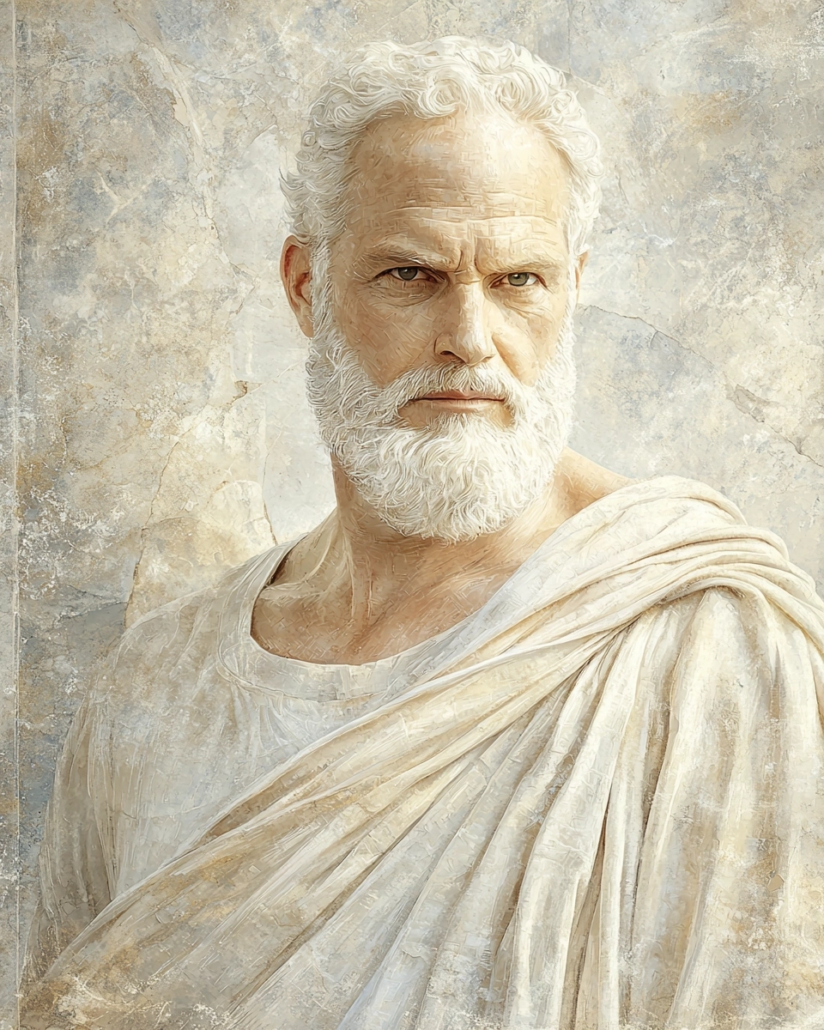
Stylized portrait – Zeno of Citium
Δ ⋮ The Painted Porch
Marble flickers on the steps of the Agora. A tongue of cypress smoke drifts from the nearby sacrificial altar through the hall. There he stands, slightly off-center in the backlight. No podium, no grandeur – just a voice against stone, teaching as if in passing.
Those who came heard no promise. Those who stayed understood: that was the promise. And that promise was a quiet one – that nothing needs to be louder than what cannot be changed. The speck of dust in the light, the shimmer on the stone, the voice that did not persuade, but remained.
Λ ⋮ System Through Shipwreck
He wasn’t from Athens – and yet he became the one who silently reorganized it. Born in Citium, Cyprus, somewhere between a Phoenician merchant world and a thirst for Greek education. His life begins around 333 BCE, ends around 262 BCE. In between: a ship that never arrived. Its cargo was lost – his teaching began. Around 300 BCE he began teaching in the Stoa poikilé. No formal school, no circle – yet profound impact. Apatheia – it wasn’t a demand, but a consequence.
Logos was not a word, but the thought that remained when everything else failed. He had many teachers – among them Crates the Cynic and Stilpo. Students? Enough to found a school that needed no lessons. Yet teaching happened – through presence, repetition of essentials, and that which didn’t fit on scrolls. The loss of his writings is no loss if what remains was never truly written.
Π ⋮ Without Fear, Without Possession
“The wise man fears neither poverty nor death.”
– Zeno of Citium
Maybe that was the moment when the audience reached for their hats – only to forget them again. Maybe not. Because what he said rarely stayed as a quote – it remained as an attitude. One that doesn’t explain why it endures, but simply persists, without fuss. That you need not fear was never the point.
Only that it’s possible not to follow fear. That possession has less to do with ownership and more with the question of to whom you surrender.
For early Stoic perspectives in brief form, see the stoic quotes by Zeno of Citium.
Ξ ⋮ The Elevator That Stalls
It’s 8:47 AM. An elevator in a Berlin co-working space abruptly halts between two floors. Three people, no conversation. An involuntary reach for a bag, then the forehead, then the bag again. No danger – just delay. But who thinks in doses during hysteria? Zeno’s true lesson begins here – not in the pose of calm, but in the practice of not faking it.
Metriopatheia (moderating emotions without repression) is not an app. It has no loading time – but it reloads you. When the message arrives that you’re late – have you truly arrived? Or were you never really present? Stoic practice doesn’t mean ignoring chaos but not losing direction within it. Even if the Wi-Fi goes down.
Σ ⋮ What the Breath Doesn’t Join
Breath has no opinion – but it has influence. Zeno’s students didn’t learn what to think, but how to think when things get tight. The trick: no trick. Just a pause before reacting, an inhale before the mind spirals. Those who get cut off by cyclists daily learn two options: scream or stand. Zeno chose the third: don’t react, withdraw.
In a world addicted to impulse, every delay is resistance. The body, well-trained in early warning, senses it first: the fist is quicker than thought – but also tires quicker. And maybe the body is the final place where philosophy must prove itself – not in seminars, but in responses. Maybe every action is a quote – just without quotation marks.
Ψ ⋮ The Axiom That Doesn’t Explain Itself
Zeno’s work is lost – and thus, perhaps, preserved. Because what remains is not the sum, but the echo.
“Virtue alone suffices.”
– Zeno of Citium (trad.)
A phrase out of time, too plain for headlines, too clear for commentary. And yet it stays. Perhaps because Spoudḗ (serious engagement with virtue) does not speak loudly but acts quietly. The core statement: What has impact is rarely what makes noise. And what endures doesn’t need to explain itself. Perhaps Zeno was never more modern than in his disappearance. Perhaps also because what is missing creates the space where thought begins. The teaching that survives no form, survives by formlessness – an irony Zeno himself might have appreciated.
Ω ⋮ Amidst the Things
Perhaps he just stood there. Between column and shadow, with a sentence he never repeated. And maybe that’s all that remains: a sentence, an attitude, a gap. Sometimes it’s enough to be present without trying to demonstrate anything. What remains is neither Zeno nor quote – it’s the way of conduct. And perhaps that’s enough. Not as an end, but a transition. A quiet formula in the noise of the world: living without needing to explain.
💬 Fragments of the Stoa
Seeker: How do I know if I’m on the right path?
Zeno: ✦ If you walk it without constantly checking the destination.
Seeker: What should I do when injustice makes me angry?
Zeno: ✦ Anger mostly hits the wrong target. Usually: yourself.
Seeker: I can’t turn off what others think of me.
Zeno: ✦ Then mute them. Don’t delete – decouple.
Seeker: Isn’t it unnatural to hide emotions?
Zeno: ✦ Natural is what doesn’t harm you. There is expression even in stillness.
≈ stoically reflected after Zeno and the Stoa · loosely paraphrased
Touchstones with Zeno of Citium
When thought splits into three rooms
Perspective: a triad of logic, physics, ethics. You can sometimes hear it right at the start of a sentence: first the question of the frame, then the question of the world, then the question of action. Zeno’s triad is not a syllabus, more a way of not viewing everything under the same light. Forget that, and you end up back on a single note – and mistake it for clarity.
Profile edge – virtue as the only good
Perspective: virtue as the only truly good. The line sounds plain, almost too clean: virtue counts, the rest does not. And yet the finer distinction hangs on it, and is often missed: externals remain indifferent material, but can still carry relative value without becoming the standard. On that edge it is easily misread – as hardness, where what is meant is order.
A decision culture under role and appropriateness
Perspective: kathēkon as appropriate action. In situations where expectations and duties press in, Zeno’s gaze feels less like morality and more like fit. The big ideal does not decide first; what comes first is whether the act suits the role and the situation without betraying the core. It is unromantic – and for that very reason easy to confuse: as if appropriateness were already compliance.
When “nature” does not sound idyllic
Perspective: living according to nature, reason, and world order. “Nature” reads like green space in many minds; with Zeno it is closer to a measuring system. Reason is not treated as private opinion, but as alignment with a larger order – the cosmos as a meaningfully structured whole, shot through with logos. That can hold, but it leaves little room for the comfortable habit of being right.
Open afterecho – happiness as a course
Perspective: eudaimonia as a “good flow of life.” Zeno’s happiness does not sound like a moment, more like a curve. The peak does not count; what counts is whether the whole course stays coherent – with breaks, with tempo, with detours. That sets a different standard than mood tracking. And it leaves something open that we rarely like left open: whether a single day deserves a verdict at all.
Stoic Fact Sheet: Zeno of Citium
Research facts, structured.
1. Name and variants
Full name: Zeno of Citium (Greek Ζήνων ὁ Κιτιεύς). In ancient and modern sources he also appears as Zeno the Stoic and – to distinguish him from other men named Zeno – as Zeno the Younger. He must not be confused with Zeno of Elea or other philosophers of the same name.
2. Life dates & era
Born probably in 333/332 BCE in Citium on Cyprus; the exact year is uncertain and is reconstructed mainly from indications given by his pupil Persaeus.
Died 262/261 BCE in Athens; the circumstances of his death (suicide after a fall) are transmitted only as an anecdote and are treated with caution in modern research. Zeno belongs to the Hellenistic period, chronologically shortly after Alexander the Great.
3. Place within Stoicism
Zeno is the founder of the Stoa and the leading figure of what is called the early Stoa. He founded the school around 300 BCE in Athens and taught in the Stoa poikilē (“painted colonnade”), from which the school takes its name.
His teaching provides the basis for the systematic development of Stoicism by Cleanthes and Chrysippus; many later Stoic positions are traced back to him but are often accessible only indirectly.
4. Historical context & role
Zeno was the son of a wealthy merchant named Mnaseas from Citium. His precise ethnic background (Greek, Phoenician or mixed) is debated, but from early on he is familiar with Greek language and philosophy.
Around 312/311 BCE he came to Athens, initially as a merchant. After a shipwreck and an encounter with Socratic writings he turned to philosophy and first studied with the Cynic Crates of Thebes, later with, among others, the Megarian Stilpo, Diodorus Cronus and the Academic Polemon.
After roughly eleven years of study he began teaching on his own around 301/300 BCE. He was highly respected in Athens, receiving honors such as a golden crown and a publicly funded burial; friendships with figures like Chremonides and Antigonus II Gonatas are reported, though the details remain only partly secure.
5. Central themes & teachings
✦ Virtue: For Seneca, virtue is the only thing truly good; external goods such as wealth, rank, reputation, or health count as “indifferents” with merely relative value. What matters is inner stance, not outward success.
✦ Passions: Passions (ira, metus, cupiditas, and others) are, in Stoic terms, misguided judgments. The aim is not numbness, but transforming the passions through insight, self-examination, and practice so they no longer contradict reason.
✦ Time: In works such as De brevitate vitae and the Epistulae morales ad Lucilium, Seneca reflects intensely on life’s brevity, how to face finitude, and how to use the time available well.
✦ Providence: In texts like De providentia and the Naturales quaestiones, he links Stoic cosmology to the question of how fate, natural events, and human suffering fit within a rationally ordered world.
✦ Practice: Seneca stresses daily philosophical practice – reading, meditation, examination of conscience – and treats philosophy as guidance for living under political uncertainty, illness, and social pressure.
6. Teachers, students, key relationships
Teachers: above all the Cynic Crates of Thebes, the Megarians Stilpo and Diodorus Cronus, and the Academic Polemon are named as formative figures. They represent a blend of Socratic tradition, Cynicism and logical rigor that continues in Stoicism.
Students: among Zeno’s pupils are, among others, Persaeus of Citium, Cleanthes of Assos (his successor as head of the school), Aristo of Chios, Herillus of Chalcedon and Sphaerus. Some of them themselves become important figures of the early Stoa.
7. Major works
None of Zeno’s works has survived in full; all titles are known only from later reports, above all those of Diogenes Laertius. Our knowledge of his writings is therefore only fragmentary.
Reported titles include, among others: “Politeia” (The Republic), “On Life in Accordance with Nature”, “On Impulse / On the Nature of the Human Being”, “On the Passions”, “On Appropriate Action (kathēkon)”, “On Law”, “On Greek Education”, as well as physical and logical works such as “On the Universe” and “On Linguistic Signs”.
What remains are quotations, paraphrases and short fragments in later authors; reconstructing his doctrine always involves a cautious approximation.
8. Later impact & influence
✦ Late Antiquity: In late antiquity and the Middle Ages, Seneca’s moral writings were widely received; Christian authors such as Augustine, Jerome, and Boethius engage with him. For a time, the (now regarded as unhistorical) idea of a correspondence between Seneca and the Apostle Paul circulated.
✦ Renaissance: The Renaissance brought a strong rediscovery of Seneca, especially in the orbit of Neo-Stoicism (e.g., Justus Lipsius). His writings shaped humanism, moral philosophy, and early modern political theory.
✦ Modern era: In modernity, Seneca influenced essayists and moral philosophers (including Montaigne) and remained a central figure in how Stoicism is pictured in literature and popular philosophy.
✦ Debates: In current discussions of Stoicism, ethics, and psychology, his analyses of passions, evaluation, and self-practice are often compared with concepts in cognitive behavioral therapy, without claiming a direct historical line.
9. Attested quotations
“Happiness is a good flow of life.”
– attributed to Zeno as a definition of eudaimonia; transmitted by Diogenes Laertius
“The goal of life is to live in accordance with nature.”
– central formula of Stoic ethics, traditionally traced back to Zeno; the exact wording is accessible only through later reports
“To live according to nature is to live according to reason.”
– traditional Stoic equation of nature and reason; probably going back to Zeno or the early Stoa, but only indirectly attested in detail
10. Comment on the sources
Zeno is relatively well documented as a person and school founder, but poorly documented as an author: not a single work of his survives complete. The titles of his writings, biographical anecdotes and central doctrinal points are preserved chiefly in Diogenes Laertius and in later Stoic and anti-Stoic sources.
Many details – especially exact chronology, personal circumstances and concrete formulations of individual points of doctrine – are disputed in scholarship or can only be regarded as cautious reconstructions.
Note
This is an editorial text—not personal, psychological, or medical advice. For individual concerns, see the disclaimer.
Further Stoic Topics – Philosophy, Virtues & Daily Life
Stoically surprised today.