

Φ ⋮ Askēsis: Why Virtue Requires Training
Askēsis begins where insight meets repetition. Between internal assent and external change often lies a zone of inertia in which realization slowly evaporates. Those who think they’ve understood something are usually just getting started – especially when in a hurry.
Stoic Thinking Space
◦ Askēsis reshapes reactions through repetition
◦ Sharpens judgments in automated transitions
◦ Stabilizes decision margins in behavior
◦ Separates assent from impulse when judgment slips
Δ ⋮ Where Understanding Evaporates
You know the moment: a thought strikes, seems to land – and is gone the next day. Not because it was wrong, but because life moves faster. Pace is the hidden opponent of comprehension: before the insight can settle, the system has already decided – by pattern, not by measure. Even decisions remain decorative: a nodding twitch that buckles at the first resistance. Habit doesn’t argue. It doesn’t ask – it acts. And what we call “spontaneous” is often just conditioned routine in elegant disguise. Understanding becomes a prop if it’s not grounded.
Λ ⋮ How Askēsis Mediates Between Knowing and Change
There’s a principle that crosses the grain of speed: Askēsis – Stoic training in attitude. Not a program, but a way of thinking that turns repetition into a different kind of judgment. The trained eye sees differently. Practice reshapes the lens through which world and self are read. Askēsis interrupts the reflex not by braking, but by rerouting. Insight isn’t applied – it is absorbed. And absorbed again. Repetition engraves a groove into decision, which at some point becomes a path. Askēsis is the Stoic training principle through which insight becomes attitude, and attitude becomes character.
Π ⋮ No Struggle – Rather a Quiet Remodeling
Those who think of self-mortification confuse movement with soreness. Askēsis is not a struggle with oneself – more a repeated denial of old automatisms. No victory, no failure – just quiet overlay. You can turn routine into virtue – if you shift direction in time.
Ξ ⋮ What Lies Between Impulse and Action
The moment before reacting is often shorter than a breath. Something in us assents long before we notice. This assent is the covert control point: not the feeling itself, not the external event, but the space in between where stimulus becomes reflex. Askēsis shifts that space – not dramatically, but by millimeters. Habit acts fast, it’s a nonstop express in the neural traffic grid. But what if you build in a detour? One second later – not to avoid, but to delay. Prohairésis (conscious inner judgment-based decision) doesn’t show in grand drama, but in the smallest switch. Training there doesn’t change the world – just the route you take through it.
Σ ⋮ If Breath Stutters, the System Is Faster Than You
A brief pause in the gaze, a twitching shoulder muscle, the rhythm of breath – the resonant surfaces of habit speak more quietly than words, but more directly. Decisions are often made before they’re cognitively formulated. The body is an archive of automatisms, not their victim. In these signals lies the trace of Héxis Ēthikḗ (embodied posture as shaped disposition): a form that doesn’t think attitude, but carries it. Askēsis isn’t a moral metronome here, but a subtle retuner. It doesn’t change the tone – only the frequency. Closeness arises where spontaneous labeling slips into a pause. It’s not control – it’s a crack in the automatism through which choice becomes possible again.
Ψ ⋮ Daily Judgment Test
A conversation turns sharper than intended. Before the other person responds, an internal judgment forms. Maybe: exaggerated, unfair, foolish. And somewhere between furrowing a brow and withdrawing, a possibility flashes – not of leniency, but interruption. What if it’s not the person, but the projection speaking? What if the tone, not the content, needed rethinking? Epiméleia Heautoû (lived self-care as everyday test posture) doesn’t unfold in the reflection afterwards, but in the willingness to pause before. The moment stays small – yet decisive. There’s time for everything else later.
💬 Stoic Splinters
Visitor: Yesterday it made perfect sense. Today it’s just décor in my head.
Epictetus: ✦ Clarity without repetition is a note in the wind: seen, not kept.
Visitor: I understand the line—and the old move still wins.
Epictetus: ✦ Understanding is fast. Habit arrives earlier and calls it “spontaneous.”
Visitor: Once it gets urgent, even insight feels like a luxury.
Epictetus: ✦ Urgency loves shortcuts. Askēsis builds a detour that brings you back.
Visitor: I wait for a big change, but it stays small and repeated.
Epictetus: ✦ Small is the point. Repeated is the effect.
≜ stoically reflected by Stay-Stoic
❔ FAQ
Question: Is Askēsis just discipline, packaged more harshly?
Answer: Not as a toughness program. Askēsis is about repetition that redirects judgment, so insight doesn’t merely sparkle but actually lands at the pace of ordinary days.
Question: How is Askēsis different from self-optimization?
Answer: Self-optimization often chases outcomes and a better image. Askēsis works quietly at the switch before that: how assent falls, before behavior becomes the automatic answer.
Question: Is it more about thinking, or more about doing?
Answer: About the link between them. The thought isn’t “applied”; it’s let in again and again, until it shifts the tone of action—without turning it into theater.
Question: What’s a plain sign it’s not staying as insight?
Answer: When the reflex doesn’t take the wheel immediately. A brief delay appears, and choice stops sounding like theory and starts acting like a tiny switch in the moment.
Question: When does Askēsis get misread or overplayed?
Answer: When training becomes a pose: everything gets scored, every slip logged. Then Askēsis turns into a control style—busy, rigid, and oddly proud of its own strictness.
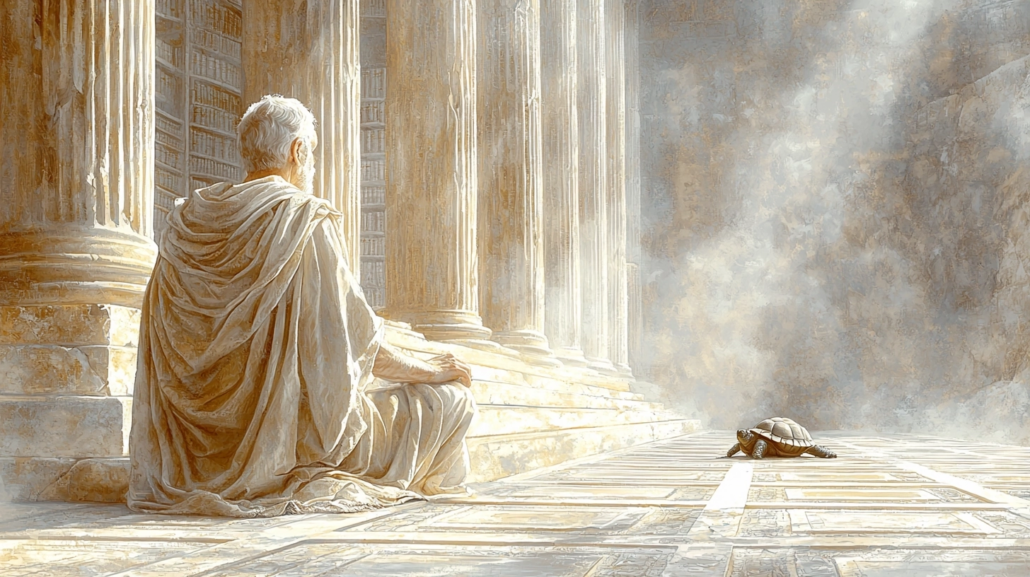
Editorial portrait by Mario Szepaniak.
Please Note
The content of this post is for informational and inspirational purposes only. It does not constitute personal, psychological, or medical advice. For individual concerns, please consult an expert. Learn more: Disclaimer.
This space for reflection exists through your support.
Become a link sponsor
(recommend, link, contribute)