

Σ ⋮ A Second-Tier Stoic — and Not Without Edge
Sphaerus is not one of the great names, but that is precisely what makes his angle interesting. With him, Synkatáthesis (the judgment’s assent to an appearing impression) moves close to everyday life: to what one takes for certain simply because it sits neatly in front of them. His philosophy does not begin with pathos, but with a small doubt — and that doubt has a surprisingly firm seat.
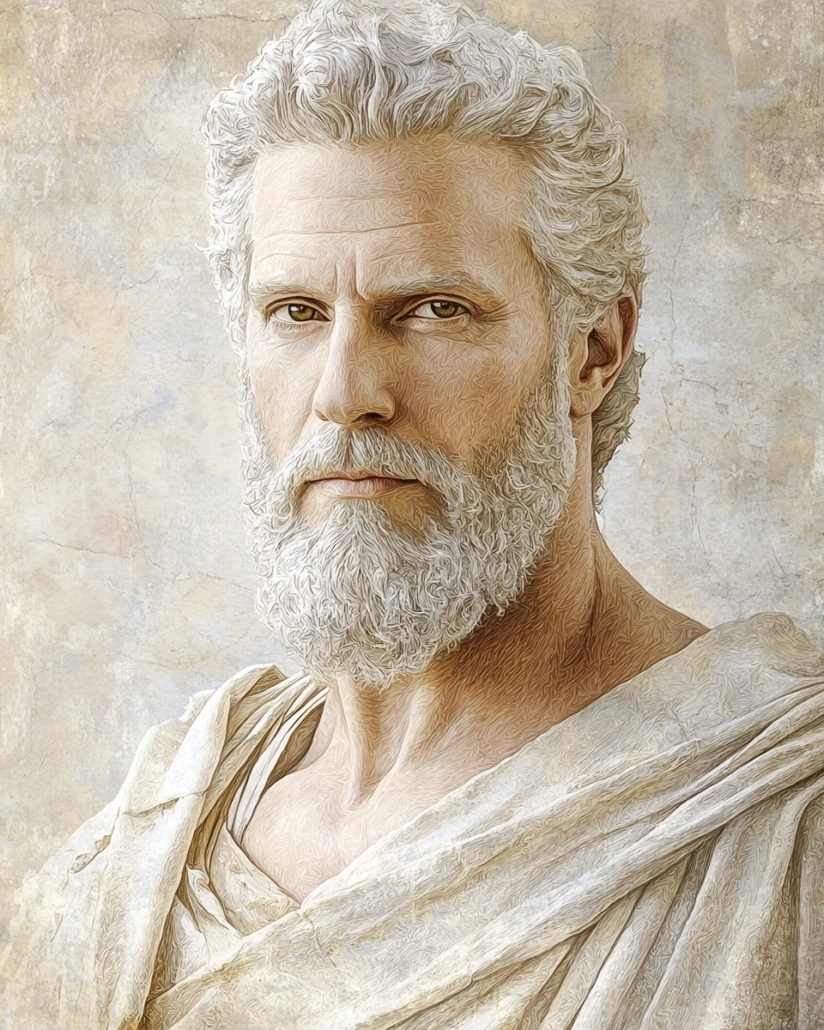
Stylized portrait – Sphaerus
Δ ⋮ The Small Crack in the Certain
You see something, recognize the shape, register the sheen, and at once judgment stands there, dressed for the room. With Sphaerus, thinking does not begin high above, but close to this brief movement of the hand, the glance, the inward nod. That is exactly where his sharpness lies: what concerns him first is not great confusion, but the moment when something lies neatly before us and therefore almost passes as true.
This is not a pose of skepticism. More like a school of slight delay. In the tradition, Sphaerus comes across as someone who does not confuse the appearance of a thing with its substance. The surface may be orderly, the form persuasive, the scene almost polite — and yet a narrow gap remains open between impression and assent. It does not take much for that. Only a gaze that does not immediately believe itself.
Learn more at: Stoic Principles for Everyday Life
Λ ⋮ Early Stoa, Spare Contours
Sphaerus belongs to the early Stoa, that is, to the phase in which the school was not yet made of quotations, but of work on concepts, on distinctions, on the rigor of the sentence. He stands in the orbit of Zeno and Cleanthes and thus appears not as a later administrator, but as a figure from the still young order of Stoic thought. The fact that his traces run through Athens, Sparta, and Alexandria gives his profile no hero tale, but rather an odd tension: school, court, politics — and in between, someone who holds fast to exactness.
His themes point in the same direction. Logic, ethics, natural philosophy, rule, passions, duty: not a narrow specialty, but a philosopher who does not decorate the system but measures it through. His exactness does not end with questions of perception; it reaches just as much into duty, rule, and order.
That is precisely why this concept suits his profile so well. Not as a label, more like a hinge. With Sphaerus, philosophy seems to become serious where an impression is not allowed to rule at once. That makes him neither dry nor solemn. It makes him quietly inconvenient.
Seen in this light, even his political proximity appears less glamorous than delicate. His connection to Cleomenes III and his later closeness to the court in Alexandria do not show a thinker above circumstances, but one standing in the middle of them. That gives the transmitted titles on kingship, constitution, duty, and the passions a particular weight. No one is writing here from a safe distance. Here someone thinks under pressure about form.
Appearance turns dangerous when assent steps forward faster than the eye can examine.
Sphaerus, Adaptation (loosely based on attested teachings, not transmitted verbatim)
The sentence is not merely deftly set. It shows a habit of thought that does not let itself be bought by first appearance. Perhaps that is this figure’s true sobriety: no grand gesture, no moral glow, but a carefully placed reservation. With him, the school does not become a backdrop for knowledge, but a discipline for protecting oneself from one’s own haste.
Π ⋮ What Remains of Him
What remains of Sphaerus is not a closed picture of works, but rather a sequence of hard edges. Perhaps that is exactly what suits him: a thinker who does not work through abundance, but through resistance. What is left of him never gleams entirely without mistrust.
Ξ ⋮ Where Language Already Gives Away a Stance
Today, old Stoic seriousness rarely appears in grand sentences. It sits instead in small formulations that do not quite trust themselves. Someone no longer says: That is how it is. They say: That is how it looks at the moment. Someone strikes the quick “obviously” from a message and leaves a narrower sentence in its place.
A meeting does not tip because of open conflict, but because of the tone in which a conjecture suddenly becomes a finding. That is where Sphaerus would likely listen more closely than to any grand profession.
For language does not merely help order things; it reaches ahead. Whoever settles something too early creates not only clarity, but often already a small regime of impression. You know this from conversational spaces in which the cleanest sentence immediately feels like the strongest one. Not because it is truer, but because it sits better.
Judgment is already wearing coat and shoes before it has even been examined. And everyone nods, which on the one hand looks efficient — and on the other hand is an astonishingly polite route into error.
That is exactly why concise language sometimes contains more honesty than fully elaborated sovereignty. A restrained afterthought, an open reservation, a sentence that does not inflate itself: it seems inconspicuous, yet it can create more order than any rhetorical dominance. The term Lakonismós (a concise, precise mode of speech that forgoes ornament) fits here not as decoration, but as a form of discipline. Not everything brief is clear. But some things only become clear once the sentence stops celebrating itself.
Read this way, Sphaerus’s contemporary value does not lie in a manual for difficult conversations. It lies in the observation that many verbal tensions already seem decided before their content is even on the table. An impression appears, a tone amplifies it, a formulation makes it socially acceptable. And suddenly appearance is once again standing there, dressed for the room.
A sentence does not first go wrong in content, but often already in the hardness of its tone.
Sphaerus, Adaptation (loosely based on attested teachings, not transmitted verbatim)
Σ ⋮ Cadence, Reservation, Afterthought
Perhaps what is decisive about this figure is not his doctrinal proposition at all, but his cadence. In the fragments and reports, Sphaerus does not appear as someone who uses language as ornament. More like someone who tests the load-bearing force of thoughts on it. A sentence carries when it does not topple too quickly into its own finality.
It also carries when it leaves something open without becoming weak. This form of rigor has nothing ceremonial about it. It resembles, rather, a firm stance on slippery ground.
That is why the motifs from the beginning return here almost unobtrusively: the small gap between impression and assent, the school of delay, the resistance to first gleam. In language, this shows itself not as theory, but as weighting. Language is not his final topic, but rather the place where the discipline of judgment becomes visible.
What comes first, how a subordinate clause relieves pressure, where one word too many suddenly makes everything hard — such details often decide whether a sentence is thinking or merely already knows. The difference is slight in sound and considerable in effect.
The hardness in Sphaerus becomes readable that way as well. Not as a sternness of pose, but as a refusal to let a well-shaped impression govern him. You can hear it in formulations that do not grab at once. In voices that do not need to inflate their finding. In a speech that sounds neither deferential nor domineering, but durable. The old school then appears not as a distant system, but as an exercise in linguistic accountability: what is said should be able to do more than simply stand there in proper order.
And perhaps that is precisely where his present-day value remains. Not as a famous name, not as a finished authority, but as a measure for sentences that claim less than they can carry. That is no small demand. But it arrives without fanfare.
Ψ ⋮ What Keeps Working in Him
Sphaerus belongs to those figures who do not work through monumental remains, but through the form of what is left. What remains of him is no great closed building, but rather a set of supporting beams from which the old construction can still be guessed. Measured against later famous names, that is little.
And yet this very brevity has something of its own. It does not make him a leading figure of the Stoa, but it does make him an illuminating marginal figure of its early sharpness. It forces the eye away from the author image and closer to the hardness of thought.
Perhaps that is exactly where his effect lies. Not in broad aftertalk, but in a kind of quiet friction that clings to a few formulations. An impression appears, a judgment moves in behind it, and somewhere in between resistance sets in. This is no heroic scene. More a small shift in inner weight. What in others hardens into doctrine, moral maxim, or formula of authority remains with Sphaerus curiously sober. He forces nothing into completion. He lets one see, rather, how much depends on a clean reservation.
Sometimes the most that remains of a thinker is where a remnant still offers resistance.
Sphaerus, Adaptation (loosely based on attested teachings, not transmitted verbatim)
Precisely because so much has been lost, transmission does not work in his case like an archive full of certainties, but more like a slender Diadókhē (an ordered passing-on through sequence, trace, and school transmission). A few titles, some reports, a handful of edges. That is not enough for comfort. But it is enough to keep a certain stance legible: the refusal to mistake first gleam for substance. Perhaps that is more aftereffect than a complete literary estate sometimes achieves.
And yet something remains unwieldy. For the slimmer the sources, the more clearly one also sees the gaps, the later ordering, the ventriloquism of later hands. What remains never comes to us entirely unmixed. Perhaps that too belongs to Sphaerus: that his sharpness appears not despite the fractures, but in them.
Ω ⋮ A Figure in Half-Light
In the end, what stands here is no master portrait. More a figure in half-light, whose contour holds precisely because it is not completely filled in. School, court, politics, conceptual labor, passions, duty — all of it is there, but not as a smooth sequence. It lies there more like stone slabs with narrow joints left open between them. One can walk across them. It will not be entirely even.
Perhaps that is exactly what makes him available to the present. Not because he could be used easily, but because he resists easy use. His name carries less sheen than others, his transmission less fullness, his effect less pose. And yet something of it remains in the ear: that thinking does not begin where a sentence sounds most closed, but where it resists its own overreach.
So Sphaerus remains not as a final conclusion, but rather as a measure of caution without weakness. Of form without pomp. Of an intellectual sobriety that needs to be neither cold nor ingratiating. This figure scarcely needs more than that. Perhaps that is precisely why it still stands.
💬Conversation Fragments
Guest: Why does a sentence often sound stronger just because it sounds sure?
Wise Stoic: ✦ Certainty is often only posture; truth usually arrives with less baggage.
Guest: Why do I notice the mistake only after I’ve already nodded?
Wise Stoic: ✦ Error rarely comes shouting; it tends to arrive dressed and entirely unhurried.
Guest: Why do brief words sometimes seem more honest than many clever sentences?
Wise Stoic: ✦ What can stand needs little ornament; the rest usually wants to impress.
Guest: What really remains when almost nothing of someone is left?
Wise Stoic: ✦ Enough, provided one can still feel where a thought put up resistance.
≈ freely reflected and inspired by the Stoa
❔ FAQ
Question: Is this about skepticism toward everything?
Answer: No. What is meant is not blanket mistrust, but a more exact distance from first impression. That small reservation is precisely what keeps appearance and substance from being equated too quickly.
Question: Is restraint in judgment already indecision?
Answer: Not necessarily. Indecision often loses itself in hesitation, whereas restraint examines the impression before it rules. The difference lies less in tempo than in inner order.
Question: Where does this stance show itself most clearly in daily life?
Answer: Often in small shifts of language. A sentence grows narrower, a judgment less ornate, a reservation audible. That is where it becomes visible that form is not meant to replace truth.
Question: Is concise language automatically the more honest language?
Answer: No. Brevity can clarify, but it can also merely disguise hardness. What matters is whether a sentence carries without making itself larger than its substance allows.
Question: Can this become a rule for every conversation?
Answer: Probably not. It does not become a fixed formula, but rather a kind of measure for verbal integrity. It helps one distinguish without reducing every situation to the same gesture.
Stoic Profile: Sphaerus
Structured research facts.
1. Name and Variants
Sphaerus is the common Latin form. Also attested are the spelling variant Sphaeros and the origin labels “of Borysthenes” and “of the Bosporus.” The Greek form of the name is Σφαῖρος.
2. Dates and Era
The dates of his life are uncertain. Scholarship most often places his birth at ca. 285 or ca. 265 BCE; the only secure point is that Sphaerus belonged to the early Stoa in the third century BCE and was still alive around 221 BCE. The year of his death remains uncertain; later reconstructions place it in part around ca. 210 BCE.
3. Place Within the Stoa
Sphaerus belongs to the early Stoa. This is supported by his closeness to the first generation of students after Zeno, his training under Zeno and Cleanthes in later testimonies, and his classification as a contemporary of Chrysippus.
4. Historical Context & Role
Sphaerus was a Stoic philosopher with political range in the Hellenistic field of power. Plutarch connects him with Sparta and the young Cleomenes III, whom he is said to have influenced philosophically. Diogenes Laertius also reports a stay at the Ptolemaic court in Alexandria; exactly which Ptolemy is meant is not entirely consistent across the sources and their interpretation. His biography therefore appears graspable only in outline: years of study in Athens, activity in Sparta, later court proximity in Alexandria.
5. Central Themes & Teachings
✦ Logic: In the tradition, Sphaerus is associated with questions of assent, probability, and epistemic certainty.
✦ Definitions: Later authors especially emphasize his precision in formulating philosophical concepts.
✦ Ethics: Titles such as On Duty, On Impulse, and On the Passions place him in the core field of Stoic ethics.
✦ Politics: Works such as On Kingship and On the Spartan Constitution show his interest in rule and law.
✦ Physics: Work titles on cosmos, elements, seed, and minimal parts attest to a systematic engagement with natural philosophy as well.
6. Teachers, Students, Important Relationships
Zeno of Citium and Cleanthes are attested as teachers, or at least named together in later reports. He appears as a fellow or later student in the orbit of Chrysippus. Especially important is his relationship to Cleomenes III of Sparta; in addition, a connection to a Ptolemaic court in Alexandria is transmitted.
7. Major Works
No work survives complete. The most important ancient list of works is provided by Diogenes Laertius. Among the titles mentioned are On the Cosmos, On the Elements, On Seed, On Kingship, On the Spartan Constitution, On Duty, On Impulse, On the Passions, On Heraclitus, and On the Art of Dialectic. The transmission is almost entirely fragmentary or doxographical.
8. Afterlife & Influence
✦ Stoic Tradition: His art of definition was explicitly valued by later Stoics and by those reporting on them.
✦ Epistemology: The anecdote about deceptively lifelike wax replicas remained a standard example in Stoic debates about assent and probability.
✦ Political Reception: His connection with Cleomenes III makes him a key figure for questions about Stoic proximity to reform politics in the Hellenistic world.
9. Adaptations / Thought-Fragments
✦ An impression calls for scrutiny before it presents itself as judgment.
✦ Concepts carry only when their sharpness does more than merely make an impression.
✦ Duty shows itself not in tone, but in a durable decision.
✦ Rule remains questionable when form takes the place of proper measure.
✦ The passions do not grow clearer when one already grants the first impulse the right.
✦ Something of lost writings still remains when the direction of thought is preserved.
Short thought-fragments derived from attested teachings – not transmitted verbatim. Editorial desk: Stay-Stoic.
10. Comment on the Source Situation
The source situation is thin. Sphaerus is accessible almost only through later testimonies, anecdotes, work titles, and scattered attributions; his own writings are lost. Especially with regard to dating, court affiliation, and political role, the material therefore requires cautious wording.
Sources
Note
This post is an editorial text – not personal, psychological, or medical advice. For individual questions, see the disclaimer.
Stoically surprised today.