

Λ ⋮ Cicero and the Courteous Gravity of Reason
Cicero enters the room early like someone who does not display the Lógos (the rational order of thought, language, and world) but carries it — well dressed, politically exposed, inwardly never quite free of drafts. In him, Stoic thought does not become a school but a form: rational, public, and for that very reason slightly at risk.
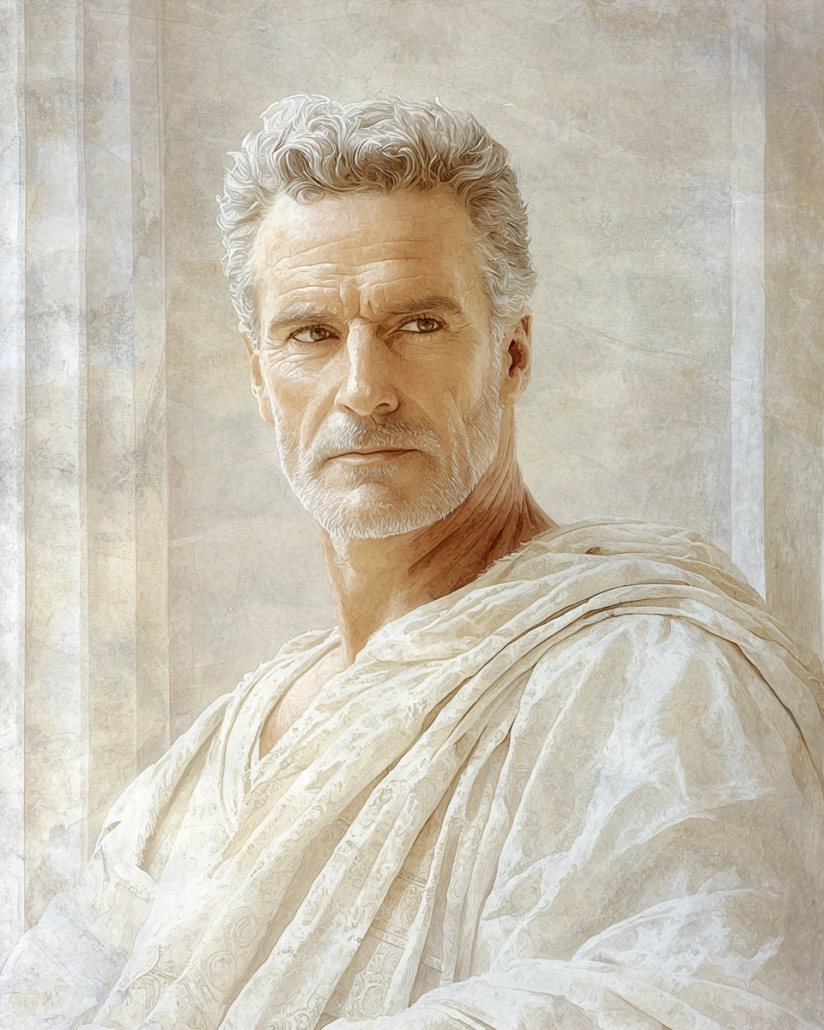
Stylized portrait – Cicero
Δ ⋮ The Voice in the Anteroom
One can first imagine Cicero as a voice, not a statue. More like a man in the folded garment of a public day, somewhere between Senate, scroll, and the soft sound of a door that never quite closes. He does not seem like a founder with a raised finger, but like someone searching for order in the sentence because outside, enough disorder is already on the move. That is what makes him interesting for Stoic thought: not as a decorative sage, but as a figure in whom reason wants to become social and immediately catches a draft.
One anchor is enough: the voice. In Cicero, it is not merely a means but a form of character. It carries office, dispute, judgment, self-discipline, and now and then that courteous sharpness that counts as civilization in the Roman world so long as nobody measures too closely. The fact that this voice later works philosophically has nothing of retreat about it. His rhetoric here is not ornament on thought, but its public working form. It remains public even when it speaks of duty, pain, fear, or the commonwealth. That is precisely where the subtle friction lies: reason is not seated in a quiet garden, but in the anteroom of politics.
Λ ⋮ A School Without an Admission Ticket
Cicero does not belong in the Stoa as a school figure, but at its edge — as an eclectic philosopher (combines different philosophical approaches without rigid school allegiance) with an Academic-skeptical profile, one who tests Stoic concepts, takes them up, rearranges them, and lets them loose on Roman conditions. He stands in the late Republic, in a political landscape whose shape is already visible even as its hold is beginning to give way. Orator, lawyer, senator, consul, later philosophical author: that is not a chronology to tick off, but a profile made of publicity, responsibility, and exposure.
His central lines remain strikingly sober. Duty is not a pose in him, but the measure of action; the commonwealth not a mere multitude, but an order of law and shared benefit. In questions of knowledge, he remains cautious and prefers the probable to dogmatic certainty. That is precisely what makes his closeness to the Stoa credible: not as a confession, but as a working relationship.
The term Phronḗsis (practical prudence for judgment and action in right measure) sits in him less like a label on a shelf than like a discreet inner mechanism. His closeness to teachers from different schools fits that as well. No pure school, rather a precisely furnished thinking room. What makes him stoically relevant, then, is not that he heads a school, but that he serves as a Roman mediator of duty, judgment, and public measure.
“We are not born for ourselves alone; our country claims a share, and our friends a share.”
Cicero, De officiis 1.22 (my own translation from the Latin text).
That is why the sentence does not stand there like a marble inscription. It sounds more like something said in a room where responsibility is not yet a program, but a burden with a collar. Perhaps that is Cicero’s real form: not a strict Stoic, but an author who makes Stoic tension usable for public seriousness without ever fully calming it down.
Π ⋮ Between Bearing and Transmission
Cicero often seems sealed, almost impeccably pressed in thought. Yet his transmission shows no flawless statue, but a figure made of roles, fractures, and a strong will to form. Perhaps that is why he remains so present: because reason in him never sits comfortably, only well.
Ξ ⋮ Phrases with a Collar
Today, Stoic bearing rarely shows itself in ceremonious seriousness. More often in small linguistic maneuvers that lower the temperature without sounding cold. Someone does not say, “This is unbearable,” but, “This is disagreeable.” Someone else replaces grand outrage with a subordinate clause that does not trivialize the matter, but separates it from its theater. That is exactly where Cicero suddenly becomes legible. Not as antique furniture polish, but as an exercise in public form.
One recognizes this form in meetings, emails, statements, even in the short sentences with which someone limits a conversation without poisoning it. The voice does not rise; it arranges. It claims no moral elevation, only measure. That looks unspectacular and is precisely why it is rare. For the contemporary tone loves either agitation or irony without liability. Cicero’s line lies between them: neither soft nor shrill, rather impeccably dressed in its cadence. A sentence may be sharp, so long as it is not sloppy.
Caution before the definitive belongs here as well. Whoever values the probable more highly than the pose of final certainty speaks differently. Not vaguely, but more precisely. A formulation leaves air without giving way. An afterthought shifts the weight. A well-placed “perhaps,” an “rather,” a properly set “still” keeps language from instantly turning into a uniform.
In such moments, Synkatáthesis (the mind’s conscious assent to an impression) becomes almost audible. Not as a technical term in the room, but as a quiet inner check against the premature sentence.
Where judgment keeps its measure, language need not grow loud to carry weight in public space.
Cicero, Adaptation (drawn from documented teachings, not literally transmitted)
Everyday life here does not mean kitchen-table coziness, but the register of speech. The anteroom of politics has different doors today, but similar noises. Press formulas, team briefings, the polished coarseness of digital debate — everywhere the question arises whether a voice clarifies something or merely stakes possession. That is exactly why Cicero’s publicly carried reason feels peculiarly modern. Not because of great truths, but because of the way a sentence dresses itself before going out.
Σ ⋮ Where Language Gains Weight
There are formulations that collapse in the very act of being spoken. Too much bearing in the first beat, too little scrutiny in the second. Then one hears nothing but intention. Cicero’s aftersound begins at the opposite point: where a sentence carries because it renounces overpressure. The voice remains recognizable, but it does not push itself in front of every thought.
Perhaps that is the finest form of discipline — not silence, but giving what is said a structure sturdy enough to hold. In him, that form serves not tone alone, but the question of how action, law, and common good remain linguistically sustainable.
From there, the guiding motifs return almost without showing themselves. The voice as form. The anteroom as a public place in which nobody speaks entirely in private. The draft as the reminder that reason never appears under laboratory conditions. A good sentence does not shut the door airtight; it merely keeps it from slamming all the time. And even the courteous sharpness that may arise from it remains usable so long as it does not tip into vanity.
That is how Stoic practice becomes readable without putting itself on display. Not as a collection of right sentences, but as the art of weighting. What comes first, what remains standing, what one still leaves out. A tone can suggest common good without displaying it. A limit can contain respect without becoming soft. Perhaps Cicero’s real presence lies exactly there: not in the monument, but in that rare urban form in which clarity appears impeccably dressed without remaining so.
Quotes attributed to him
- “The welfare of the people is the ultimate law.”
- “To be ignorant of what occurred before you were born is to remain always a child.”
- “Virtue is a habit of the mind, consistent with nature and moderation and reason.”
Ψ ⋮ What Remains Without Standing Still
What is striking in Cicero is that influence appears not as afterglory, but as a form that keeps working. His sentences live not only from thought, but from the way they carry. That is why even the familiar passages do not feel like trophies of education, but like carefully made elements of a public tone. One hears duty, measure, common good, but also the effort not to let any of it collapse into mere pose. That tension has something durable about it: not because it is final, but because it never becomes entirely smooth.
That durability also owes itself to the transmission that carries its own shadow with it. Much survives, some only in part, some is lost; and even what is well preserved appears not as a calm block, but as the work of a man who was at once role, voice, and form. That makes Cicero less self-contained than his classical finish might suggest. His texts stand there like well-kept rooms in which drafts still move. Perhaps that is exactly why they keep being entered again.
In this suspension, tone itself gains a special weight. Not every clarity is already judgment, not every sharpness already bearing. Where a formulation can endure publicity without growing loud, something begins that touches Parrhēsía (frank speech with truthfulness and responsible openness) without being confused with swagger. It is a frankness with a collar, almost courteous, and precisely for that reason not harmless.
A short sentence is enough here. It does not need to shine, only to hold.
“The commonwealth is the affair of the people.”
Cicero, De re publica 1.39 (my own translation from the Latin text).
The sentence is strict enough to resist mere decoration. More like a slab in the ground, over which one walks and briefly notices that beneath the pavement order was still being thought — or at least its claim.
Ω ⋮ Still in the Room Later On
Perhaps that is this figure’s peculiar aftersound: no saintly stillness, no exhaustive doctrine, rather a certain air in the sentence. Someone speaks, weighs, limits, keeps the voice straight, and does not overdo it even when the situation would almost allow it. That sounds like little. In public space, it is at times astonishingly much.
And yet a residue of discomfort remains. Cicero does not lend himself entirely as a model precisely because he does not stand before us as a pure school Stoic. His transmission shows a will to form and fracture, classical measure and political draft, intellectual sharpness and that slight vulnerability already present in the introduction. That is why nothing ends tidily here. The voice stands for one moment longer in the anteroom, as if it had just spoken and already left the sentence behind.
💬Conversation Fragments
Guest: Why does so much today sound bigger than it really is?
Wise Stoic: ✦ Much of it only wants to impress; greatness would manage with less performance.
Guest: Why does a calm sentence often seem stronger than outrage?
Wise Stoic: ✦ Outrage pushes itself forward; a calm sentence gives the matter better form.
Guest: Why is it so easy to get tangled in one’s own words?
Wise Stoic: ✦ Words carry badly once vanity quietly puts on the heavier coat.
Guest: Why does clarity sometimes sound cool, though it means no harm?
Wise Stoic: ✦ Clarity rarely comes padded; many already mistake a straight tone for hardness.
≈ freely reflected and inspired by the Stoa
❔ FAQ
Question: Is Stoic clarity simply another word for sobriety?
Answer: Sobriety can merely be dry. Stoic clarity orders more precisely because it also reckons with a sentence’s weight, tone, and limit.
Question: Does measure in language mean everything has to sound soft?
Answer: No. Measure does not make statements milder, only more fitting. A sharp sentence can be measured if it does not demand overpressure and performance.
Question: How can one tell whether a sentence orders rather than impresses?
Answer: It leaves room for the thing itself and needs no extra volume. Impression wants immediate effect; order holds even without emphasis.
Question: Is cautious language just another word for indecision?
Answer: Not necessarily. Caution becomes indecisive only when it shies away from every commitment. It remains sound when it leaves open what is open.
Question: Why does a calm tone often feel unfamiliar in everyday life?
Answer: Because many registers of speech are built on speed, friction, or self-assertion. Calm then stands out not through weakness, but through a different measure.
Stoic Profile: Cicero
Structured research facts.
1. Name and Variants
Marcus Tullius Cicero; common short form: Cicero. The English traditional form “Tully” is historically attested. In Greek, the name usually appears as Κικέρων.
2. Dates and Period
Born January 3, 106 BCE, in Arpinum; died December 7, 43 BCE, near Formiae. He belongs to the late Roman Republic, more precisely to its final crisis phase before the Principate.
3. Place Within Stoicism
Cicero was not a strict Stoic, but an eclectic philosopher with an Academic-skeptical profile and a strong Stoic reception. Epistemologically, he understood himself as an Academicus, yet in ethics, duty theory, and natural law he frequently took up Stoic positions and transmitted them within a Roman context.
4. Historical Context & Role
Cicero was an orator, lawyer, senator, consul, and philosophical writer. As a homo novus, he reached the consulship in 63 BCE and turned the Catilinarian conspiracy into the defining political glory of his career. The execution of conspirators without due process led to his exile in 58 BCE. In 51–50 BCE, he governed Cilicia as proconsul. After Caesar’s assassination, he attacked Mark Antony in the Philippicae; in 43 BCE, he was killed in the power struggle of the triumvirs.
5. Central Themes & Teachings
✦ Duty: In De officiis, he joins moral obligation, common good, and practical judgment.
✦ Natural law: In De legibus and De re publica, he thinks law not merely positivistically, but as an order grounded in reason.
✦ Commonwealth: For him, the state appears as a community of law and shared benefit, not merely a mass of people.
✦ Knowledge: As an Academicus, he prefers the probable to dogmatic certainty.
✦ Passions: In the Tusculanae disputationes, he treats grief, fear, and the training of the soul in close proximity to Stoic ethics.
6. Teachers, Students, Important Relationships
Philosophical study with Philo of Larissa, the Stoic Diodotus, and the Epicurean Phaedrus is attested; he also studied rhetoric with Apollonius Molon. Politically and biographically important are his relationships with Pompey, Caesar, Atticus, his brother Quintus, and — fatally in the final phase — Mark Antony and Octavian.
7. Major Works
Among his central surviving philosophical works are De re publica, De legibus, Academica, De finibus bonorum et malorum, Tusculanae disputationes, De natura deorum, De divinatione, De fato, Cato maior de senectute, Laelius de amicitia, Paradoxa Stoicorum, and De officiis. Lost or only fragmentarily preserved are, among others, Hortensius, Consolatio, and De gloria; De re publica survives only in part.
8. Afterlife & Influence
✦ Language: Cicero shaped a Latin vocabulary through which Greek philosophy could be articulated in a Roman setting.
✦ Rhetoric: His prose and oratorical art became the classical benchmark of so-called Ciceronian rhetoric.
✦ Reception: Augustine testifies that the lost Hortensius led him to philosophy.
✦ Politics: His account of the commonwealth and his republican writings exerted influence far beyond antiquity.
9. Adaptations / Sense Thoughts
✦ Not everything useful may therefore already count as reasonable.
✦ A state remains more than a crowd only where law gives use its form.
✦ Whoever respects the probable need not disguise certainty.
✦ Duty rarely appears in pathos — mostly only in the fact that someone holds firm.
✦ Passions grow loud when judgment opens the door to them too early.
✦ Philosophy begins not above things, but in the middle of what is to count.
Brief sense thoughts derived from documented teachings — not literally transmitted. Editorial team: Stay-Stoic.
10. Comment on the State of the Sources
The source situation for Cicero is unusually dense overall, because speeches, letters, and several philosophical dialogues survive. At the same time, part of his philosophical work is lost or only fragmentarily accessible, especially Hortensius, Consolatio, De gloria, and large parts of De re publica.
Sources
- Stanford Encyclopedia of Philosophy – Cicero
- Internet Encyclopedia of Philosophy – Cicero (106—43 B.C.E.)
- Internet Encyclopedia of Philosophy – Cicero: Academic Skepticism
- Encyclopaedia Britannica – Cicero | Biography, Philosophy, Writings, Books, Death, & Facts
- Encyclopaedia Britannica – Cicero – Roman Law, Oratory, Philosophy
- Wikipedia (EN) – Cicero
Note
This post is an editorial text — not personal, psychological, or medical advice. For individual questions, see the disclaimer.
Stoically surprised today.
Klicke hier, um Ihren eigenen Text einzufügen