

Π ⋮ Panaetius of Rhodes – Duty Without Posture
Panaetius of Rhodes thinks early about Kathēkonta, as if duties were not chains but fine markings on smooth stone. In Rome he seems polite, almost invisible, and he nudges the Stoa toward the everyday. You notice it only when the tone suddenly sounds civil – and still sharp.
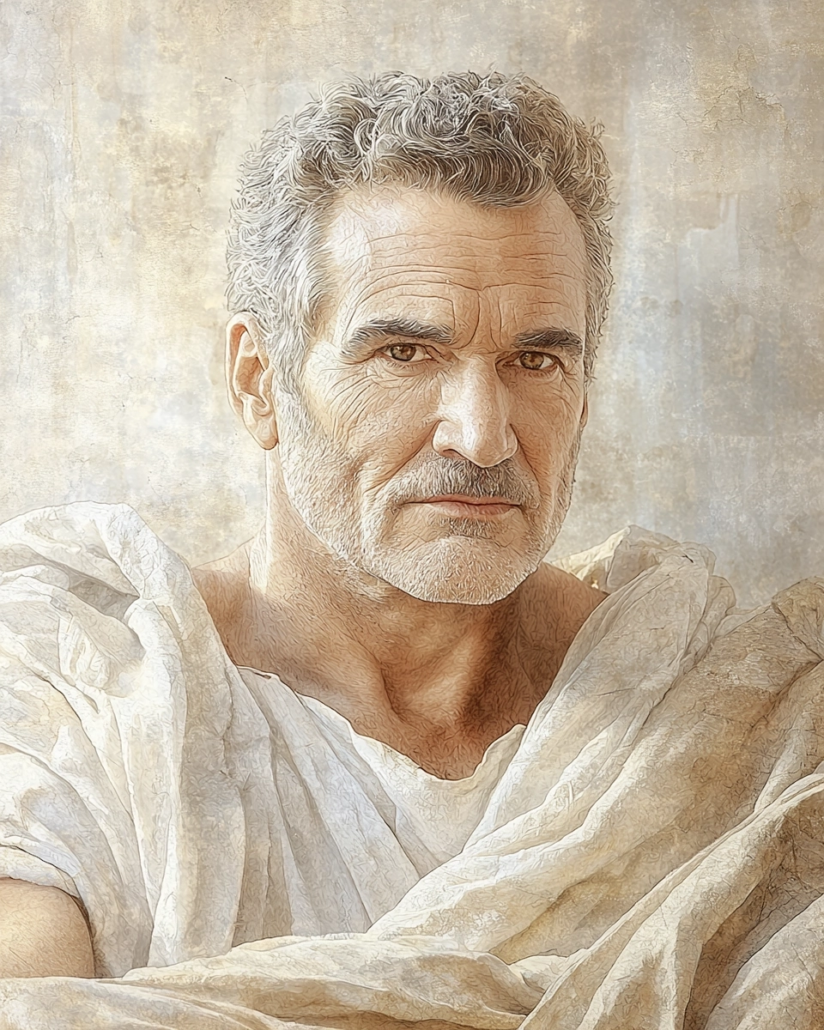
Stylized portrait – Panaetius of Rhodes
Δ ⋮ Signet ring, smooth stone
A signet ring, cool despite the warmth of the hand, presses into soft clay. No drama, just an imprint – and suddenly a piece of material has become an obligation. In this scene, duties are not drums but markings – quiet, yet not negotiable. You can feel it: nothing heroic is being polished here, only what is fitting is being fixed.
Panaetius fits because he does not make the Stoa louder, but more civil. The tone grows more courteous; the edge remains. Like on smooth stone: the imprint is small, but it shifts where the foot will land later. Miss it, and it looks like etiquette. Look closer, and you see: it is a trace.
Λ ⋮ Middle Stoa, civil gravity
He belongs to that middle phase of the Stoa that people like to label “Middle Stoicism” – and just as readily problematize. Born on Rhodes (c. 185/180 BCE), died in Athens (c. 110/109 BCE), trained in Athens under Diogenes of Babylon/Seleucia and Antipater of Tarsus, with an eye on Plato and Aristotle.
Then Rome: Scipio Aemilianus and his circle, a diplomatic journey to the East around c. 140 BCE. Later, after Antipater’s death, Panaetius takes over the leadership of the school and returns to Athens for his final years.
What matters is less the route than the shift. Panaetius writes about duties so effectively that Cicero shapes his De Officiis from it. That sounds like a handbook, but it is closer to a new stance toward practice: not the distant target of the perfectly wise person, but the fine question of the Kathēkon (Appropriate action fitted to role and situation.) in an ordinary day.
That fits his skepticism toward astrology and divination, without simply dropping the idea of providence. And when orthodox world-conflagration as a grand cycle seems too tidy, he rejects it – as if even the cosmic had no duty to provide dramaturgy.
Duty begins where a role turns concrete and excuses suddenly cost too much.
Panaetius of Rhodes, Adaptation (loosely from attested teachings, not verbatim)
The point: this civil gravity does not go soft. It stays sharp, just without posture. Like a margin note that does not shout, yet refuses to disappear while you read – a marking where you later decide whether you go straight or swerve.
Π ⋮ Second book, first loss
Nothing of Panaetius survives as a work, only voices about him: Cicero uses him, Gellius cites him. The ideal looks groomed; the transmission is not. Of all things, “Book 2” shows up like a lost key you briefly hold – and then do not.
Ξ ⋮ Afterthought under office light
You hear it today not in temples but in calendar invites: the small tone that decides whether a sentence sets an obligation or merely performs a gesture. “I can take this on, if …” – and responsibility already tilts into an “if” opened like a polite umbrella. Or: “Just for context” – three words that turn a report into a direction, without wearing the sign “opinion.” It is this civil gravity that shows up first in form: in parentheses, in afterthoughts, in the refusal to use exclamation marks no one will miss.
Responsibility tightens when a sentence drops “if” and fits the situation.
Panaetius of Rhodes, Adaptation (loosely from attested teachings, not verbatim)
You can watch that without turning it into a virtue show: how someone does not distribute blame but concentrates it by saying “I” – and how someone else fogs the matter with “we,” without any ill will. Between intention and form there is often a remainder that never enters the email, yet still shapes the outcome. Exactly there the markings appear: not as morality, but as a trace in tone.
And then there are moments when language suddenly plays astrology: “It’ll work out somehow” – as if a sentence could soothe the future. Panaetius’ skepticism toward divination sits here like a quiet frown in the back of the mind. Not because one now has to speak “correctly,” but because you notice how fast formulations become small oracles. You read them later and realize: the tone was already a decision before any argument arrived.
Σ ⋮ Wording as resonance
You often feel the weight of a formulation physically before it looks logical: a small tug when a sentence turns too smooth, a breath when it stays precise without going hard. The draft is the real stage. First there is a “definitely,” then it disappears, as if someone closed the door softly.
An “actually” gets deleted because it only rearranges one’s own uncertainty. And suddenly the sentence feels load-bearing – not because it is pretty, but because it stops pretending it can supply the world order. When Panaetius rejects the grand dramaturgy of world-conflagration, it sounds today like an aversion to rhetorical finality: too clean, too closed, too finished.
Here language becomes a workbench: trimming, adding afterthoughts, leaving things out. A small technique that explains less than it sorts.
You could almost call it Hermēneutikḗ Téchne (Context-based interpretation stabilizes meaning in use.) without meaning it ceremonially. It shows up in the distance between intention and statement, in the courage to delay, in the omission of reflex afterthoughts meant to soften everything again. And it has a pleasantly unheroic side effect: the tone stays civil, but not soft. That marks where responsibility sits, and it also reveals what is missing – like a “Book 2” that briefly surfaces and reminds you that transmission is never identical with the ideal.
Ψ ⋮ Margin voices, civil shadow
Panaetius often feels like someone you know only because others pull him into the frame – Cicero with the confident grip of a stylist, Gellius with the calm habit of a note-taker. What arrives is not the work but the imprint: a tone of duties, a civically sharpened gravity, a skepticism toward small oracles that dress up as sentences. And somewhere in between that “Book 2,” flashing up like a lost key – a reminder that transmission likes to pretend it is possession.
The imprint of other voices remains when the work is missing – duty becomes legible as form.
Panaetius of Rhodes, Adaptation (loosely from attested teachings, not verbatim)
Maybe we like reading Panaetius as the polite variant of the Stoa because politeness now sounds like relief. Maybe that is only our convenient projection, a clean tone laid over a messy state of sources. That is exactly why the trace stays interesting: because it is not closed, because it looks more like a workbench than a monument. You can snag on it without turning it into posture – and you can be wrong without everything immediately breaking.
Ω ⋮ The sentence that remains
When a thinker mostly survives as a quotation, form acquires a strange weight. You read a few lines, feel the civil cut, and beside it stands the silence – not as mysticism, but as a gap.
Influence is then no parade, more a quiet passing-along – a tone others adopt, smooth, sharpen, until you can hardly say where the hand began and where it stopped.
What remains when the tone is gone and only the marking is there.
Maybe that is the most sober kind of afterglow: not “truth” as possession, but as Katálēpsis (Concept-grasping knowledge set against mere opinion.) in the small – in the decision of how tight a sentence gets, how open it stays, how much responsibility it carries. Panaetius stands there like a name in the margin, readable and yet not fully graspable. No ending, more a quiet remainder in tone – listening.
💬 Stoic Fragments
Visitor: I said “maybe,” yet I still stayed put.
Seneca: ✦ You stop not by words, but by assent.
Visitor: I nodded, and inside it went empty.
Seneca: ✦ An outer yes fills no room, only calendars.
Visitor: I paused, trying to sound polite.
Seneca: ✦ Politeness can hide what you refuse to carry.
Visitor: I stepped back, then I said “we.”
Seneca: ✦ Saying “we” shares weight and slips away.
≈ stoically reflected and inspired by Seneca and the Stoa – Stay-Stoic
Touchstones in Panaetius of Rhodes
Duty without pathos
Main perspective: appropriateness – what fits role and situation. With Panaetius, duty does not feel like posture, more like a quiet click into place. The move is rarely “more,” almost always “more fitting” – tighter, clearer, unagitated. And that is exactly how it becomes uncomfortably precise.
Profile edge – when the most civil tone cuts
Main perspective: civil gravity – courteous, but not soft. Whoever puts a matter into form also puts it into direction. The risk is not harshness, but cleanliness: a smoothness that looks like decency and yet has already decided. The tension stays quiet because it hides in tone.
Measure and frame – without oracles
Main perspective: skepticism – what is sold as a sign is often language. Panaetius’ distrust of divination does not flip into coldness here, but into sobriety. A frame is not a promise, and providence is no free pass for convenient interpretation. The thinking stays workable precisely because it opens no logic of omens.
Inner stir – assent in the moment
Main perspective: assent – where an interpretation suddenly binds. The micro-reaction is small: an impulse, a brief hesitation, an afterthought that wants to soften everything again. Panaetius reads here like a quiet question to one’s own wording: is this getting more precise – or only more polite. The difference is tiny, but it holds.
Open afterglow after reading
Main perspective: transmission – closeness remains distance. When a profile is mostly graspable through later voices, some residual blur always remains. That fits oddly well with a philosophy aimed at appropriateness, not monuments. You leave with a cleaner tone – and with the sense that this tone itself is already interpretation.
Stoic Profile: Panaetius of Rhodes
Structured research facts.
1. Name and variants
Panaetius of Rhodes; Lat. Panaetius (also: Panetius; often with the origin add-on Rhodius); Gr. Παναίτιος (Panaítios).
2. Dates and period
Born c. 185/180 BCE (Rhodes) – died c. 110/109 BCE (Athens). Period: Hellenistic philosophy in the 2nd century BCE, in the tension field between Greek schools and the Roman Republic.
3. Place within the Stoa
Middle Stoa: his era (with Posidonius) is described in standard accounts as “Middle Stoicism”; at the same time, the explanatory power of this periodization is debated in scholarship.
4. Historical context and role
Stoic philosopher from Rhodes, trained in Athens (among others under Diogenes of Babylon/Seleucia and Antipater of Tarsus), with attested interest in Plato and Aristotle. Active in Rome for many years – part of the “Scipionic Circle” around Scipio Aemilianus; accompanied an embassy to the East around c. 140 BCE. After Antipater’s death he became head of the school and spent his later years back in Athens.
One detail is uncertain: reference works connect Panaetius with a priesthood of Poseidon Hippios in Lindos; in scholarship it is disputed whether the office belongs to him or to a namesake ancestor.
5. Core themes and teachings
✦ Kathēkonta: development of “appropriate actions/duties” as an orienting concept for practical judgment.
✦ Reception: his work on duties forms the basis for Cicero’s De Officiis.
✦ School profile: intensified engagement of the Stoa with Platonic and (possibly) Aristotelian teaching in the 2nd century BCE.
✦ Cosmology: rejection of the orthodox Stoic doctrine of world cycles with periodic conflagration (ekpyrosis).
✦ Divination: skepticism toward astrology and divination, while maintaining commitment to divine providence.
6. Teachers, students, key relationships
Teachers/influences: Diogenes of Babylon/Seleucia and Antipater of Tarsus; an early influence by Crates of Mallos (Pergamon) is also reported (uncertain, since only traceable in later testimonies). Relationships: Scipio Aemilianus and his circle; sources also connect him to Polybius. Students: Posidonius of Apamea; further student circles are mentioned, including Hecato.
7. Major works
Περὶ τοῦ καθήκοντος (“On Duties”): lost, but attested as a multi-volume treatise (Gellius explicitly cites from “Book 2”); indirectly influential above all through Cicero’s De Officiis. Several other treatises are attributed to him (Britannica lists five), yet none survives; reconstruction relies on fragments and testimonia.
8. Afterlife and influence
✦ Cicero: via De Officiis, a Panaetian doctrine of duties was widely received.
✦ Rome: in standard accounts he is treated as a key figure in transmitting Stoicism into elite Roman milieus of the Republic.
✦ School history: “Middle Stoicism” is anchored historiographically in him and Posidonius, alongside ongoing debate about the periodization.
9. Adaptations / sense-thoughts
Brief sense-thoughts, derived from attested teachings – not preserved verbatim.
✦ Appropriate action reads role and situation together, not feelings.
✦ Duty grows smaller when it turns concrete, not less serious.
✦ Providence does not excuse when judgment already distributes responsibility.
✦ Astrology easily replaces thinking; skepticism keeps decisions workable.
✦ Cosmic cycles persuade less when they look like dramaturgy.
✦ Duty-theory remains effective even when later voices carry it.
✦ Reception is a filter: moral tone smooths while the edge sits in detail.
✦ Philosophy becomes testable when fittingness outranks perfection.
10. Note on the sources
No writing by Panaetius survives; what we know comes from later testimonies and fragments (including via Cicero and Aulus Gellius). As a result, dates, the scope of works, and individual doctrinal positions are sometimes only probabilistically recoverable and disputed in detail.
Check out our collection of stoic quotes by Panaetius of Rhodes.
- Stanford Encyclopedia of Philosophy – Stoicism
- Internet Encyclopedia of Philosophy – Stoicism
- Encyclopaedia Britannica – Panaetius
- Oxford Reference – Panaetius
- Oxford Research Encyclopedias: Classics – Panaetius, c. 185–109 BCE
- Cambridge Core – “The School, from Zeno to Arius Didymus” (The Cambridge Companion to the Stoics)
Note
This post is an editorial text – not personal, psychological, or medical advice. For individual questions, see the disclaimer.
Further Stoic Topics – Philosophy, Virtues & Daily Life
Stoically surprised today.