

Φ ⋮ Marcus Aurelius between field camp and inner order
Marcus Aurelius is not sitting in a history book but in a cold field camp, somewhere between rain, paper, and duty. His figure is less heroic tableau than a quiet shift of perspective: away from victory and defeat toward the discipline of his own reason. The emperor sits in a draft, not in a monument.
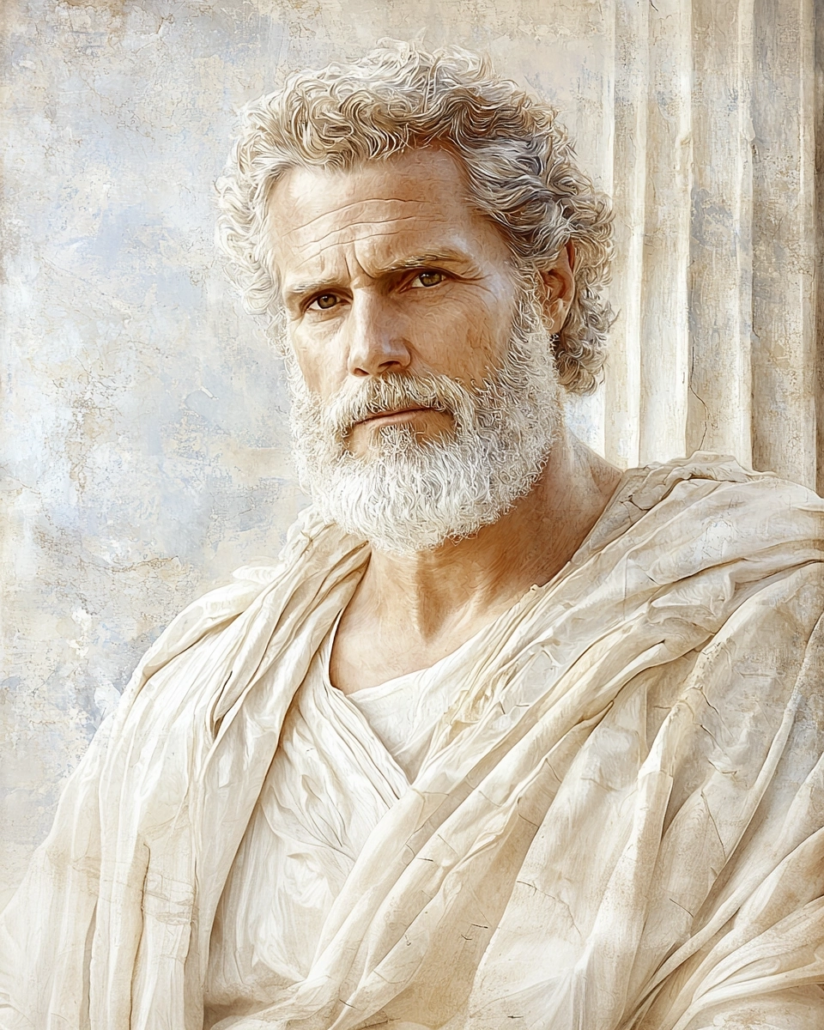
Δ ⋮ Half-darkness over a field camp
You can picture Marcus Aurelius at a table, in front of him a worn wax tablet, the wood scarred like counsel consulted too often. Outside, rain drips from a makeshift tent roof, somewhere armor clinks, the world grinding away in noise and movement.
Inside, the noise is no smaller, only invisible: thoughts that still sound like orders and already demand scrutiny. The hand that just signed directives now draws spare sentences into a soft medium, almost reluctantly, as if each syllable were a small suspension of the imperial tone.
It is the same hand, but a different addressee: not the army, not the Senate, but his own head. The field camp becomes a writing room, the writing room a mirror; the emperor negotiates with himself whether fame is any useful measure at all when no one is meant to read his thoughts (a private rehearsal, not a performance).
Λ ⋮ Emperor, text, and the late Stoa
Historically, Marcus Aurelius sits on the shelf with a remarkable lack of fuss: an emperor of the Nerva–Antonine line, adopted into a dynasty later polished into the textbook example of “good government.”
Late Stoa here means no school founding with marble columns, but a Roman everyday life in which Stoic theory is broken down into decisions in the dirt of the world—promotions, disciplinary measures, sickbeds, mistrust, loyalty tests.
Marcus Aurelius thus stands at a junction: he is not a system builder reconstructing the Stoa, but a late practitioner testing the catalogue of doctrines against his office and his role.
Π ⋮ A pause inside his own head
“Everything is only for a day,” notes Marcus Aurelius and nevertheless, as is well known, remains in office for a long time. Perhaps that is precisely the trick: take the day seriously, play the role soberly, and confuse neither with eternity or with the self.
Here the reflection tightens. It turns from observation toward an inner reminder that does not seek an audience.
Do not act as if you were going to live ten thousand years. Death hangs over you. While you live, while it is in your power, be good.
Marcus Aurelius, Meditations 4.17 (standard English translation).
The sentence does not moralize from above; it presses quietly, like a note written for oneself and rediscovered too late to ignore.
Ξ ⋮ Between meeting room and screen light
Do not imagine Marcus Aurelius in a marble courtyard, but in an overcooled meeting room somewhere between presentation, e‑mail flood, and that peculiar fatigue that does not come from the body.
The scene is modern only in its furniture; the mechanism is ancient.
A short pause before replying to a message that already feels heavier than it is. A breath taken not for calm, but for scale. What looks urgent often only sounds loud.
This is the point where Stoic attention tightens — not around events themselves, but around the inner move that quietly assigns them weight.
If you are pained by any external thing, it is not this thing that disturbs you, but your judgment about it.
Marcus Aurelius, Meditations 8.47 (standard English translation).
The routines in question are anything but heroic; they are almost insultingly simple — and therefore rarely admired.
What changes is not the calendar; it is the angle from which pressure is interpreted.
Σ ⋮ The body as silent recorder
In Stoic thought the body is no enemy, but neither is it an oracle – more a sober recorder that reacts too early and only later concedes that the situation was less dramatic.
A tightened jaw, a restless leg, a pulse that insists something is wrong before thought has even caught up.
Stoic practice does not consist in ignoring these signals, but in reading them as raw data. Sensation reports; judgment decides.
Ψ ⋮ Resonance of an imperial self-conversation
Read today, Marcus Aurelius sometimes sounds like a strictly kept therapy report that has accidentally risen to the rank of a classic—not because it offers cures, but because it records relapses without drama.
At this stage the text no longer circles around technique, but around resolve — the point where reflection is expected to condense into conduct.
Waste no more time arguing about what a good man should be. Be one.
Marcus Aurelius, Meditations 10.16 (standard English translation).
The sentences look less like finished doctrines, more like notes of someone who knows how easily power and self-deception cooperate — and how little patience the moment itself has for excuses.
A thematically related selection can be found in the stoic quotes by Marcus Aurelius.
Ω ⋮ Open margins of an imperial notebook
At the end of this profile Marcus Aurelius is once more sitting alone over a wax tablet, even if you now locate him more readily in front of a screen.
So this ending stays deliberately open. No conclusion, no final quintessence (only margin notes).
💬 Teaching fragments of the Stoa
[Seeker]: Why does every decision feel as if the whole world hangs on it?
Marcus Aurelius: ✦ The world makes its own noise; only your judgment decides how loud it becomes inside you.
[Seeker]: How am I supposed to stay calm when something urgent keeps coming at me?
Marcus Aurelius: ✦ Urgency belongs to the event; classification belongs to you.
[Seeker]: How do I know whether I play my role well or merely function?
Marcus Aurelius: ✦ Check whether you see clearly instead of whether you shine; the rest is stage prop.
[Seeker]: What do I do with the fear of making something irreversibly wrong?
Marcus Aurelius: ✦ Mistakes belong to the stage; only what you never retell to yourself becomes irreversible.
≜ stoically reflected by Stay-Stoic
Reception & interpretations of Marcus Aurelius
From field camp to reading list
Marcus Aurelius moves today between schoolbook, seminar syllabus, and the edge of cultural pages. His profile oscillates between historical imperial image, laconic self-questioner, and modern projection surface for the question of how power and inner order can even relate to one another.
How has the view of Marcus Aurelius changed historically?
In antiquity he was regarded primarily as a just emperor and final high point of a comparatively mild era; in Renaissance and Enlightenment as a model of the “philosophizing ruler”; and in modernity increasingly as a voice of sober self-examination that cuts into politically ambivalent times.
Which modern thinkers draw on his thought?
Different authors – for example from existential philosophy, virtue ethics, or practical philosophies of living – read different motifs in the Meditations: inner freedom despite role, responsibility in office, focus on presence and finitude, distance from fame and external effect.
Which editions shape the way his texts are read today?
The present image is shaped above all by critical Greek–German and Greek–English editions of the Meditations, supplemented by annotated translations whose selection, tone, and commentary each set their own accents and favour particular readings.
Which open spaces and controversies mark his current interpretation?
Debated topics include the relationship between Stoic severity and compassion, the assessment of his political decisions in the light of his notes, and the question of whether the work should be read more as a personal working journal or as an indirect ethics lecture by an emperor.
Stoic profile: Marcus Aurelius
Structured research facts based on established standard sources.
1. Name and variants
Marcus Aurelius (Lat. Marcus Aurelius Antoninus; in German often “Mark Aurel”) was a Roman emperor and Stoic philosopher. He was born as Marcus Annius Catilius Severus and later bore the name Marcus Annius Verus; after his adoption by Antoninus Pius he became Marcus Aelius Aurelius Verus and, as emperor, Imperator Caesar Marcus Aurelius Antoninus Augustus.
In Greek sources he appears as Μάρκος Αὐρήλιος Ἀντωνῖνος; his main work has been transmitted under the Greek title Τὰ εἰς ἑαυτόν (“To Himself”), commonly known in English as the Meditations.
2. Life dates & period
Born on 26 April 121 CE in Rome; died on 17 March 180 CE, probably in Vindobona (modern Vienna) or alternatively in Sirmium in Pannonia – the exact place of death is not fully settled in current scholarship. He belongs to the period of the “High Principate” and the Nerva–Antonine dynasty and is often regarded as the last representative of the so-called golden age of the Roman Empire.
3. Position within Stoicism
Marcus Aurelius is assigned to the late Roman Stoa (imperial Stoicism), together with authors such as Seneca and Epictetus. His thought embodies a distinctly ethical and practical version of Stoicism: less systematic theory, more personal exercise texts for working on one’s own judgements, fulfilling one’s duties, and locating the self within a rationally ordered cosmos.
4. Historical context & role
Marcus Aurelius was Roman emperor from 161 to 180; at first he ruled jointly with Lucius Verus, and after Verus’ death he governed alone. As adoptive son and successor of Antoninus Pius he belongs to the line of the so-called “adoptive emperors”, who in later historiography often appear as paradigmatically moderate and upright rulers.
His reign was marked by military conflicts (among others the Parthian War and the Marcomannic Wars), internal tensions (such as the usurpation of Avidius Cassius), and the Antonine Plague. Against this background the Meditations can often be read as reflections of a ruler thinking in the field camp about transience, duty, and the limits of political power.
5. Central themes & teachings
✦ Nature: the guiding motif of “living according to nature” – aligning reason, inner stance, and cosmic order.
✦ Judgment: exercises in testing one’s impressions; not events, but our judgments about them, decide.
✦ Passions: measure the passions against reason; inner assent as the hinge between impression and response.
✦ Duty: a pronounced ethic of duty and role-consciousness – the person as part of a political and cosmic community.
✦ Community: responsibility for others’ welfare as a trust held within the whole.
✦ Mortality: the constant presence of impermanence; relativizing fame and posthumous fame.
✦ Cosmopolis: a cosmopolitan outlook – all human beings as fellow citizens of the same world-city.
6. Teachers, students, key relationships
In the Meditations Marcus Aurelius names numerous role models and teachers, among them the rhetorician Fronto, the Stoic Junius Rusticus, Apollonius of Chalcedon, Sextus of Chaeronea, and his adoptive father Antoninus Pius. Through Rusticus he became acquainted above all with the writings of Epictetus, which became central for his Stoic practice.
As emperor he in turn shaped the environment of the court and his successors, especially his son Commodus, although Commodus hardly matches the Stoic ideal of the wise person politically or in character. Little that is certain is known about a more narrowly defined philosophical “circle of students”; his influence was transmitted primarily through his role as ruler and through the later circulation of his main work.
7. Principal works
The central surviving work is the Meditations, written in Greek (Τὰ εἰς ἑαυτόν), a collection of personal notes in twelve books, probably composed in the 170s, partly in the context of the Danube wars. It is not a systematically planned book but a set of loosely arranged reflections originally intended for his own use.
In addition, letters to his teacher Fronto as well as legal texts, rescripts, and speech fragments are preserved, while other writings mentioned in antiquity (such as philosophical treatises) are considered lost.
8. Later impact & influence
✦ Antiquity: long treated as the ideal of the philosophical emperor; his reign framed as a high point of Roman history (including by Edward Gibbon).
✦ Reception: Renaissance and Enlightenment – model of a reason-governed ruler and moral writer; the Meditations part of educated reading canons.
✦ Modernity: influence in academic philosophy and popular readings of Stoicism – from existential self-questioning to political ethics.
✦ Spillover: connections in psychology and contemporary “practical philosophy.”
9. Attested quotations
Look within; there is the source of the good, and it never runs dry as long as you keep digging.
Marcus Aurelius, Meditations 7.59 (own translation from the Greek tradition).
Everything exists only for a day – both the one who remembers and the thing remembered.
Marcus Aurelius, Meditations 4.35 (own translation, broadly following a standard text edition).
Your mind takes on the color of your habitual thoughts; your soul is tinted in its tones by them.
Marcus Aurelius, Meditations 5.16 (own translation based on a standard text).
10. Comment on the state of the sources
Marcus Aurelius is comparatively well documented: ancient historians, inscriptions, legal sources, and his own Meditations allow for a relatively dense picture of his person and reign. Nonetheless many biographical details, inner developments, and circumstances of composition remain uncertain, and our present image depends heavily on late antique and modern selection and interpretation of the surviving texts.
Editorial portrait by Mario Szepaniak.
Quellen / Sources
Main sources used include, among others, the Stanford Encyclopedia of Philosophy, the Internet Encyclopedia of Philosophy, the Encyclopaedia Britannica, the Perseus Digital Library, and the German and English Wikipedia articles on Marcus Aurelius and the Meditations.
Further Stoic Topics – Philosophy, Virtues & Daily Life
Stoically surprised today.