

Ξ ⋮ Herillus and the crack in the early schoolroom
Herillus of Carthage places Epistḗmē (secured knowledge as the highest aim of thought and life) at the center and tilts early Stoicism slightly out of balance. Where others try to secure the order of life, he draws a narrower line: knowledge suffices, the rest loses rank. No grand entrance, rather a cleanly cut crack in the schoolroom.
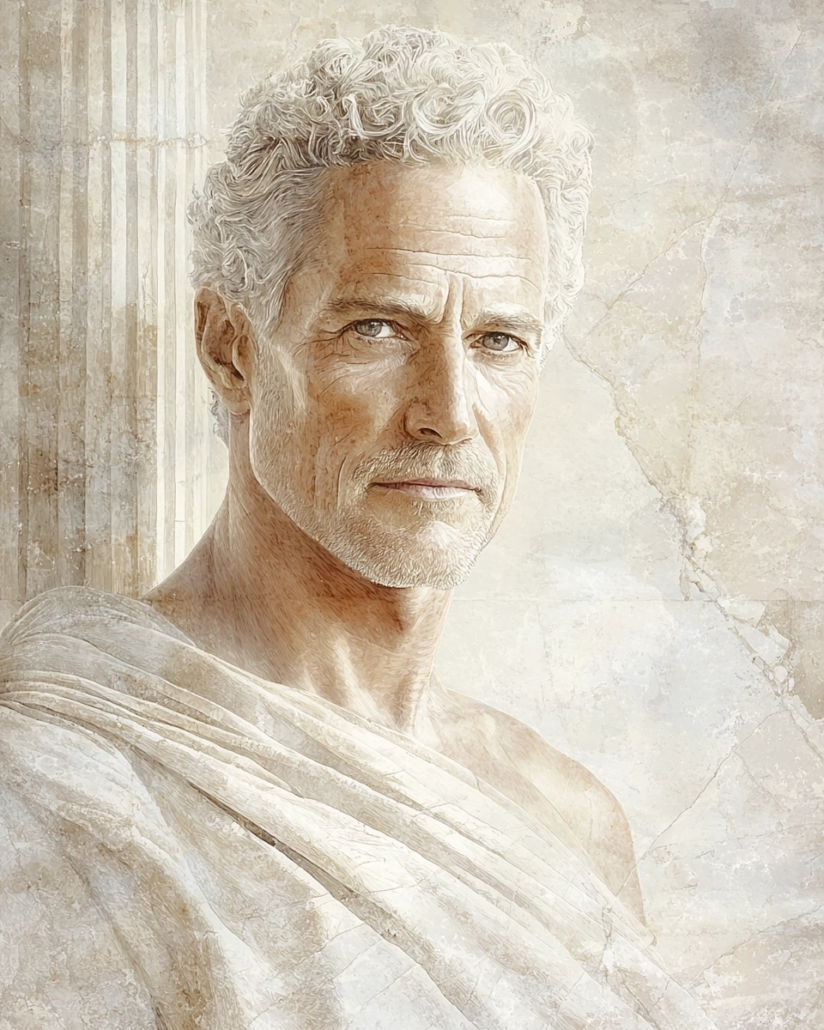
Stylized portrait – Herillus of Carthage
Δ ⋮ A head in half-shadow
Not much of Herillus remains. More a narrow outline, and with it a small, somewhat dry scene: a young man in the schoolroom, his head shaved, as though attention had to be pulled away from the person and toward something harder. Whether the anecdote fully holds is not quite certain; that it suits the figure is hard to miss. Herillus appears not as a steady support of the early Painted Portico (image for the early Stoic school space and its order of thought), but as a slight shift within the room — no collapse, rather a cut that makes the line of the school visible precisely because he does not quite follow it.
Λ ⋮ Knowledge instead of reassurance
Herillus belongs to the early Stoa of the third century BCE and to the immediate circle around Zeno. It is precisely there that his position stands out. He is not outside the school, but neither is he in its settled center. Ancient transmission treats him as a dissident mind: a student who knows the basic tone and yet begins at exactly the point where the early Stoic coherence starts to tear.
That point is clear enough. For Herillus, the highest good is not virtue in its usual Stoic formulation, but Epistḗmē (secured knowledge as the highest aim of thought and life). This shifts not merely an emphasis, but the whole order of rank. If knowledge becomes the final standard, then much that carries weight in life loses its highest claim. That is why Herillus declares everything between virtue and vice indifferent. It does not disappear, but it no longer bears the last word.
In the background lies the question of Synkatáthesis (the mind’s assent to an impression or judgment): not every impression deserves assent, and Herillus is clearly interested only in the condition in which thought is no longer displaced by ignorance.
“The end of action is knowledge.”
Herillus, transmitted in Diogenes Laertius VII 165.
What is provocative about this sentence is not its tone, but the spareness of its claim. As far as the sources reach, Herillus does not sketch a rich doctrinal structure, but a hard priority. That fits the brief note that his writings contained counterarguments against Zeno. No great break, rather work in the same room with different pressure against the same wall. Later authors treat him less as a leading figure than as a problem case within the early school — a figure in whom it becomes visible that the Portico was never a completely smooth front, even at the start.
Π ⋮ Contest over the Standard
What remains of Herillus is not a complete system, but a displacement. In that alone, early Stoicism shows something smoother names can easily conceal: it was not only order, but early on a dispute over the final standard.
Ξ ⋮ Where sentences grow narrow
A figure like Herillus does not leap into the present as a doctrine, but as a measure for language. You see it where a sentence is suddenly led more tightly. In a meeting, for instance, when after several polite loops a formulation finally appears with nothing left dangling from it. Not unfriendly, not heroic, simply without the usual padding.
The tone alters the room faster than any argument. One word less, one afterthought less, a slight distance from one’s own gesture — and suddenly there is a crack in the scene. What stands out is not hardness, but sharp distinction.
That is noticeable in contemporary language precisely because so much is tuned to smoothing things over. Emails want to sound agreeable, posts want to signal stance, conversations want to appear both open and unassailable. Herillus would be a poor name for reassurance, but a useful disturbance. His priority in favor of knowledge is not something one hears today as doctrine, but rather as distrust toward sentences that promise more order than they can actually bear. Then not every word matters equally. Some formulations simply stand to the side. The tone remains calm, but the line grows sharper. What does not hold does not dramatically collapse — it merely loses its standing within the sentence.
Σ ⋮ Form, afterthought, resistance
That is probably where the real presentness of this figure lies: not in large concepts, but in small decisions of language. A claim is set down without being immediately wrapped in attitude. An objection remains standing without being staged as an attack. A sentence ends one beat earlier than the manners of the milieu would have expected.
Such movements look inconspicuous, but they shift the order of rank within the sentence. The early schoolroom of the transmission almost reappears as a present scene, only without columns, more as a situation between protocol, statement, and incidental half-shadow.
That is also why the thought of Parrhēsía (open speech without ornament or strategic soothing) fits here, though in a muted form. Not as a gesture of courage, more as linguistic self-limitation. Whoever speaks that way does not paste a softer wallpaper onto the sentence afterward. That still does not mean the speaker is right. It only means that the tone risks something: no pose of depth, no quick reconciliation, no artificially smooth front. Perhaps that is the real aftersound of Herillus. Not a teaching for daily life, more a quiet resistance to ways of speaking that act, even while being formed, as though everything had already been arranged.
Ψ ⋮ What remains of the line
What remains of Herillus is no broad structure, but an edge at which early Stoicism briefly becomes visible against itself. Precisely because almost nothing survives in full, this figure does not seem smaller, but sharper. You see fewer furnishings in the room and more of the wall. Transmission does not let him spread out; it holds him in a strict side position: student, deviation, priority. That is little — and yet enough not to lose the difference.
Perhaps that is exactly what explains his peculiar afterlife. Not as a major voice, not as a line of origin, but as a marked border case in the school’s memory. Later accounts carry him along with a certain coolness, almost as though the matter were settled and had to be mentioned once more precisely for that reason. A position can vanish from the center and still leave pressure behind. Transmission does not always work through abundance. Sometimes a narrow remainder is enough, provided it keeps the point of dispute open.
“Everything between virtue and vice”
Traditional attribution to Herillus, transmitted in Diogenes Laertius VII 165.
This sentence hardly needs more. It stands there like a clean cut, a little too straight. Not because it explains everything, but because it preserves the severity of the figure: reduction without consolation, clarity without any promise of warmth. Perhaps that is the quietest form of Lakonismós (brief speech that cuts more than it elaborates). Not ornament of form, more a discipline of leaving things out. In Herillus, it even reaches his own afterlife. What is missing is visibly missing.
Ω ⋮ No last sentence, only an afterspace
So Herillus remains not as a figure of security, but as a narrow counterspace. Between quotation, note, and later classification, a movement of thought persists that does not seek breadth. For a moment, the early Portico appears less monumental. More like a room in which lines are drawn, discarded, and yet not entirely erased. That, too, belongs to the school: not only what prevails, but also what remains legible as deviation.
It is precisely there, perhaps, that his peculiar presentness lies. Not in the rank of a name, but in the way an inherited sharpness can still stand within a sentence today without needing much around it. A remainder, a crack, a line a little too severe — perhaps that is all it is. But sometimes what merely runs along the edge carries a school’s more exact imprint better than its smooth self-descriptions do.
💬 Conversation Fragments
Guest: Why does a clear sentence often feel harsher than conflict?
Epictetus: ✦ Because much suffers not from contradiction, but from the end of evasion.
Guest: Why does the right word still sometimes feel strange?
Epictetus: ✦ What holds rarely fits at once; it stands askew before it settles.
Guest: Why do some thoughts leave behind only a narrow remainder?
Epictetus: ✦ Because not every loss is poverty; some things grow exact only then.
Guest: Does an answer have to be complete in order to hold?
Epictetus: ✦ Completeness often only sounds full; what holds is what can remain standing.
≈ freely reflected and inspired by Epictetus
❔ FAQ
Question: Does knowledge here simply mean knowing as much as possible?
Answer: It does not mean sheer accumulation or learned stock. It means an insight that sustains judgment and gives a sentence different weight.
Question: Is Herillus therefore simply opposed to virtue?
Answer: What he opposes above all is the usual order of rank. The dispute lies less in tone than in the question of what a life is finally measured by.
Question: Does indifferent mean everything should become unimportant?
Answer: No, the term does not make things trivial. It draws a strict boundary and strips many things of final rank without removing them from view.
Question: Why do brief sentences often sound sharper than loud ones?
Answer: Sharpness often comes from omission, not volume. When a sentence carries less evasion, the matter becomes clearer and the tone almost hardens on its own.
Question: Can something remain at all from such scant transmission?
Answer: Yes, a narrow remainder can preserve a contour remarkably well. Especially with disputed figures, little material often remains, yet a distinct profile still does.
Stoic Profile: Herillus of Carthage
Structured research facts.
1. Name and variants
The forms Herillos and Herillus are transmitted; alongside them one also finds the Latin side form Erillus. The Greek name form is Ἥριλλος. The designation of origin is likewise uncertain: the transmission usually gives Carthage, while individual manuscripts and modern editions give Chalcedon instead.
2. Dates and period
His year of birth and death are unknown. The only secure point is his activity in the third century BCE, that is, in the early phase of Hellenistic Stoicism after Zeno of Citium.
3. Place within the Stoa
Herillus belongs to the early Stoa, though as a heterodox or non-orthodox representative. The reason is his marked departure from Zeno’s ethics: he sets knowledge as the goal, not the classical Stoic determination of living in accordance with nature.
4. Historical context & role
He was active in the school environment of the first Stoa in Athens and is named by Diogenes Laertius among Zeno’s students. According to the transmission, his writings explicitly contained counterarguments against Zeno. One biographical detail is attested only anecdotally: Zeno is said to have had his head shaved as a young man in order to drive away his admirers.
5. Central themes & teachings
✦ Knowledge: For Herillus, the highest good is ἐπιστήμη, that is, secured knowledge.
✦ Telos: Life is to be aligned in every respect with a measure guided by knowledge.
✦ Hypoteles: Alongside the highest goal, he admits a subordinate goal that non-sages can also pursue.
✦ Indifference: He declares everything between virtue and vice indifferent.
✦ Cognition: He describes knowledge as a state in dealing with impressions that arguments cannot overturn.
6. Teachers, students, key relationships
Zeno of Citium is attested as his teacher. No students of his own are securely transmitted. In later ancient discussion, Herillus is often mentioned together with Aristo of Chios, because both were regarded as deviationists within the early Stoa.
7. Major works
No work survives in full. What remains are only titles and brief notices, above all in Diogenes Laertius: On Exercise, On Passions, On Opinion, The Lawgiver, The Teacher, Dialogues, and Ethical Theses, as well as Hermes and Medea. Diogenes describes the writings as brief but forceful.
8. Afterlife & influence
✦ School criticism: Cicero cites Herillus as an example of an end theory rejected by the Stoa.
✦ Marginal position: By late antiquity, his position is regarded as largely settled; Cicero remarks that since Chrysippus one had hardly refuted him anymore.
✦ Transmission: His name remains present above all in doxographical debates about the diversity of early Stoic ethics.
9. Adaptations / sense-thoughts
✦ Knowledge counts only where it steadies judgment against mere opinion.
✦ A life gains measure when it rests on knowledge rather than accident.
✦ Alongside the highest goal, room remains for a subordinate striving of the non-wise.
✦ Between virtue and vice lie many things that cannot claim final rank.
✦ Not every impression deserves assent; only what survives testing becomes stable.
✦ Where knowledge takes precedence, some seemingly important things quietly lose weight.
Brief sense-thoughts derived from attested teachings — not transmitted verbatim.
10. Comment on the state of the sources
The source situation is extremely sparse. No work by Herillus survives; his teaching can be reconstructed only from later testimonies, above all Diogenes Laertius and Cicero. Already in the designation of origin — Carthage or Chalcedon — it becomes clear how uncertain the transmission is.
Note
This post is an editorial text — not personal, psychological, or medical advice. For individual questions, see the disclaimer.
Stoically surprised today.