

Σ ⋮ Chrysippus – the workshop of the Logos
Chrysippus of Soli stands early within the Lógos – not as ornament, but as working light. Where other schools sought polish, he stacked arguments. A name that smells of paper: lost writings, remaining traces, and between them a system that refuses comfort.
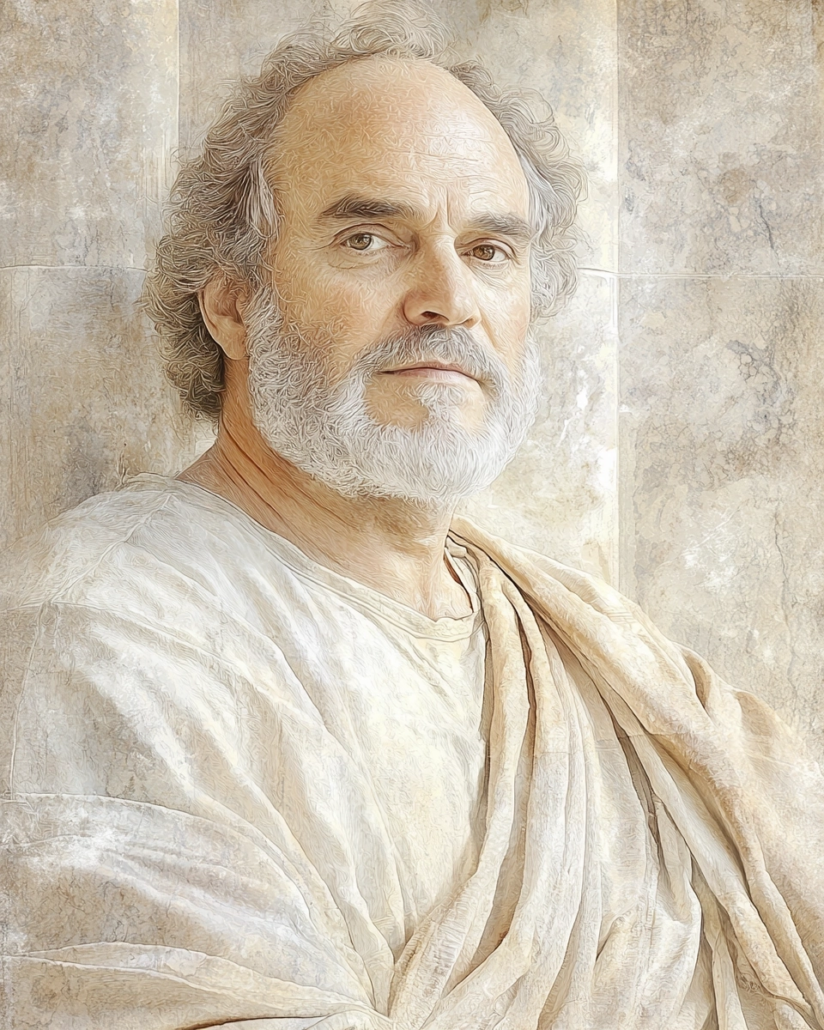
Stylized portrait – Chrysippus of Soli
Δ ⋮ Wax tablet in half-shadow
A wax tablet lies there, darkened by constant revision. Its edge is blunt, as if someone had thought too often with the stylus grip. Nearby: oil smell, dust, a soft scraping that sounds less like art than work. In moments like these, Athens is less a stage than a workshop. No speeches, only the small sounds of order: shifting, scratching, smoothing, again. It is precisely this kind of space in which a philosophy does not shine, but contracts – until it is sharp enough to withstand objections. And somewhere in this sobriety hangs the idea that thinking does not consist of grand gestures, but of what you return to the tablet after erasing it.
Λ ⋮ A system of fragments
Historically, Chrysippus becomes tangible in the Hellenistic world as someone who does not merely belong to the Stoa, but holds it together. Tradition places his origin in Soloi/Soli in Cilicia; Tarsus is sometimes also named – a small fissure at the outset. In Athens he becomes a student of Cleanthes; some reports also mention study under Arcesilaus and Lacydes in the Academy, as if he picked up contradiction next door. After Zeno and Cleanthes he leads the school for years – as the one who not only defends the Stoic position, but expands it: logic, physics, ethics as three hard domains that mutually support one another. In logic he becomes the system worker of propositions and inferences; dialectic here is not style, but a protective measure. In epistemology much hangs on impression and assent – on how quickly a judgment pins the world down. In physics everything remains material, borne by pneuma, order, providence; at the same time the strong doctrine of determination and fate stands in the room, and with it the question of what freedom may still look like. In ethics the core is dry: virtue as measure, passions as erroneous judgments, the good life as a form of precision. That almost everything he wrote is lost – surviving only in quotations, paraphrases, and fragments – reads like an additional punchline: the systematizer remains, his paper disappears.
If one does not know what follows from what, one cannot know the truth.
Chrysippus, in Diogenes Laertius VII, 45 (trans.).
The remark does not crown the system; it exposes its working rule. Truth here is not illumination, but consequence. What cannot be followed through cannot be held.
Π ⋮ A first decoupling
A system builder always has a problem: the system stays, the books go. Of Chrysippus there are titles, splinters, other people’s voices – and the quiet suspicion that the Stoa without his pedantry would be less Stoa. Perhaps that was his only luxury.
Ξ ⋮ Glass-walled meeting room
The modern site of dialectic is rarely the agora. More often a glass-walled meeting room where everyone pretends transparency is a virtue. On the table stand water bottles no one opens, and a laptop that already has a posture before the first sentence. Roles settle into calendars: “lead,” “stakeholder,” “point of contact.” And somewhere in between sits a person noticing how quickly a face becomes an argument – or a tone of voice a judgment.
In such minutes, what matters in Chrysippus today is not historical, but craft-like. Not because he offers an answer, but because he knows the point at which things tip: between impression and assent, between what is said and what inwardly counts as “valid.” A sentence drops that sounds like a decision but is really just expectation. Someone smiles as if that were already consensus. And while words stack up, a second logic runs in the background – the one that turns a glance into an affront, a delay into reproach, a proposal into defeat.
Everyday life is full of small proofs no one names as such. Email chains marked “FYI” that are in fact mothballed accusations. Chat messages that mark an entire hierarchy with a single emoji. A commute on which the body still sways with the train while the mind already reenacts a dialogue that never happened. And in waiting zones – doctor’s offices, hotlines, airports – there emerges a peculiar form of philosophical poverty: much time, too many judgments, little occasion.
Here the friction lies not in a grand ideal, but in micro-tension. Role and person stand side by side like two signs on the same door. Function and reaction rarely fit in the same sentence. And what is “appropriate” suddenly feels less like morality than like a sober question: what is actually the object here – and what is merely its inner continuation? Most conflicts fail not on the world, but on the speed of assent.
Σ ⋮ The body before it becomes opinion
Before a thought is finished, the body has usually already signed. The jaw tightens before a word is spoken. The breath flattens, as if the air in the room had been negotiated. Shoulders slide a fraction forward – a small capitulation no one notices. And in the chest sits that inconspicuous pull that refuses the name “feeling” but still makes itself known. Stoic practice begins precisely here: not as theory, but as perception of the first millimeters.
In the tradition, Chrysippus is the system worker – and for that very reason he works as a foil for these pre-verbal moments. Because his theme hinges on the point at which an impression turns into a judgment. This is not a ceremonial threshold. It is more like a short mechanical process – like a click that opens a file you did not want to open. The Stoa has a term for this: Synkatáthesis (assent to an impression – the small click that fixes the world). The body often senses the click earlier than the mind.
You see it in small delays. A glance shifts briefly aside, as if searching for material. A hand touches the glass, as though there were an edge to hold on to. The neck warms when a non-neutral name is mentioned. Fatigue rises not because it is late, but because inner argument consumes energy. And sometimes there is that peculiar rigidity – a kind of polite petrification that performs composure outwardly while inwardly it is simply overload.
When Stoics speak of passions as erroneous judgments, it sounds cool on paper. In the body it is less theory than sound: the soft rattling of the inner machine once it has committed. Practice would then not be “control,” but omission – a brief non-participation, a split second of distance in which the body regains space. Not as solution, rather as correction of speed. And in this distance something appears that is almost unmodern: that dignity sometimes simply means not turning every inner twitch immediately into a story.
No impression compels assent; it is we who give it.
Chrysippus, fragment in Stobaeus (trans.).
The sentence sharpens what the body already hinted at. Assent is not drama, but timing. What feels inevitable is often only fast.
Ψ ⋮ Resonance between brackets
One could easily misunderstand Chrysippus if one looks only at what is missing. Almost everything is gone – and yet something like a load-bearing construction remains. Not as monument, rather as scaffolding on which later hands could keep working. His effect therefore appears less as quotable gold, more as quiet substructure: logic as protective measure, ethics as precision, physics as an order indifferent to our moods. A school that keeps running without paper, as if it had grown used to absence.
Transmission itself is a peculiar piece of furniture: a cabinet full of drawers that no longer fit. Titles here, splinters there, other voices as stand-ins. When something of Chrysippus “speaks,” it almost always does so through someone else’s mouth – as paraphrase, fragment, doxographic curve. This makes him both stable and blurred. Stable, because the ground plan recurs. Blurred, because every recurrence is also an overprint.
Nothing happens contrary to reason, but only contrary to our expectation.
Chrysippus, in Galen (trans.).
The sentence acts like a short bolt on a door – no pathos, more a technical decision. And at the same time it admits a counter-voice all by itself: perhaps it is easier to avoid the crowd when one already prefers inferences to festivities. Perhaps distance is not always virtue, sometimes temperament. This small uncertainty is no damage. It is the point at which a profile does not turn into a statue.
What remains is not the book, but the discipline that would carry it.
That the Stoa, in retrospect, likes to work with big names belongs to human order – we hang signs on doors to calm the corridors. Chrysippus is such a sign, only one that smells of workshop. And scholarship has to live with what it gets: quotations, catalogues, reconstructions from later testimonies. That makes the matter less comfortable, but also more honest. There is no easy access here – only a form of rereading that always proceeds by touch.
Ω ⋮ A marginal note to time
Perhaps the most pleasant thing about Chrysippus is that he does not lend himself to consolation. He is no warm quote on a refrigerator, more a light that shows where sentences wobble. His closeness lies not in feeling, but in an attitude toward form: thinking until it holds. And if it does not hold – again. That sounds like work, and it is work.
When people today say “stoic,” they often mean a pose: unmoved, untouchable, sleekly factual. The Stoa, as it appears in fragments, is rougher. It has more to do with assent than with hardness, more with judgment than with coldness. And it quietly reminds us that the world consists not only of events, but of the inner processes that paste meaning onto them – sometimes too quickly, sometimes too eagerly. Which of these actually belongs to you, and which is merely the continuation of an old impression.
When effect is mentioned, one move often suffices: that a system lives not because it is complete, but because it remains connectable. That has to do with time – with Synéchēs Metabolḗ (continuous transformation – change without dramatic rupture). Not as a narrative of progress, rather as a quiet indication: even a thought changes as it is passed on. And sometimes that is its only form of fidelity.
In the end there is no conclusion. Only an image: a wax tablet whose edge has gone blunt from constant revision. The system stands in half-shadow, not out of secrecy, but because the sources demand it. And perhaps that is the most fitting form of resonance – not as answer, but as a possibility that slows one’s own judgment just a little.
Abstention
💬 Teaching fragments of the Stoa
Inquirer: I collect reasons like stones – and in the end I cannot carry a single one. What am I missing?
Chrysippus: ✦ Do not check how many stones you have, but which one truly follows – the rest is decoration.
Inquirer: A single impression – and everything in me is already decided. Is that already judgment?
Chrysippus: ✦ The impression arrives uninvited; it is decided only when you host it like a guest.
Inquirer: If the world runs in order anyway – why bother at all?
Chrysippus: ✦ Order is no license for comfort – you are part of it, not its spectator.
Inquirer: My anger feels justified. Why does it still feel so unpleasant?
Chrysippus: ✦ Because it masquerades as feeling, but works as judgment – and judgments take themselves too seriously.
≈ stoically reflected after Chrysippos and the Stoa · loosely paraphrased
Testing points with Chrysippus
Characteristic mode of thought
Perspective: logic / argument structure / derivation
Thought in Chrysippus does not move along convictions, but along coherence. A thought is not believed, but examined – so soberly that any rhetorical impulse appears foreign. For him, the path to insight is a matter of craft.
Limits & potential misunderstandings
Perspective: passions as judgments
Chrysippus is often read as claiming that passions are not merely feelings, but judgments. The line is thin: whoever takes this as a devaluation of the emotional misses that it concerns the moment when an impression becomes interpretation – not a condemnation of sensing itself.
Business anchoring: where this Stoic’s principles touch down at work
Perspective: determinism / causal chaining
In handover situations, when responsibility shifts, friction arises: who carries what, why, and from when? Chrysippus would not speak of guilt here, but of cause. Not as excuse – but as sober reconstruction: who sets in motion, who follows, who assents?
Psychology anchoring: how this Stoic’s concepts correspond with modern psychology
Perspective: judgment / assent
A hint of fatigue in the chest, a minimal stiffness in the gaze – sometimes that already marks a judgment that has anchored itself bodily. Psychology might speak of somatic marking. For Chrysippus, the judgment itself is the marker. And assent often begins as residual tension.
Open resonance after reading
Perspective: transmission / reception
Chrysippus reaches us mostly indirectly – quoted, paraphrased, interpreted. His presence is that of an undertone, not a slogan. Perhaps this is why he lingers: because he does not impose, but quietly corrects – in moments when one might almost have missed one’s own judgment.
Stoic profile: Chrysippus of Soli
Structured research facts.
1. Name and variants
Chrysippus of Soloi/Soli (Ancient Greek: Χρύσιππος ὁ Σολεύς; Latin: Chrysippus). In ancient sources and modern scholarship not to be confused with other name bearers (“Chrysippus” is not a unique proper name; Diogenes Laertius lists, among others, a Chrysippus of Cnidus, a physician).
2. Dates & period
Dates uncertain: usually c. 280 BCE to c. 206/207 BCE (sources vary slightly). Diogenes Laertius dates his death to the 143rd Olympiad and gives an age of 73 years (only approximately convertible chronologically). Period: Hellenistic philosophy (Early/Old Stoa).
3. Position within the Stoa
Chrysippus is regarded as a central figure of the “Old Stoa” and as its decisive systematizer: after Zeno of Citium and Cleanthes he led the school in Athens for decades (dates vary in the literature; often c. 230–206 BCE). The terms “Old” vs. “Middle” Stoa are partly contested in scholarship; Chrysippus is nevertheless regularly counted as part of the classical core phase.
4. Historical context & role
Origin: Soloi/Soli in Cilicia; Diogenes Laertius alternatively reports “Soli or Tarsus” (uncertain). Active in Athens, he became a student of Cleanthes and gained a reputation as an outstanding dialectician. Ancient testimonies emphasize his enormous productivity (more than 700 writings/works are mentioned) and a work discipline that explained his renown; at the same time his style is sometimes criticized as cumbersome or overloaded. At least two ancient anecdotes about his death circulate (including “death by laughter”), to be treated as uncertain biographical tradition.
5. Central themes & teachings
✦ Logic: Stoic propositional logic and dialectic as a tool against rival objections.
✦ Epistemology: impressions (phantasia) and assent as the hinge of knowledge and error.
✦ Physics: materialist ontology, pneuma, providence; determinism and compatibilism debates.
✦ Ethics: virtue at the core; passions as mistaken judgments.
✦ System: refining the triad logic – physics – ethics.
6. Teachers, students, key relationships
Teachers: primarily Cleanthes; tradition sometimes says Chrysippus “heard Zeno,” but more consistently Cleanthes (this lineage is not fully consistent). Diogenes Laertius also reports that Chrysippus studied for a time under Arcesilaus and Lacydes in the Academy (an important station for his dialectical culture). Relationships: ancient sources mention family ties (including nephews Aristocreon and Philocrates) and his distance from courtly invitations. Succession in the scholarchy is generally reported as continuing with pupils from his circle; concrete name lists vary by source and reconstruction.
7. Major works
No work survives complete; the corpus exists fragmentarily in quotations, paraphrases, and doxographical reports (e.g., in Diogenes Laertius, Cicero, Plutarch, Galen, among others). Ancient reports range between “more than 700” and roughly “750” writings. Attested titles include numerous works on logic/dialectic (many listed in Diogenes’ catalogue), natural philosophy (e.g., “Physics”), and ethics (“On Ends”). Modern scholarship reconstructs key doctrines primarily through standardized fragment collections (e.g., SVF).
8. Later impact & influence
✦ Antiquity: treated as the key “systematizer”; a saying runs that without him there is no Stoa.
✦ Logic: shaped Stoic propositional logic and later ancient logical traditions.
✦ Framework: stabilized logic – physics – ethics as a reference frame for later Stoics.
✦ Research: modern work proceeds mainly through fragments (testimonia) and specialist studies on logic, determinism, and ethics.
9. Attested quotations
“Had I followed the crowd, I would not have studied philosophy.”
Diogenes Laertius, Lives of the Eminent Philosophers, Book VII (Chrysippus), §182 (Hicks trans.).
“As for myself; if I had believed there was anyone better than me, I would have studied with him.”
Diogenes Laertius, Lives of the Eminent Philosophers, Book VII (Chrysippus), §183 (Hicks trans.).
“Now give the donkey a draught of unmixed wine so that he may wash down the figs.”
Diogenes Laertius, Lives of the Eminent Philosophers, Book VII (Chrysippus), §185 (Hicks trans.).
Would you like to explore Chrysippus of Soli’s inspiring quotes? Check out our collection of stoic quotes by Chrysippus of Soli.
10. Comment on the source situation
The source situation is fragmentary: Chrysippus’s extensive original works are largely lost; knowledge of his life and doctrine derives mainly from later quotations, catalogues, and doxographical reports. Biographical details (e.g., death anecdotes, individual life episodes) are therefore partly uncertain and must be treated critically.
Editorial portrait by Mario Szepaniak.
Sources
Note
This is an editorial text—not personal, psychological, or medical advice. For individual concerns, see the disclaimer.
Further Stoic Topics – Philosophy, Virtues & Daily Life
Stoically surprised today.