

Π ⋮ Enkráteia: self-mastery without posing
You often don’t notice Enkráteia in the big no, but in the small not-adding-on. You sit there, perfectly civil, and feel an impulse already looking for a signature. Self-mastery looks like restraint – but it’s the freedom not to hand every inner pusher an office.
Stoic thoughtspace
◦ Enkráteia slows tempo: no instant reacting
◦ Sharpens decisions: separate impulse from judgment
◦ Orders habits: don’t serve every urge
◦ When rushed: choice stays still available
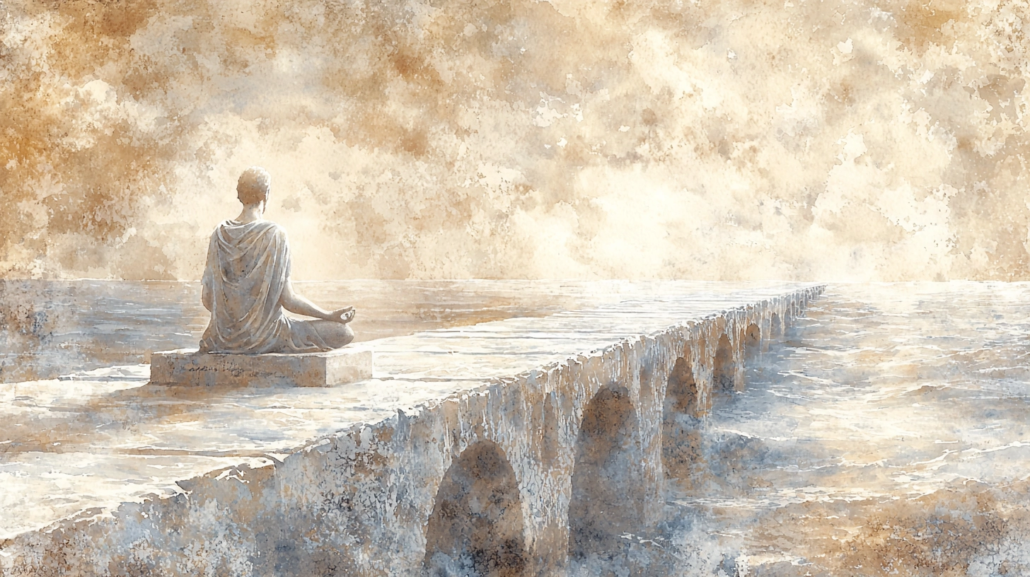
Ξ ⋮ The add-on nobody ordered
It’s astonishing how often a sentence wants to add “just” one more thing – and suddenly the room is furnished differently. You’ve already agreed, you’ve already smiled, you’ve already found the tone that passes for reasonable. Then that afterthought arrives like a knife served too late: not loud, not crude, but with a clean edge.
Enkráteia starts exactly where you’d usually talk your way out with style. Not in heroic resistance, but in the inconspicuous decision not to intensify, not to accelerate, not to pile on again. That sounds harmless. And unfortunately it is not.
Λ ⋮ ἐγκράτεια, enkrateia, enkrateía
The term ἐγκράτεια (enkrateia / enkrateía) has a peculiar sobriety: “self-control,” “continence,” “having yourself in hand” – translations that immediately sound like good manners. That’s the first trick. Because Enkráteia means less good manners than self-mastery: an inner governing that doesn’t constantly ask for applause.
In Stoic terms, this isn’t a decorative ideal, but a craft at the point where language likes to take the wheel. Words are quick. They’re useful. And they’re ready to disguise your impulses as opinions. Enkráteia, then, isn’t silence, but selection: which sentence gets to carry – and which one only pretends it can.
“Free is the one who doesn’t give the first impulse a voice.”
– Stay-Stoic
Ψ ⋮ The first small test
Sometimes Enkráteia is just a barely visible cut: you leave the punchline where it lies, even though it would fit perfectly. You write the sentence – and you don’t send it. Not out of virtue-pride, more because you notice how cheap the effect would be. That’s no enlightenment. More a moment in which self-mastery doesn’t shine, it simply doesn’t get in the way.
Σ ⋮ Habits with a polite tone
In everyday life, it’s rarely the big decisions that sound like self-mastery. It’s the routinized small things that pretend they’re merely style: the quick add-on, the smooth cushioning, the casual correction. People call it “form.” They mean: effect.
Right here Enkráteia becomes uncomfortable, because it doesn’t work with grand gestures, but with refusing small automatisms. A sentence is allowed to stand without being immediately “improved.” A look stays calm without apologizing for itself. That isn’t harshness. More an inner protocol: what actually belongs – and what only wants to score a point.
Enkráteia (Inner steering that checks impulses before they act.) doesn’t feel like discipline in scenes like this, but like a clean cut: less emphasis, more clarity. And suddenly the room isn’t fuller, it’s more exact.
Ψ ⋮ Tension log
You often recognize the moment not by the content, but by the body that’s already positioning itself before the sentence. The shoulders go a touch firmer, the breath gets shorter, the voice a shade too smooth. An inner automatism takes over: quickly secure it, quickly be right, quickly put your own version into the world.
Enkráteia doesn’t mean “be relaxed,” but: decouple. The impulse may be there without immediately showing up as action. The pause isn’t silence out of fear, but a small in-between space in which the add-on suddenly looks like a bad deal. Self-mastery shows up here as a quiet technique: not everything that presses gets a form. And that feels – irritatingly enough – less like loss than like order.
Ψ ⋮ The second version you don’t send
Enkráteia has a quiet side career as editing: you notice that the first draft is rarely “your truth,” but only your speed. The impulse writes fast because it likes to count as a person. And then that sentence sits there, groomed, slightly offended, ready for takeoff.
What remains when you look again is less morality than decision: Prohairésis (Inner choice-power holding space between stimulus and response.) – not as a doctrine term, more as a sober lever. You grab it where it hurts: at the urge to be right immediately.
The punchline stays on the table. The add-on stays in the draft. And suddenly there’s something that almost feels like freedom – not the grand kind, but the everyday kind, with a clean edge.
“The impulse isn’t the problem – its claim to rule is.”
– Stay-Stoic
Ω ⋮ Afterglow without posing
Maybe that’s the real contrast: not between you and the world, but between what wants to be said immediately and what remains bearable afterward. Enkráteia doesn’t turn language into a virtue show. More a workshop where you learn that not every spark needs a fire.
The surroundings don’t become friendlier. They just become less responsible for your inner life. Some sentences may remain unbuilt – like scaffolding you take down in the evening without celebrating the facade. And when you do speak, it doesn’t sound louder – only less like adding on.
Choice.
💬 Stoic Splinters
Visitor: I already agreed, and still want to add “one small thing.”
Epictetus: ✦ The add-on often sounds like clarity. Usually it wants to govern.
Visitor: The perfect punchline sits there, and I get restless if it stays there.
Epictetus: ✦ Only the one chasing effect confuses it with being right.
Visitor: I type the sentence, delete it, type it again—like it has a claim.
Epictetus: ✦ Impulse writes fast. You decide whether it gets the green light.
Visitor: I can hear the tone in me; it’s already applying for office.
Epictetus: ✦ Don’t give it a title. Let it prove it can carry.
≜ stoically reflected by Stay-Stoic
❔ FAQ
Question: Is enkrateia just renunciation as a virtue pose?
Answer: More like precise non-addition: the impulse stays visible, but it doesn’t automatically get the stage. It looks unspectacular, which is exactly why it works in ordinary moments.
Question: Is it simply “pull yourself together” with a better label?
Answer: Pulling yourself together often manages the outward image. Enkrateia sits one step earlier: the inner approval that gives a sentence weight—or leaves it as draft, without drama.
Question: Does it mean saying less, or feeling less?
Answer: Neither. Feeling and impulse can show up; what matters is whether they instantly become “my opinion.” Sometimes the cleanest choice is one sentence fewer—no extra blade.
Question: Where does it touch prohairesis without going textbook?
Answer: Where a narrow gap appears between trigger and reaction, making assent possible. Enkrateia uses that gap like an editor: not everything that sounds fast gets published.
Question: When does the term get overplayed into a program or pose?
Answer: When every impulse gets audited and every tone scored. Then self-mastery turns into self-display: busy, rigid, and oddly proud of its own control.
Editorial portrait by Mario Szepaniak.
Please Note
The content of this post is for informational and inspirational purposes only. It does not constitute personal, psychological, or medical advice. For individual concerns, please consult an expert. Learn more: Disclaimer.
This thinkspace exists through support.