

Φ ⋮ Cleanthes and the discipline of cosmic order
Cleanthes enters the text like a man who doesn’t explain the Lógos, but carries it – as if it were a bucket you’re not allowed to set down. His Stoicism smells of cold well water, and of gods who don’t console. A name that says order – and still sounds like night work.
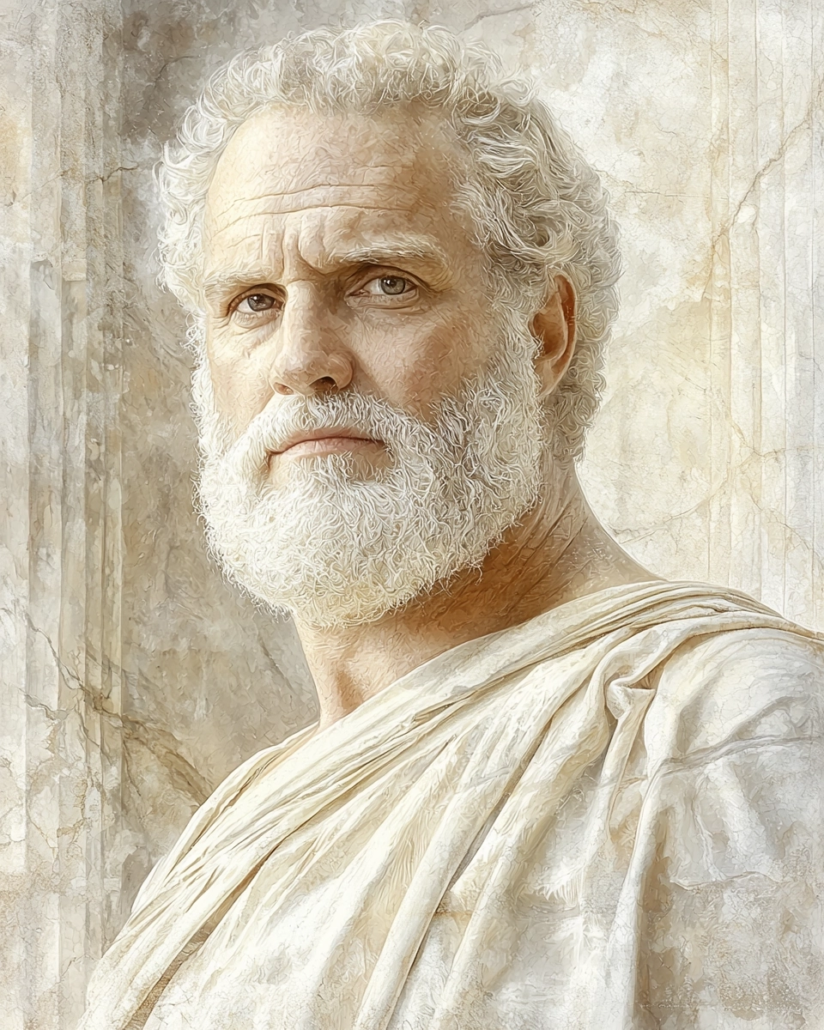
Stylized portrait – Cleanthes
Δ ⋮ The clay jug at the edge of night
An oil lamp flickers – not for drama, but because lamps do that. Beside it, a clay jug, the familiar sound of water hitting ceramic – and a rope scraping over the well’s lip. Nothing heroic in this scene – just the old Stoic luxury of having something real in your hand.
Cleanthes fits that kind of margin. Not up on the grandstand – more in the gap between work and thinking, where the body still remembers what weight is. The tradition loves this sort of image: a philosopher hauling water at night, hauling arguments by day. It’s almost too neat, as if someone poured the hardness of poverty into a tidy teaching plaque. And still, something in it rings true: order rarely begins in the head. It often begins at the wrist.
Λ ⋮ Second man of the Stoa, first in tone
Cleanthes of Assos belongs to the early Stoa – that founding phase when a lot still doesn’t look polished, more like scaffolding: visible, useful, sometimes a bit crooked.
He comes from Assos in the Troad, works in Athens, and stands at a delicate point in the school’s story: after Zeno of Citium he takes over the Stoic school’s leadership and keeps it together, before Chrysippus later builds it out systematically.
His profile is less the grand architect than the person who makes the building livable. With Cleanthes, the early Stoa takes on a distinctly religious coloring: Zeus – not as a comfort figure, but as a principle of order – moves to the foreground. The cosmos appears as a living whole, threaded through with reason, law, and a world-logic that couldn’t care less about personal plans. This is not cozy spirituality. More like a sober imposition: if there is an order, it isn’t there to adjust itself to your mood.
A line from the Hymn to Zeus sets the tone without explaining it.
For it is right that all mortals should address you.
– Cleanthes, Hymnos eis Dia (trans. Effe)
Even in scattered teachings, this body-near metaphysics glints through. Early Stoic psychology binds mind and warmth – the nous as an “inner fire” or vital heat, not as a floating cloud. Ethics doesn’t stand there as a moral sermon, but as a determination of aim: the telos of human action as eudaimonia, as a life that goes well – not in the sense of a happiness high, more as a quiet fit with the world.
Most of his writings have vanished. What remains are titles, fragments, later voices – and a text that feels like a leftover strip of light: the Hymn to Zeus. It’s less an exhibit than a soundtrack: you can hear how the Stoa can sound when it doesn’t merely claim order, but actually sings it. And at the same time everything stays brittle: what we “know” is often a bundle of fragments, lists, anecdotes – clean enough to quote, too restless to settle into.
Π ⋮ Transmission, tidied up
You’d like to put Cleanthes on display as a model specimen: the successor, the pious one, the diligent one. The sources supply enough lumber for that – and still leave splinters everywhere. Maybe that’s his best contribution: he doesn’t read like a monument, but like a tool. A bit worn, and therefore honest.
Ξ ⋮ Meeting room, commute, inbox
In the meeting room, water bottles stand around like small, transparent alibis. On the table lies a pen that writes nothing, but signals plenty. The voices are friendly; the roles sit tighter than shirt collars.
Someone says “just a quick follow-up” – and the room believes in peace for a moment. Then a sentence drops that sounds like an evaluation, and a face does that tiny delay before it folds back into its professional version.
The old Stoic idea of order shows up here not as doctrine, but as background noise: the quiet click when judgment and function lock into each other. In moments like that, the cosmos doesn’t feel vast; it feels small – as a sheet of paper, a calendar, an expectation that mistakes itself for a law of nature.
And still everything hangs on the same hinge: the inner assent to an impression marching through the mind, pressed and wearing a name tag.
On the commute, the setting is less polite. Doors shut, people stand too close, the air turns stale, someone takes a call in the tone of public property.
The body registers first; the mind delivers the story afterward. One short look is enough, one silence in a message thread that lasts a beat too long, one “FYI” – and the stage is built. The modern tragedy isn’t loud; it’s formatted.
In this small economy of expectations and reactions, you can feel how close Cleanthes’ gaze at cosmic order suddenly is.
Not as a dome of stars, but as a chain of small appropriatenesses: what fits the role without the person sticking to it? what stays factual without turning cold? and what is merely a spontaneous opinion posing as character? Order is no ornament here. It’s what remains when the reflex briefly cuts out.
Σ ⋮ The body as the first ledger
The body keeps accounts long before the sentence is finished. The shoulders rise as if an invisible bucket had been hung there. The jaw goes hard, the tongue presses against the teeth, and the heart sets a beat meant only for the inside. In waiting zones – elevator, hotline, clinic corridor – a special kind of fatigue forms: not the fatigue of sleep, but the fatigue of constant readiness to do something “right” any second.
Here too, that large, impersonal order flickers into view – as a claim that does not console.
Zeus, giver of all, cloud-wrapped, lord of the bright lightning …
– Cleanthes, Hymnos eis Dia (trans. Effe)
Sometimes it’s only the thumb above a glass surface. It hovers over “send” like over a doorbell you can’t unpress. The impulse is fast; the stance is slow. That’s the resonance space where Stoic practice shows up today without announcing itself: as delay, as a small refusal, as an inner step to the side – not heroic, more like hygiene.
In the Stoa’s language, that’s the point where the impression doesn’t rule, but the assent to it does. Synkatáthesis (Assent to an impression – the moment a stance is born.) sounds nicer than it feels. It isn’t a golden switch in the head; it’s more like a quick grip on your own wrist – as if checking whether your pulse is putting on a show.
Cleanthes’ idea of a whole ordered by reason becomes, in the body, not an explanation but a temperature. There are days it feels like “inner fire”: a dry wakefulness that doesn’t shove the impulse away, but refuses to hand it the throne.
And there are days when all that remains is a plain posture – chin a little lower, shoulders a little softer, breath not as a technique but as a fact. Stoic, not because it shines. Stoic, because it doesn’t make the scene bigger than it is.
Ψ ⋮ Aftereffect without a monument
Cleanthes lingers in the Stoa’s memory like a sound, not a statue. You know there were many writings – and today you mostly see the margins: titles, shards, later voices that quote him or talk past him. The Hymn to Zeus reads like a rare piece of unbroken language.
Not because it explains everything, but because it makes a stance audible: order as something larger than your private interior renovation.
And right there the unease begins. Transmission is kind to clear figures, especially to the ones who tell well. Cleanthes supplies the material: the school’s second man, the pious tone, the image of cosmic order. At the same time it’s all so fragmentary that every later reader inevitably builds along – sometimes elegantly, sometimes with too much plaster. Maybe that’s the price of a thinking that carries more than it records.
With Cleanthes, order is less a result than an obligation.
A transmitted line is attributed to Cleanthes – more as a tonal trace than as a deed of ownership.
For neither mortals nor gods receive a greater honor than to praise the common law …
– Cleanthes, Hymnos eis Dia (trans. Effe)
It fits – and it may fit a little too well.
Because the smoother a sentence sits, the easier it becomes a substitute for the real thing: the slow, workmanlike relation between assent, worldview, and the small daily resistance against one’s own theater. Cleanthes can’t be fully secured. That isn’t a defect. It’s how certain voices work: as an aftersound that disturbs certainty.
Ω ⋮ Time, measure, world-reference
Anyone who reaches for Cleanthes today reaches for something already polished by other hands. The text you think you’re reading is often a layering: fragment, interpretation, translation, interpretation again.
And still something very direct can happen, almost physical: a moment when the world stops looking like a stage and starts looking like an order that keeps running even while the calendar tantrums.
Maybe that’s the modern form of his Zeus – not as a figure, but as background hum. The light turns, the train moves, a message arrives without asking permission. In that kind of moment, time takes on a quality that isn’t cozy, but clear: Kairós (The fitting moment – not made, only recognized.) – a cut in the stream that doesn’t look spectacular, more like a brief hand on the light switch.
The soft counter-voice remains. Maybe this cosmic order, for all its strict sound, is also just a particularly elegant way to calm yourself down.
Maybe “order” is sometimes used like a lid when things rattle inside. And still: there is a sobriety that isn’t cold, but relieving. Not everything demands a comment, not everything demands a reaction, not everything demands an I in top form.
Whether that is enough when the day turns loud
To carry on
💬 Stoic teaching splinters
Seeker: At the well the water is clear – and still my hand trembles. Why?
Cleanthes: ✦ The water is calm enough. A judgment stirs it up – and calls it unrest.
Seeker: In the temple they call on Zeus as if he’d answer. Why does it stay quiet?
Cleanthes: ✦ Because order doesn’t speak; it orders. The voice comes from you – the law from elsewhere.
Seeker: I only see things: stone, dust, people. Where is the connection?
Cleanthes: ✦ You look for a thing and mean an order. It isn’t far away – just not loud.
Seeker: You call mind an inner fire. Mine flickers. Is that already the end?
Cleanthes: ✦ “End” is a big word for a small flicker. The warmth carries – and fit can happen without shine.
≈ stoically reflected after Cleanthes and the Stoa · loosely paraphrased
Touchstones in Cleanthes
When order doesn’t console
With Cleanthes, the gaze pulls away from the event to the frame that holds it. The tone grows quieter, but stricter: less story about oneself, more measure of the world.
Profile edge – Zeus as a name for law
His Zeus can sound like piety, but often reads more like a word for order. If you look for closeness too quickly, you may pour warmth into what Cleanthes means as rule – and miss the sobriety his thinking actually has.
A culture of decision under measure and responsibility
In situations where standards apply even when nobody applauds, Cleanthes works like a silent touchstone. What matters isn’t winning fast, but whether an action fits the frame without bending the frame – fit as an aim, not shine.
Inner motion and self-leadership in the moment
If mind is thought as warmth, unrest shows up first as temperature: too hot, too flickering, too close. Cleanthes’ turn is not to fight the motion, but to loosen the interpretation that makes it large.
Open afterglow after reading
In the end, what remains is less a sentence than a climate: order as a world-measure that doesn’t flatter. Whether one finds comfort in it – or clarity – can stay open.
Stoic profile: Cleanthes
Structured research facts.
1. Name and variants
Greek: Κλεάνθης (Kleánthēs). Latin: Cleanthes. Common locative: “Cleanthes of Assos” (Assos in the Troad, Asia Minor).
2. Dates & period
Birth: 331/330 BCE (Assos). Death: 232/231 BCE (paired years are common in research/reference literature and mark residual uncertainty).
Period: early Hellenistic; active in Athens. School office: head (scholarch) of the Stoa after Zeno of Citium, roughly 263–232 BCE.
3. Place within the Stoa
Early Stoa (Old Stoa): second scholarch after Zeno, before Chrysippus; in standard school histories positioned as a central figure of the founding phase.
4. Historical context & role
Ancient biographical tradition (doxographical/anecdotal): Cleanthes came to Athens “with only four drachmas” and became a student of Zeno; earlier he is said to have been a boxer (pugilist).
Out of poverty he worked at night as a water carrier in gardens and practiced dialectic by day; hence the nickname “Well-lifter” (Phreantlēs). A hearing is reported in which he proved his work through witnesses (a gardener; a woman who sold him flour); the Areopagites wanted to give him money, which Zeno forbade him to accept. Also transmitted are (1) a gift from Antigonus (Antigonus II Gonatas) and (2) the note that Cleanthes, for lack of money, wrote down Zeno’s lectures on shells and on shoulder blades of oxen. His death is described in tradition as a voluntary continuation of a medically initiated fast (after gum inflammation).
5. Central themes & teachings
✦ Theology: a “religious” tone in early Stoicism; Zeus/God as the ordering principle, with the Hymn to Zeus as a key witness.
✦ Cosmos: the universe as a living whole; God understood as enlivening aether and as pervading reason.
✦ Psyche: early Stoic psychology – mind/nous as “inner fire” or “vital heat”; later development of the pneuma model mainly associated with Chrysippus.
✦ Telos: ethics within the system – a eudaimonistic account of the goal; eudaimonia as the final end of action.
6. Teachers, students, key relations
Teacher: Zeno of Citium (Cleanthes as legitimate successor). Student: Chrysippus (later scholarch and chief systematizer). Biographical notes also mention Antigonus II Gonatas as a king who supported him; Britannica also calls Antigonus a “pupil” (interpretable as a listener/student in a broader sense).
7. Major works
A large corpus is reported, largely lost: Britannica mentions “about 50” writings, of which only fragments survive; fragments/testimonia are found, among others, in Diogenes Laertius and Stobaeus, partly also in Cicero and Seneca.
Diogenes Laertius preserves numerous work titles (selection): “On Time,” “On Zeno’s Physics” (2 books), “Interpretations of Heraclitus” (4 books), “On the Gods,” “On Duty” (3 books), “On Logic” (3 books), “On the End” (peri telous). The most prominent continuous text is the Hymn to Zeus (Hymnos eis Dia), treated as a core piece of evidence for the early Stoa.
8. Later impact & influence
✦ School: as second scholarch, secured continuity between Zeno and Chrysippus and set the school’s tone, especially in theological-cosmological register.
✦ Hymn to Zeus: a rare, coherent specimen of Stoic piety-language; still read as a key to Stoic ideas of providence and logos.
✦ Fate: the formula “ducunt volentem…” – transmitted under Seneca’s name, yet also discussed as a Latin rendering of Cleanthes; authorship remains uncertain.
9. Attestable quotations
“Most high among immortals, of many names, ruling nature forever by laws, mighty leader: hail to you, Zeus.”
Cleanthes, Hymnos eis Dia (working translation).
“Highest king of the all: without you nothing happens on earth or sea, nor at the aether’s pole of heaven.”
Cleanthes, Hymnos eis Dia (working translation).
“Drive these away, Father, from the soul, and grant that we may strike upon insight …”
Cleanthes, Hymnos eis Dia (trans. Effe).
Would you like to explore Cleanthes’ inspiring quotes? Check out our collection of stoic quotes by Cleanthes.
10. Note on the state of the sources
The source situation is fragmentary overall: of Cleanthes’ extensive writings, almost only titles, fragments, and later testimonia remain. Biographical material is strongly anecdotal (esp. Diogenes Laertius) and must be read cautiously; the Hymn to Zeus is the most important continuous piece.
Editorial portrait by Mario Szepaniak.
Sources
Note
This is an editorial text—not personal, psychological, or medical advice. For individual concerns, see the disclaimer.
Further Stoic Topics – Philosophy, Virtues & Daily Life
Stoically surprised today.