

Ψ ⋮ Epictetus: Choice in a Headwind
Epictetus brings up prohairesis early, as if it sits on the tongue like metal. No pose: more the tone of a man who learned that freedom doesn’t shine. In a world full of doors, the inside is the key – and everything else just makes noise around it.
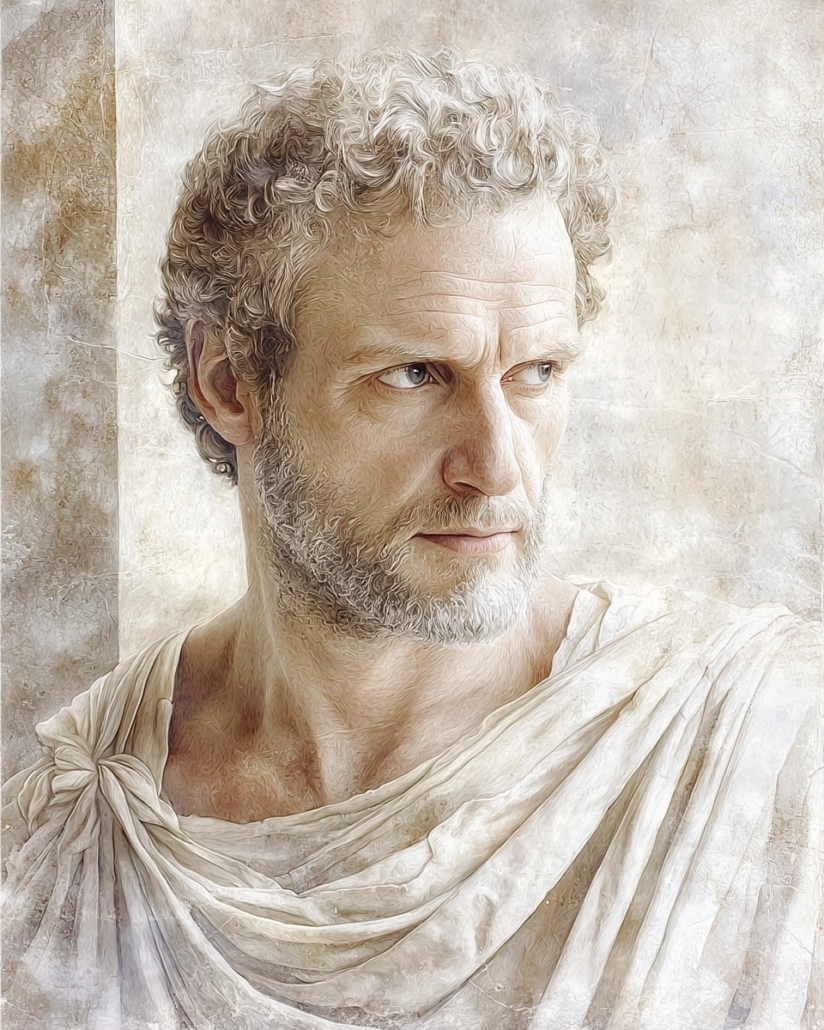
Stylized portrait – Epictetus
Φ ⋮ Oil Lamp in the Half-Dark
People like to imagine something grand when the word “philosophy” shows up. Epictetus starts, instead, with things you almost step over: an oil lamp, a plain chair, a clay jug that, when it’s bumped, acts as if it’s been insulted. The light is small, but it has stamina. It holds on without claiming it rescues the night.
In that half-dark, every word feels like a decision, not a piece of jewelry. The lamp smokes, the wick is too short, and somewhere wood snaps. Outside, the world keeps going – groomed, loud, with status and background noise. Inside, what remains is what can’t be carried out: the moment an impression appears – and you notice it already wants a vote.
Σ ⋮ Late Stoa, Early Sobriety
Epictetus belongs to late, Roman Stoicism – a time when philosophy no longer lives in the shadow of marble academies, but in the noise of households, orders, and political weather.
His biography is patchy in details, but the basic line is relentlessly clear: he grows up enslaved in Rome, in the household of Epaphroditus from Nero’s circle, studies philosophy with Musonius Rufus, is later freed, and then appears as a teacher himself.
Then comes the imperial throat-clearing: under Domitian, philosophers have to leave Rome. Epictetus goes to Nicopolis and establishes a school there.
People often read this move as “exile” – and miss how it sharpens the tone of his teaching: not theory, but practice. Not shiny sentences, but training the mind to test impressions before they take command. The core is his prohairesis: the power of choice, the place where freedom shows up at all. Anything can happen outside; inside it’s decided whether it takes root. In his words:
Men are disturbed not by things, but by the views which they take of them.
– Epictetus, Encheiridion 5 (trans. W. A. Oldfather)
That isn’t comfort, more a kind of bookkeeping. Epictetus revalues goods: property, rank, health – all of it outside, all of it removable.
The only thing that qualifies as “good” is virtue – character at work: self-control, integrity, the sober yes to reasonable action. Along with that comes askēsis, practice as everyday business, not as a pose. And along with that comes his trust in the cosmos: Zeus, providence, world order – not as a sweet wallpaper, but as the assumption that the stage won’t be rebuilt for each person individually.
The fact that Epictetus wrote nothing himself fits uncomfortably well with that strictness. What we have are Arrian’s notes: teaching conversations, of which only four books survive, and the Handbook as a compact distillation.
A teaching about inner freedom, preserved as a note, a selection, a leftover stock – like a lamp that keeps burning even though no one officially ordered it.
Ξ ⋮ Transmission with a Crack
You want the Stoic as a flawless statue: unshakable, smooth, official. Epictetus arrives as conversation instead, taken down by Arrian, cut into a handbook, as incomplete as any memory. Add a teacher with a bad leg who speaks about freedom without selling it as decoration. The ideal type clears its throat; the material stays.
Π ⋮ Conference Room, CC, and Supporting Roles
A modern conference room is a clean place where things get dirty. The air is conditioned, the faces are friendly, the glass on the table so smooth that any hesitation looks like a fingerprint. Someone says “alignment,” someone else says “ownership,” and nobody means property. Epictetus would probably have nodded, not because he knows the words, but because he recognizes the mechanism: impressions latch on like Velcro, and judgment is already stuck to them.
Between role and person there’s often only an email. One line that calls itself “brief” and still builds a small stage. The phone vibrates before a thought even forms; the body is faster than the argument. You sit there – functional, polite – and notice how eagerly outside worlds like to park inside you. In moments like that, self-control doesn’t feel heroic, more like simply not typing a needless comment.
Everyday life has its liturgy: queues, ticket numbers, follow-up questions with the wrong kind of friendliness. On the train you become a silhouette between bags and deadlines; in a chat window, a dot at the end of a message.
Stoic choice-power here isn’t a lightsaber; it’s a small gap in syntax. Not to seem cool, but to avoid confusing what’s yours: Ergón (one’s own work, done plainly in the moment). Everything else keeps running, with its agenda and its noise. Sometimes the only clean move is deciding what you will answer at all.
Ψ ⋮ The Body as Preface
Before a judgment forms, the jaw often tightens first. The shoulders slide a few millimeters forward, as if they’ve signed a secret contract. The breath gets smaller – not dramatic, more like a room where someone leaves the door half closed. Epictetus’s sobriety shows up here not as a thought, but as perception: the moment you notice an impression already knocking from the inside.
Hands are surprisingly honest. They type faster than the head can keep up; they reach for the coffee cup as if it were an argument. And then that brief stall when you would have to “give something back” without it feeling like loss: status, approval, a piece of calm. The body registers the switch at once – a little heat at the nape, a dry mouth, a gaze that lingers too long on a name.
In moments like that, virtue isn’t a pose, but posture in the literal sense: spine, soles, the minimal step back from reflex. Not because it’s “better,” but because otherwise it becomes automatic.
You can almost see assent or refusal taking hold inside – a quiet yes, a silent no, both without an audience. The effect isn’t shine, more a strange normality: the scene stays the same, but the inner life stops playing extra.
Ψ ⋮ Handbook in Circulation
Epictetus has that odd talent of feeling small and large at the same time while you read him. Small, because he inflates nothing: no heroic gestures, no world-formula. Large, because with a few moves he gets to the place where everything tips – not outside, where the noise sits, but where assent is granted.
Maybe that explains the aftersound. The Encheiridion is so compact it behaves like an object: you slip it into a pocket, set it down, find it again. And yet it remains a remainder: Arrian’s notes, selection, compression. It carries the marks of teaching never designed for printer’s ink. That is exactly where a strange authority comes from: not the author’s, but the authority of what’s been handed down – holding its ground against smooth modernity without ingratiating itself.
And then there it is, almost too brief, a formulation:
Never say of anything, “I have lost it,” but, “I have returned it.”
– Epictetus, Encheiridion 11 (trans. W. A. Oldfather)
Epictetus’s freedom sits inside the sentence, not in the course of the world.
And yet there’s a quiet counter-voice you shouldn’t wave away with compliments. If everything is pushed inward, the outer world can start to look like an alibi: as if the stage were mere scenery and other people were only extras.
Add this: world order, Zeus, providence – with Epictetus it sounds like a sober frame, not like décor. But frames can also tighten when you take them too literally. Maybe his tone is most usable where you don’t use it as a shield, but as a measuring device: for your own tendency to treat impressions as facts.
Ω ⋮ An Echo That Doesn’t Clap
When Epictetus shows up today, it’s rarely as a historical figure. More as a tone: a clipped, unexcited language that doesn’t promise you the sky, but checks the acoustics. You notice how easily you hang yourself on sentences that pretend to be railings. And you notice how quickly railings turn into bars when you grip them too hard.
What remains is a kind of calm that doesn’t smell like wellness. The word for it is heavier than it sounds: Apátheia (unshaken by passions, without coldness or escape).
Not as an end state, more as a moment when the body doesn’t sign off immediately. The impression arrives, the reflex takes a run – and somewhere in between is a small delay that needs no stage.
Maybe that’s the real reason the tradition holds even though it’s full of gaps. It promises no completeness. It leaves room for friction, for misunderstanding, for the narrow risk of taking yourself too seriously. And when later readers turn it into a program, you can still hear, underneath it all, a class that simply went on – night after night – with the same lamp and the same limits.
The impression knocks again. Inside, it goes briefly quiet, as if someone had to make room first.
Delaying.
💬 Stoic Splinters
Inquirer: In the meeting I speak like a role. Later my own voice sounds unfamiliar.
Epictetus: ✦ Roles are strangely loyal – the judgment living in them, less so.
Inquirer: A short email, three recipients, CC. And suddenly the air feels official.
Epictetus: ✦ Odd how quickly the outer world finds a chair inside you.
Inquirer: They moved my desk. “Nothing personal,” they say.
Epictetus: ✦ The impersonal rarely hits the body – it hits the assent that insists on being personal.
Inquirer: I can tell by my jaw that I’ve decided before I know it.
Epictetus: ✦ The impression arrives early; freedom comes in later – a bit late, but still.
≈ stoically reflected after Epictetus and the Stoa · loosely paraphrased
Touchstones in Epictetus
What is Epictetus’s distinctive motion of thought
He relocates the drama to a quiet jurisdiction: assent. Not outside, where events happen, but inside, where a judgment signs the paperwork. His freedom isn’t a pose; it’s a sober responsibility—and that’s why it’s hard to counterfeit.
Where does this position turn uncomfortable or easy to misread
Once everything is moved inward, the outer world can start to look like set dressing. That can lighten the load, but it can also dull the senses—as if the stage were scenery and other people were just noise. Epictetus can bear that tension, but he can also be used as a clean hiding place.
Conflict Management, Negotiation, and Change
Epictetus reads conflict as a test of role and responsibility, not of charisma. In negotiation and change, he’s useful precisely where pressure compresses language: when people hide behind procedure, when status wants to speak first, when “process” becomes a shield. He keeps pointing to the internal assent that turns a situation into a stance.
Stress Research, Emotion Regulation, and Resilience
His teaching lands in the narrow space between stimulus and response, where stress tries to decide for you. That’s why it resonates with emotion regulation and resilience work: not as a protocol, but as a discipline of how evaluations form and harden. Epictetus is strict about that moment—before the body has finished agreeing.
What remains as an open remainder after reading
A suspicion toward one’s own automatic phrasing. And the sense that “inside” doesn’t always mean depth—sometimes it just means habit. Epictetus leaves that tension in place, like a lamp that keeps burning without explaining itself.
Stoic Profile: Epictetus
Structured research facts.
1. Name and variants
Most commonly Epictetus in English; in German often Epiktet. Ancient Greek: Ἐπίκτητος (Epíktētos) – literally “acquired / purchased”; his original name is not preserved.
2. Dates and period
Born c. 50–55 CE (Hierapolis in Phrygia, today Pamukkale/Turkey), died c. 135 CE (Nicopolis in Epirus, Greece). Epictetus belongs to the Roman Imperial period and worked across the transition from the 1st into the early 2nd century CE; exact dates and details remain partly uncertain.
3. Place within Stoicism
Late (Roman) Stoicism: Epictetus is regarded as one of the most influential ethical teachers of Stoicism in the early Imperial era. His focus is strongly on practical ethics, self-governance, and training judgment – less on systematic logic or natural philosophy.
4. Historical context and role
He grew up as a slave in the Roman milieu, in the household of Epaphroditus (from Nero’s circle). He was able to study philosophy (among others with Musonius Rufus), was later freed, and then taught himself. Under Emperor Domitian there was a philosophers’ edict (dated depending on the source to c. 89–93 CE), after which Epictetus had to leave Rome. He then founded a school in Nicopolis, where he taught until his death. It is also transmitted that he was lame or lived with a lasting leg condition (the cause is not clear in the sources).
5. Central themes & teachings
✦ Control: inner stance and judgment rather than external circumstances.
✦ Prohairesis: moral agency as the locus of freedom.
✦ Impressions: test them, assent or refuse – instead of reacting on autopilot.
✦ Virtue: the only good; character and self-control over possessions, status, or health.
✦ Practice: askēsis as daily training, not decorative theory.
✦ World order: the cosmos as meaningfully ordered; assent to one’s role within the whole.
6. Teachers, students, key relationships
Musonius Rufus is named as an important teacher. Epictetus’s most influential student is Arrian, who transmitted his teaching conversations. A central biographical relationship is his early tie to the household of Epaphroditus (enslavement/manumission). Little is securely known about his private life; in the tradition he appears primarily as a teacher figure shaped by instruction and conversation.
7. Major works
As far as is known today, Epictetus himself wrote nothing. His teaching is known mainly through Arrian’s notes:
• Diatribai / Discourses – originally likely multi-volume; four books survive.
• Encheiridion / Handbook (Manual) – a compact compendium largely assembled from the Discourses.
• In addition, there are fragments and later compilations (whose proximity to the original is sometimes weaker).
8. Later impact & influence
✦ Ethics: a practice-focused approach, centering freedom as inner independence.
✦ Reception: read as a teacher of self-governance, largely mediated through the Encheiridion.
✦ Framework: influence across Roman Stoicism and beyond (especially in the Imperial period).
✦ Resonance: its religious tone made it discussable, and respected, among early Christian thinkers.
9. Verifiable quotes
Some things are under our control, while others are not under our control.
– Epictetus, Encheiridion 1 (trans. W. A. Oldfather)
Don’t demand that things happen as you wish, but wish that they happen as they do happen, and you will go on well.
– Epictetus, Encheiridion 8 (trans. W. A. Oldfather)
Remember that you are an actor in a drama of such sort as the author chooses.
– Epictetus, Encheiridion 17 (trans. W. A. Oldfather)
Would you like to explore Epictetus’ inspiring quotes? Check out our collection of stoic quotes by Epictetus.
10. Note on the source situation
Epictetus’s teaching is comparatively tangible because it is transmitted extensively in instructional texts (above all through Arrian) – at the same time, his biography remains patchy in details, and a large part of the original teaching conversations has been lost.
Editorial portrait by Mario Szepaniak.
Sources
Note
This is an editorial text—not personal, psychological, or medical advice. For individual concerns, see the disclaimer.
Further Stoic Topics – Philosophy, Virtues & Daily Life
Stoically surprised today.