

Φ ⋮ Posidonius and the Art of Measuring the Cosmos
Posidonius comes across less as a moral lecturer and more as someone who tests connections. Early on, the word sympathy lands softly – not as warmth, but as coupling: how things set one another in motion. Follow him and you notice quickly: thinking here is work on the connections, not on the impression.
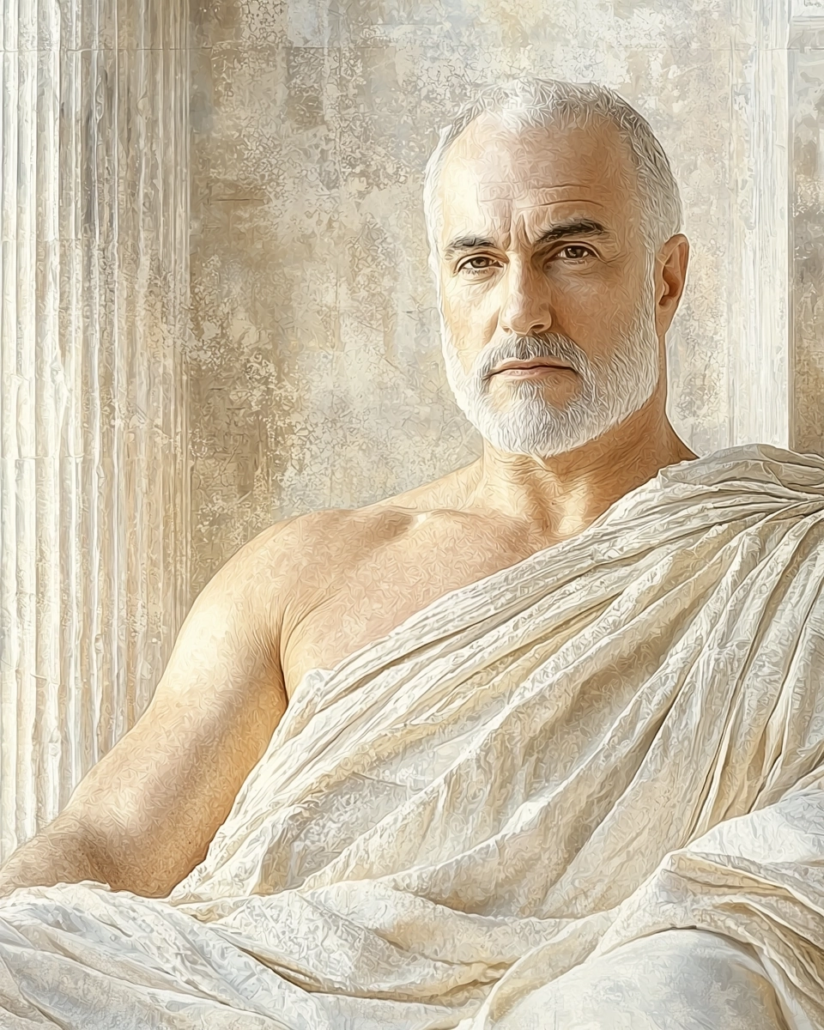
Stylized portrait – Posidonius
Ξ ⋮ A bronze sphere
A planet sphere is a strange piece of furniture. It sits there as if someone decided to press the sky’s restlessness into an object – with axes, circles, small resistances. Bronze doesn’t smell like theory; it smells more like a workshop and fingerprints. And yet it isn’t décor. It’s a clue: if you take the world seriously, you have to be able to handle it, or it turns into posture.
You can picture the light sliding over the metal rings while outside the sea makes its own argument. Not moral, not friendly – just rhythmic. In that image, Posidonius looks less like a man with a maxim and more like a mind that likes to test whether a claim can take wind. The cosmos isn’t made mystical, but workable. And when “cosmic linkage” shows up, it doesn’t sound like esoterica; it sounds like a screw joint.
Σ ⋮ Middle Stoa, wide radius
Historically, Posidonius sits in the late Hellenistic transition zone: born ca. 135 BC, died ca. 51 BC (both ca.). He comes from Apameia in Syria, becomes a student of the Stoic Panaetius, and later is known as a teacher on Rhodes – with a reputation that draws Roman elites. Cicero names him as teacher and audience, Strabo names him as a scholar of his time, and an encounter with Pompey on Rhodes is attested in the tradition. Travels and observations in western regions such as Iberia and Gaul also appear as an attested trail.
His profile remains Stoic, but not monolithic. In moral psychology he becomes interesting where he treats the passions not only as disturbances, but as forces one must understand more precisely – partly Platonizing, without losing the Stoic need for order. In physics, natural inquiry is not a side subject: tides, meteorology, astronomy appear as fields where the Stoic worldview gets its material. And “sympathy” functions for him not as a pretty word but as a framework for explanation: for nature, for fate, even for the touchy question of how divination fits a worldview.
“If you want to speak of the cosmos, start with what you can measure; the rest won’t be flattered.”
Posidonius, Adaptation (derived from attested teachings; not a verbatim transmission).
The tragic part – or depending on mood, the practical part – is the state of transmission: no work survives complete. We know titles and topics of more than 20 writings, including an extensive history in 52 books covering the years 146–88 BC. Posidonius mostly speaks only indirectly – through quotations, paraphrases, and reports in authors such as Cicero, Strabo, Seneca, Plutarch. For that very reason much remains disputed in scholarship, all the way to the famous “Posidonian question”: how far his system really hangs together when reconstructed from fragments.
Ω ⋮ First turn
He writes 52 books of history, and we read him through other people’s mouths. The ideal of total overview stands there, neatly groomed – but the transmission undoes it. Posidonius remains present like a name in the margin – not small, just indirect. A philosopher as an echo that sounds remarkably precise.
Ξ ⋮ The afterthought that pulls the world back in
You rarely notice it by the content. You notice it by the afterthought. First there’s a clean report – and then comes, almost like a coin glued on: “… I think.” Or “… at least for now.” A sentence that pulls itself back a little before it does damage. Not out of politeness, more out of craft instinct. Posidonius probably wouldn’t have called it “mindfulness.” He would have recognized it as a correction to one’s own claim – a small tidal movement in tone.
You see it especially well in meetings. Someone says, “That’s clear.” Then there’s a short silence, and suddenly a second sentence appears like a piece of wood under the table leg: “So – clear enough to keep working.” Nothing is solved, but the situation is corrected. Responsibility no longer sits in the grand gesture; it sits in the phrasing that cleanly stakes out the room to move. It looks unspectacular, and that is exactly where the suspicion lies that it’s meant seriously.
In messages, emails, comments, these micro-decisions show up too: when a fact already becomes an interpretation because an adjective arrives too early. Whether “difficult” is still description or already judgment. Whether a “we” carries or merely disperses. Whether a “one” dilutes responsibility until it slips like fog through any window. Stoic practice doesn’t sound like a maxim here; it sounds like a voice that notices when it gets too loud – and then doesn’t grow dramatically softer, but more exact.
Maybe that’s today’s form of “sympathy,” without having to unpack the word: sentences hang together, and their effects travel faster than intention. Once you’ve seen that, you stop treating language as packaging and start treating it as part of the content. The sentence is not the messenger. It is the event.
Σ ⋮ Resonance, brevity, the art of leaving things out
A sentence often carries not because it’s “true,” but because it doesn’t want too much. You can hear it like a footstep on wood: if the step is too proud, it creaks. If the step is too cautious, you stop. Between those lies a sober precision that doesn’t harden. Stoic practice shows itself before the finished statement – in drafting, in striking, in the quiet add-on that doesn’t apologize but calibrates.
It has a body. Not as depth psychology, more as everyday physics: the throat tightens when the sentence wants to become an accusation. The hand types faster when the impulse wants to dress itself up as “plain talk.” And sometimes something rare happens: you leave the sentence lying there. Not as a moral gesture, but because you notice it would be too early. Omission as form. Delay as style. Distance between intention and voice.
In that in-between space, Lakonismós (Brevity that clarifies without turning rigid) feels almost like a tool on the workbench: not decorative, but ready to hand. Cutting down here doesn’t mean “saying less,” it means producing less noise. The sentence stays closer to the fact without crushing it. And if an interpretation wants in, it comes as an afterthought, not as a crown.
Posidonius matters here less as a person than as a stance of attention: natural inquiry as discipline, not hobby. Anyone who watches tides knows the wave doesn’t wait for the ego. A conversation doesn’t wait for the perfect phrasing either – it reacts to what was actually said. Resonance is the world’s feedback to the sentence. You can ignore it. Or you can listen and write the sentence again, with less racket.
Ψ ⋮ Fragments with a sea view
With Posidonius you quickly feel as if you’re looking through a window someone else installed. Cicero, Strabo, Seneca, Plutarch – they stand in the room, hold the frame, tilt the glass slightly, and suddenly you think you can make out the contours. Only the original blueprint is missing. That isn’t a scandal. It’s history’s normal rudeness.
What remains is impact in narrow bands: Roman educational elites drawn to a teacher on Rhodes; natural explanations carried forward in geography and natural philosophy; moral-psychological friction because his account of the passions doesn’t politely fit one drawer. All of it looks solid until you look more closely. Then you notice: “solid” here often just means “repeated often enough.”
Transmission is not an archive here, but the actual stage.
And yet – or precisely because of it – the few inherited sentences have a strange gravity. You don’t read them like proofs, more like impacts. They are short, and they don’t pretend to carry the whole man with them.
“A model is honest: it admits motion rules us, even when we talk as if we ruled motion.”
Posidonius, Adaptation (derived from attested teachings; not a verbatim transmission).
The quote is harmless, almost friendly. And yet it shows the underlying motion: thinking as mechanics, not pose. A sphere that reproduces movements is not a metaphor – it’s the decision not merely to claim the cosmos, but to build it. Someone who works like that doesn’t fit well with the modern craving for final labels. “The Stoic,” “the historian,” “the natural philosopher” – it sounds tidy, but it smells like a drawer.
The counter-voice is quiet and comes from scholarship itself: how far is what we call “Posidonius” really his own tone – and how much is montage. The famous “Posidonian question” stands like a warning sign at the edge: caution, composite figure. Right here, Diadókhē (Passing on teachings through people, schools, and texts) becomes sober reality: not only ideas travel, attributions do too. You don’t get Posidonius as property, but as circulation.
Maybe that is the appropriate form of his afterlife: no monument, more a system of recurring traces. Like tides – visible, calculable, and yet never identical to what you’d like to hold still.
Ω ⋮ Afterglow without a claim of ownership
If you read Posidonius today, you also read the gaps. You read the places where an author like Cicero admires something, and you read the places where transmission simply had no desire to be complete. The result is not a tidy doctrine but a temperament: a tilt toward observation, a willingness to order, a skepticism toward the quick verdict as soon as it starts sounding too pretty.
Maybe that is also why his “sympathy” feels so modern without needing to be updated. It describes no warmth, but linkage – that things touch even when they don’t know each other. Sentences do that too. A subordinate clause can pivot a whole discussion, an adjective can shed responsibility, an early judgment can close a room before it was ever open.
And somewhere between it all stands a man we know wrote much, observed much, ordered much – and whose books are lost. You can read that as lack. You can also read it as an invitation to accuracy, without any ceremonial tone. Not everything that’s missing is empty.
Noticing.
💬 Lesson shards of the Stoa
Seeker: On the threshold they made me small. I’m still wearing it on my face.
Posidonius: ✦ You call it offense – I see a force you’re feeding right now.
Seeker: By the water I wait for it to finally go calm. I get restless doing it.
Posidonius: ✦ The tide never apologizes for its pace – and still arrives on time.
Seeker: In the yard a shadow fell crooked. I’m afraid it was a sign against me.
Posidonius: ✦ If you go looking for a sign, you find yourself first – and only then the shadow.
Seeker: On the road a word hit me that wasn’t even meant for me.
Posidonius: ✦ Words are like ropes – you feel the pull even when you’re not on the other end.
≈ stoically reflected Posidonius and the Stoa · loosely paraphrased
Reception & readings of Posidonius
Why Posidonius keeps getting read anew
Because he writes not only about stance, but about linkage. His “sympathy” works like a lens: things don’t sit politely side by side, they react. Anyone who thinks that way fits times when every word has a second effect you never ordered.
Present-day reading without zeitgeist slogans
You don’t have to update anything to recognize him. It’s enough when a conversation tips because an adjective came too early, or when a report already starts playing judgment. Then you see: natural inquiry is a stance here – observe first, name after. Not as a virtue pose, more as a clean workshop.
An inner turn as a reading trace
Reading rarely produces enlightenment; it produces a small correction: the impulse wants to nail things down, and suddenly the sentence tightens. Or anger wants to grow large, and by brevity it loses its sheen. That isn’t a method, just a moment when interpretation doesn’t automatically get assent.
Transmission and translation as filters of the image
Posidonius rarely appears as a voice, more as a passage. Anyone who reads him also reads the filters: quotations, paraphrases, other people’s frames. The image becomes sharper and more suspect at once. You recognize contours – and in the same moment notice that contours are also a kind of selection.
Open interpretive spaces that may remain
Maybe that is his most fitting afterlife: not a closed system, but a set of tensions you don’t have to resolve. Passion as force, cosmos as connection, signs as question – and in between, the sober suspicion that any sure reading has already become too round.
Stoic profile: Posidonius
Structured research facts.
1. Name and variants
Latin/English: Poseidonius (also Posidonius); Greek: Ποσειδώνιος. Byname/origin: “of Apameia” (Syria) – in scholarship also commonly “of Rhodes,” because he taught there; nickname: “the Athlete” (in later tradition).
2. Dates & period
Born ca. 135 BC; died ca. 51 BC (both ca.). Period: late Hellenistic era – transition into Roman dominance in the eastern Mediterranean; philosophically and culturally shaped by Greco-Roman exchange zones.
3. Place within Stoicism
Middle Stoa (Middle Stoicism): chronologically after Panaetius and before the Roman Imperial period; known for a renewed synthesis of Stoic systematics with strong interest in natural inquiry and history.
4. Historical context & role
Posidonius was a Stoic, scholar, and prolific writer (philosophical, historical, scientific). He came from Apameia in Syria, studied under the Stoic Panaetius, and later became famous as a teacher on Rhodes; his reputation attracted Roman elites.
Close points of contact with Roman figures are attested: Cicero names him as a teacher (study in 78–77 BC), and Strabo reports an encounter with Pompey on Rhodes. Multi-year travels and field observations in western regions (including Iberia/Gades, Italy, Gaul, Sicily) are widely attested in the tradition.
5. Central themes & teachings
✦ Passions: A modified psychology of the soul that treats affects more as natural forces (partly Platonizing).
✦ Sympathy: Cosmic “linkage”/interconnection as background for nature, fate, and mantic phenomena.
✦ Divination: Systematic placement of prophecy between god, fate, and nature (Stoic providence debate).
✦ Natural inquiry: Empirical detail observation (e.g., tides, meteorology, astronomy) as part of Stoic physics.
✦ History: Universal-historical approach; extensive historiography (e.g., 146–88 BC) in many books.
6. Teachers, students, key relationships
Teacher: Panaetius (attested). Students/influence contacts: Cicero (attested as listener/student); Strabo and Seneca are among the most important later authors who use or mention Posidonius as a source. Strabo also reports an encounter with Pompey on Rhodes (relationship/patronage context).
7. Major works
No work survives complete. Titles and topics of more than 20 writings are attested; especially highlighted is a 52-volume history for the years 146–88 BC. In addition, writings on logic, physics (astronomy/meteorology), ethics, and geography are reported. Posidonius is preserved above all indirectly – in quotations, paraphrases, and reports in authors such as Cicero, Strabo, Seneca, Plutarch, and others.
8. Afterlife & influence
✦ Roman reception: Considered a key mediator of Stoic ideas among Roman educational elites (e.g., via Cicero).
✦ Science: Natural explanations (e.g., tides) were widely received in ancient geography and natural philosophy.
✦ Moral psychology: His divergences in the theory of passions shaped later debates on Stoic emotion theory.
9. Adapted sense-lines
Several short adaptations, derived from attested themes (not verbatim quotations).
✦ “Teaching travels by attention, not monuments; a clear mind draws listeners across seas and languages.”
✦ “Nothing stands alone: what you touch tugs back, and your life is the knot, not the strand.”
✦ “A passion is not an intruder; it is a force – name it precisely before you let it drive.”
✦ “Look longer than your first explanation; nature repeats, but never for your convenience.”
✦ “History is the test of ideas: what survives in action is what thought really was.”
✦ “Before you call something a sign, ask what in you is asking for permission.”
✦ “When a thinker reaches you through others, treat certainty as borrowed and keep the seams visible.”
Posidonius, Adaptation (derived from attested teachings; not a verbatim transmission).
Would you like to explore Posidonius’ inspiring quotes? Check out our collection of stoic quotes by Posidonius.
10. Note on the source situation
Posidonius’ writings are lost; reconstruction relies on scattered fragments and testimonia, often in indirect speech or polemical context. Accordingly, detailed attributions and system reconstructions are in part disputed in scholarship (“Posidonian question”).
Editorial portrait by Mario Szepaniak.
- Stanford Encyclopedia of Philosophy – Stoicism
- Encyclopaedia Britannica – Poseidonius
- Cambridge Core – “Posidonius” (Later Stoicism 155 BC to AD 200)
- Routledge Encyclopedia of Philosophy – Posidonius (c.135–c.50 BC)
- Wikipedia (EN) – Posidonius
- LacusCurtius (University of Chicago) – Greek & Latin Texts
Note
This is an editorial text—not personal, psychological, or medical advice. For individual concerns, see the disclaimer.
Further Stoic Topics – Philosophy, Virtues & Daily Life
Stoically surprised today.