

Π ⋮ Musonius Rufus – Practice on rough cloth
Musonius Rufus enters early with Askēsis – not as a pose, more as a sound. A rough cloak, a plain meal, a look that treats pleasure as a bad adviser. No hero. More a teacher who looks for virtue exactly where one prefers not to.
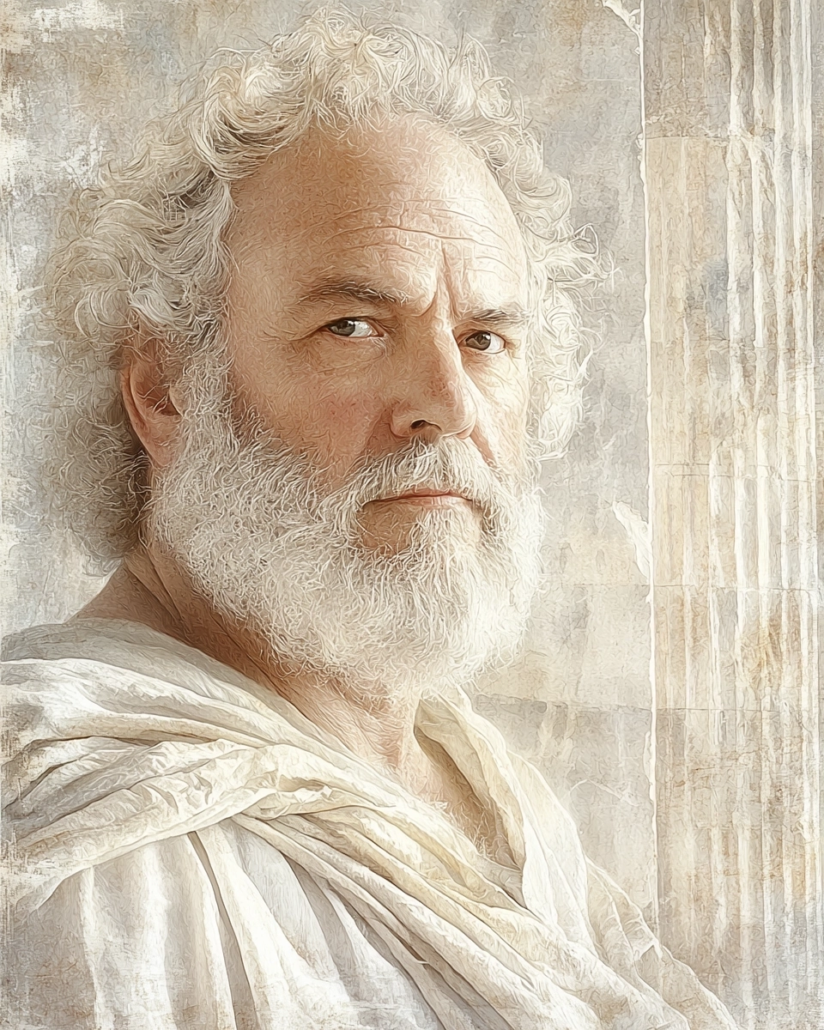
Stylized portrait – Musonius Rufus
Φ ⋮ The cloak that doesn’t flatter
You notice it in the fabric before you grasp it in the sentence. A coarse cloak sits on the shoulder like a small imposition – it warms, but it doesn’t court. It scratches, it reminds, it leaves the body no illusion about comfort. In antiquity this isn’t fashion, but a choice you can see, even when nobody comments on it.
Musonius Rufus fits this cloak because there is nothing about him that demands decoration. His strictness isn’t dramatic, it’s almost craftlike: food, clothing, possessions – everything becomes a kind of touchstone, without turning into a festival of renunciation. It feels almost banal, and that is where the irritation sits. Everyday life isn’t treated as a side issue, but as the place where judgment is trained in the first place.
You can call that dry; sometimes a sentence that offers no warmth is enough.
And above all, this is nature’s work: to bind desire and impulse tightly to what is fitting and useful.
– Musonius Rufus, Fragment 40 (transmitted by Epictetus)
It sounds like bookkeeping and still hits the exact point where pleasure likes to decide what “measure” is.
Anyone who thinks like that is rarely charming in company. You sit at the table, and suddenly the question is no longer what tastes good, but what has measure. Not as a sermon – more as a quiet shift in the line of sight. The cloak keeps scratching, and you understand: this is not a symbol. This is material.
Σ ⋮ Imperial Rome, teaching tone, an ethics without trim
Musonius Rufus belongs to imperial Rome, to the 1st century CE – to that phase in which philosophy in Rome could be both instruction and risk.
He is attested as a teacher; as an “author” in the strict sense, less so. What remains within reach comes as excerpt, as diatribe, as a teaching line at second hand – a voice speaking through filters and still unmistakably itself.
His profile is practical, almost impatient with theory: training before system, virtue as the measure of the good, pleasure as a reliable source of bad priorities.
Alongside that, an edge that can hardly be moderated away: education and the capacity for virtue apply to women and men alike. Not as a gesture toward the times, but as a consequence that simply runs along inside his logic.
And then this surprisingly sober stage: marriage, parenthood, the household. Where one likes to file things as “private,” he places the field of appropriate action. No sweetness, no family idyll. More the idea that attachment is work – and that in this work you find out whether a judgment holds or only shines.
Ξ ⋮ The teacher – and the longing for the beautiful quote
One would prefer a clean scroll, a definitive “text by Musonius.” Instead you get teaching remnants, passed on, sorted, sometimes too smooth. The ideal picture stands neatly groomed on the shelf. The cloak in real life keeps scratching – and works, unpleasantly reliable.
Ξ ⋮ The note in the wallet
In the waiting area of a public office, the chairs stand like a quiet threat: every seat a small contract with your patience. A number crawls across the display and refuses to become yours. Next to you, someone rustles a plastic bag as if that were already an opinion. Nobody is “private,” everyone is function – and still people are slighted, breathing, judging.
Musonius Rufus wouldn’t reach for a grand meaning in a scene like that. He would probably only point to the moment when pleasure – the quick craving for relief, for an exit, for a small triumph – suddenly takes the wheel. Then waiting becomes an attack, silence becomes an insult, a number becomes a ranking. And the inner excuse sounds strikingly modern: one merely reacted.
On the commuter train it’s the same, just louder. The bag presses, the coffee is too hot, the message in the group chat is too loud. A sentence is typed, deleted, typed again. This role-self takes a run-up: competent, composed, unbothered. And somewhere in between lies the movement that makes Musonius’ strictness so irritant: not everything that feels urgent is fitting.
You could simply muscle the day through. Musonius would rather let it count, without turning it solemn.
Won’t you train yourself to be content with what has been given to you?
– Musonius Rufus, Fragment 43 (transmitted by Epictetus)
No comfort promise – more a thin cut through excuses: suddenly you notice how much “urgency” is just habit.
Sometimes what is fitting is almost embarrassingly small: a call you make not out of politeness but out of attachment; giving up the punchline because it would only poison the room; a meal that doesn’t want to be “earned,” it simply suffices.
In such small things lives what, in him, looks more like craft than worldview: Kathēkon
(Appropriate action within a role, without pathos or self-image).
And then the point where he stays disturbingly precise: marriage and parenthood, not as “private life,” but as a test field. A calendar full of appointments turns closeness into logistics. The tone goes factual, loyalty gets counted.
Musonius’ gaze doesn’t shift this toward romance – more toward measure: what is an action worth when it comes only from duty-feel but no longer carries respect. And what is respect when it shows up only as a mannerism.
Σ ⋮ The body as the first log
The body usually starts before the sentence. The chin pushes forward as if it had to defend a boundary.
The hand reaches for the phone even though it’s looking for nothing in particular. A small heat sits at the back of the neck – it doesn’t want to explain, it wants to drive. It’s not a crisis – more a log being written without asking permission.
With Musonius this doesn’t become a psychological drama, more a sober observation: if training comes before theory, then that training begins where the body has already set the tone. Hunger, fatigue, overstimulation – not “excuses,” but not guilt either. They are material, like the coarse cloak. Only this time you wear it under the skin.
A plain moment: the stomach growls, and suddenly every decision turns moral. Food must now be “good,” “earned,” “right.” Pleasure steps forward, politely disguised as a claim. Musonius’ asceticism doesn’t sound like a program here; it sounds like a small unmasking: what gets sold as freedom is often just a reflex that likes to be right.
Or the other variant, more elegant: you are exhausted and become kind. Too kind. The back gives way, the voice goes soft because it can’t carry a quarrel.
And yet there remains some scrap of judgment that notices this friendliness isn’t virtue, but fatigue in a mask. Musonius’ measure stays unpleasant because it doesn’t ask after mood; it asks after load-bearing: does the resolve still hold when the body has strength again.
This kind of training shows itself as delay, not as technique: a breath that doesn’t explain, it only makes room; a look that sees the role before it plays it; a restraint that doesn’t look heroic, but clean. The body stays the resonant surface – and precisely because of that it becomes the place where judgment, assent, and what is fitting get their first chance at all.
Ψ ⋮ Teaching remnants with a sharp edge
Musonius Rufus doesn’t reach us as a book, but as instruction that received its order after the fact. You read a voice that has passed through many hands – Stobaeus, excerpts, fragments – and you notice how quickly you yourself reach for a clean system, just to make the cloak stop scratching at last.
In reception he is gladly called “down to earth,” as if that were a friendly trait. But this everydayness in Musonius is not a sofa – it’s a proving ground.
It shows up where one likes to skip the small: in eating, in possessions, in marriage, in the question of whether education is really a privilege or simply a duty of reason. And the smoother you retell him, the more he sounds like harmless strictness – until you notice he doesn’t treat pleasure as sin, but as very reliable bad counsel.
For Musonius, simplicity isn’t a style; it’s a test.
Sometimes one sentence from the tradition is enough to make that dryness audible – without asking it to serve as proof.
What you can obtain from yourself is needless and foolish to seek from another.
– Musonius Rufus, Fragment 45 (transmitted by Epictetus)
This is not an invitation to self-improvement. It’s more a sober boundary line: teaching without conduct remains décor, conduct without measure remains mood. And right here sits the narrow wit of his effect – that people like to quote him, but dislike inhabiting him.
The quiet countervoice still remains in the room. We read Musonius through filters, and filters have a life of their own: sometimes they amplify the strictness, sometimes they dampen it into a pedagogical tone he probably wouldn’t have needed. Perhaps that is, soberly speaking, the real test: whether one can endure the gaps without turning them into myth.
Ω ⋮ What remains when it goes quiet
After Musonius there is no grand image, more a stance that sits down at the edge of the day. Nothing ceremonial about it.
It looks at the household, at attachments, at the small decisions you like to file as “just” – and treats that “just” like an excuse that works astonishingly often.
When marriage and parenthood appear in him as the field of fitting action, it doesn’t sound like idyll, but like responsibility without stage. Closeness isn’t managed as feeling, but as work you cannot delegate.
And equality in education, in that light, doesn’t feel modern, but consistent: if you take capacity for virtue seriously, you can hardly sort it by sex.
Perhaps that is his quiet contribution to worldliness: that community doesn’t arise from big sentences, but from what you actually carry within your own radius. It begins where Oikeíōsis
(Affiliation with oneself as the start of everyday moral orientation) appears not as a term, but as a felt relation – in the moment you notice an impulse is already on its way, and you don’t also have to give it permission.
And time. Not as pathos, more as a quiet accounting: what you file away as “small” today returns tomorrow as habit, groomed, with ID. Musonius then doesn’t become comfort, but a measure that doesn’t grow softer just because you’re tired.
Measure.
💬 Lesson splinters of the Stoa
Seeker: At the table I reach for the best piece. Afterwards, I feel ashamed.
Musonius Rufus: ✦ The hand was quicker than judgment. When pleasure chooses, virtue is left to clean up.
Seeker: My cloak is rough. People look at me as if I were poor.
Musonius Rufus: ✦ They read cloth like rank. You’re only wearing what doesn’t lie.
Seeker: In the courtyard they say women don’t need learning. I don’t want the quarrel.
Musonius Rufus: ✦ Virtue has no sex. Whoever divides it is only dividing convenience.
Seeker: At the threshold I count what I do for my own. Then it turns bitter.
Musonius Rufus: ✦ When attachment becomes an invoice, the payment is already made: closeness walks out.
≈ stoically reflected after Musonius Rufus and the Stoa · loosely paraphrased
Tests and edge cases in Musonius Rufus
Training that scratches in everyday life
With Musonius, thinking often begins where it turns bodily: with plain food, with rough cloth, with a small refusal that doesn’t look “noble.” The movement is tight and sober – less ecstasy of insight, more everyday life as material.
Profile edge: when simplicity feels like hardness
It’s easy to mistake his demand for plainness as a moral pose – and just as easy to soften it until it only means “live modestly.” The tension sits in between: for him, simplicity isn’t style, but a kind of load test for judgment and pleasure.
Attachment as a test field – without trim
When marriage and parenthood appear in Musonius, it doesn’t sound like private idyll, but like work at measure. Decisions take on the timbre of roles, and suddenly what counts isn’t the good sentence but the carrying power: whether an action carries respect, or only habit.
Inner impulse: pleasure as reliable bad counsel
The impulse often shows up like an argument: the best, the quickest, the most pleasant. Musonius’ tone cuts here not broadly but precisely: what feels urgent can still be poorly grounded. The moment of assent is small – and that is exactly why it betrays.
Open afterglow after reading
Because his voice is transmitted as excerpt and teaching remnant, reading also remains slightly provisional. You don’t get a polished system figure, more a strict practice that makes no effort at charm – and leaves open whether you read that strictness as measure or as imposition.
Stoic profile: Musonius Rufus
Structured research facts.
1. Name and variants
Gaius Musonius Rufus; often shortened: Musonius Rufus; in references often: C. Musonius Rufus. Greek: Γάϊος Μουσώνιος Ῥοῦφος (Musōnios Rhūphos). Origin: Volsinii (Etruria).
2. Life dates & period
Born: approx. 20–30 CE (uncertain). Died: no later than before 101/102 CE (by then he is treated as already deceased).
Period: Roman imperial era (1st century CE), especially from Nero to Vespasian. The biography is only patchily attested; dates therefore vary in parts of the scholarship.
3. Place within the Stoa
Roman or late Stoa (Stoicism of the imperial period). Classified mainly by period, teaching activity in Rome, and transmission as Epictetus’ teacher; no systematic treatises have survived.
4. Historical context & role
Roman philosopher and teacher, likely of equestrian rank; active as a Stoic lecturer in Rome. Political frame: imperial surveillance of philosophical circles, especially under Nero and later Domitian.
Attested stations (with dating uncertainty): teaching in Rome; exile by Nero to Gyaros (65 CE); return under Galba (68 CE); under Vespasian initially tolerated, later exiled again (date uncertain); died before 101/102 CE.
5. Central themes & doctrines
✦ Practice: training before theory.
✦ Virtue: measure of the good; pleasure as a bad adviser.
✦ Askesis: simplicity as training of judgment.
✦ Education: equal capacity for virtue in women and men; education for both.
✦ Marriage: marriage and parenthood as a field of appropriate action.
✦ Everyday life: plainness in food, clothing, possessions as a touchstone.
6. Teachers, students, key relationships
Teacher(s): not securely attested. Students/circle: Epictetus is regarded as his best-known student; further attributions (e.g., Dio Chrysostom) appear in references but are not always clear in detail. Political milieu: contact points with the “Stoic opposition” against Nero are reported; individual episodes depend on the sources.
7. Main works
It is unclear whether Musonius himself wrote for publication. What survives are excerpts from lectures/diatribes: 21 longer excerpts in Stobaeus (basis: a collection by a student named Lucius); further fragments from a second, lost collection (a Pollio is named) as well as quotations in later authors (e.g., Aulus Gellius).
8. Legacy & influence
✦ Teaching tone: formative influence on Epictetus and the style of imperial Stoicism.
✦ Debates: reference point for practice orientation and asceticism in Stoicism.
✦ Themes: rediscovered for women’s education and an ethics of marriage and family.
✦ Reception: often read as “everyday-oriented”; the strictness of simplicity demands is sometimes softened.
9. Attested quotations
Three brief, attestable passages from the tradition (Stobaeus; my translation after Cora E. Lutz). No titles, no paraphrases.
“Philosophy helps only in this way: when right teaching is joined by conduct that agrees with it.”
Musonius Rufus, Diatribe 1 (transmitted by Stobaeus; after Lutz, my translation).
“No one lives well today who does not take the day as if it were the last.”
Musonius Rufus, Fragment 22 (transmitted by Stobaeus; after Lutz, my translation).
“If you measure what is pleasant by pleasure, nothing is more pleasant than self-control; if you measure what is avoidable by pain, nothing is more painful than lack of control.”
Musonius Rufus, Fragment 24 (transmitted by Stobaeus; after Lutz, my translation).
Would you like to explore Musonius Rufus’ inspiring quotes? Check out our collection of stoic quotes by Musonius Rufus.
10. Note on the state of the sources
Musonius is well attested as a teacher figure, but his own textual form remains indirect: what survives is mainly excerpt and fragment transmission through Stobaeus and later citations; reconstructing his profile therefore depends on the selection and filtering of the transmitters.
Editorial portrait by Mario Szepaniak.
Sources
Note
This is an editorial text—not personal, psychological, or medical advice. For individual concerns, see the disclaimer.
Further Stoic Topics – Philosophy, Virtues & Daily Life
Stoically surprised today.