

Π ⋮ Hierocles – circles of closeness
Hierocles stands in the half-light of a papyrus roll, and somewhere between ink and everyday life oikeiosis begins – that strange sense of belonging-to-oneself. No founder, no monument of thought. More like someone who sorts duties like loose change, and turns closeness into a philosophical problem.
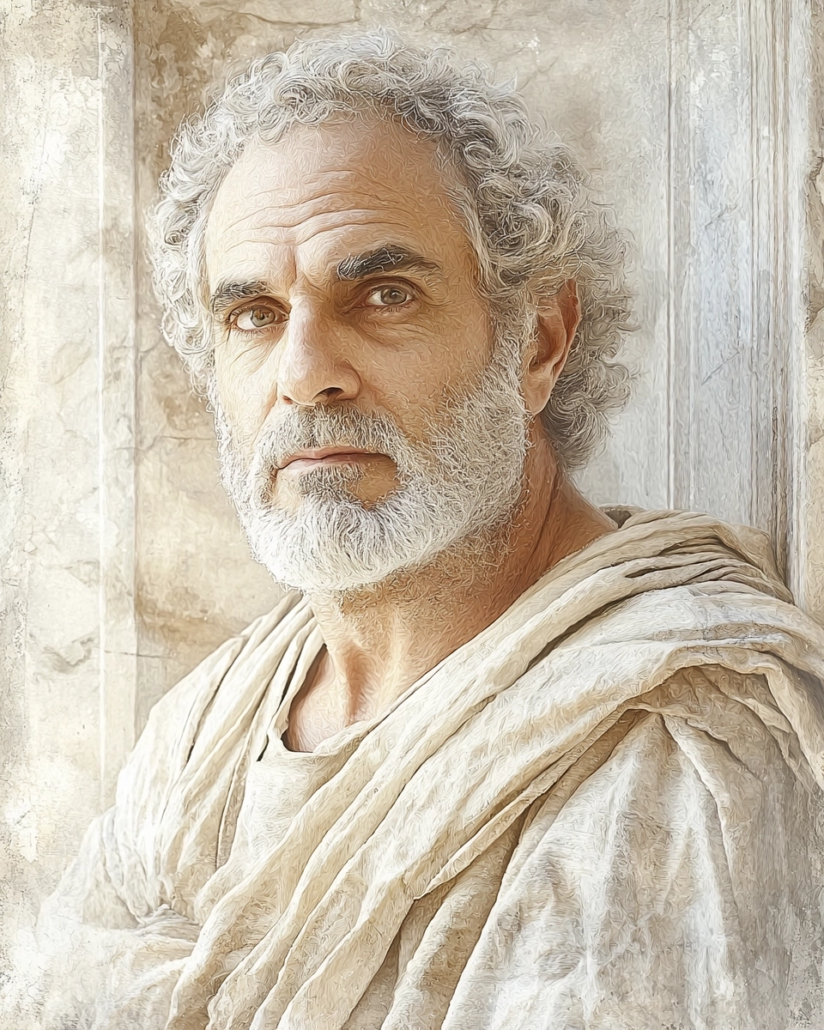
Stylized portrait – Hierocles
Φ ⋮ Papyrus smells like everyday life
A shred of papyrus is not a romantic object. It is brittle, dust sits in the fibers, and it makes that quiet noise when you touch it too boldly – as if it were complaining. That fits: Hierocles is not a philosopher for marble pedestals, more for margins, for scraps, for what remains after the grand lecture has long ended.
You can picture the setting without painting it in: a writing surface, a few strokes, a thought not calculated for effect.
Not the cosmos as fireworks, but the human being as a rather concrete creature who gets up in the morning, owes someone something, misses someone, stands in someone’s way. And somewhere in it the irritating question that doesn’t sound like “meaning,” but like mechanics: How does attachment begin at all – and why does it so rarely end where we would like it to?
The papyrus is the object, but the real anchor is a tone: dry enough not to comfort, precise enough not to turn cynical. Anyone expecting “Stoicism” gets a smell first, a surface, a small discomfort. The rest comes later – once you’re ready to treat closeness not as a feeling, but as a structure.
Σ ⋮ Late ethics, neatly folded
We know remarkably little about Hierocles, and what little we have reads as if it were deliberately sparse: the Roman imperial period, usually placed in the 2nd century CE, often somewhere near the Hadrianic era.
No city map, no anecdotes, no list of students to quote. What remains is not a pose, but the work: ethics, fairly systematic, and for that very reason a bit unmodern – because it doesn’t apologize.
The transmission is fragmentary. A partially preserved treatise readable as the Elements of an ethics – papyrus, not a showpiece volume.
And then excerpts and fragments, above all preserved through Stobaeus. This creates a strange kind of authority: not the kind that gets loud, but the kind that keeps speaking despite gaps. You can hear a late Stoicism that spends less time on grand world-designs than on the question of how a person moves within roles without breaking under them.
In one transmitted sentence, it looks like a sober hand gesture.
The whole human race is by nature made for community; and the first and most basic bond is that of marriage.
Hierocles, Stobaeus, Anthologion (fragment “On Wedlock”) (my translation).
This is no line for a wall plaque, more a hint at how closeness gets built: step by step.
Hierocles starts from the self, not as narcissism but as a point of departure. Living beings perceive themselves – as themselves; from that arises a kind of basic orientation that can become moral.
From there the path doesn’t lead into the private, but into circles: family, household, community, further forms of belonging. Closeness is not simply there; it is graded, sometimes uncomfortable, sometimes downright unpleasant. And yet it is the field in which duties appear – those actions that “fit,” because you are not alone, but someone’s child, someone’s parent, partner, citizen.
It sounds sober – and it is. The measure remains living in accordance with nature – rational, not romantic. No pedagogical warmth, no psychological offer of explanation. More an attempt to survey social space without devaluing it.
If you insist on asking for a network, you get only silence: no reliable names. The work stands on its own – and with it the reminder that philosophy is sometimes strictest precisely where it is most everyday.
Ξ ⋮ A first, small tilt
We like to imagine how a Stoic “teaches” – clear gaze, straight sentences, a room that falls quiet. Hierocles comes differently. He survives as a papyrus remnant and as an excerpt, meaning a supporting role in his own play. Perhaps that is the most fitting form: ethics that doesn’t show off, but remains.
Ξ ⋮ The meeting room as a small cosmos
In the meeting room there’s that smell of carpet, drip coffee, and unresolved responsibilities. The projector hums as if it had an opinion. Someone says “brief,” and the word hangs in the air like a bad promise. Hierocles would not have been a good morale booster. He would probably have just noted that roles take over the tone faster than people do.
They’re micro-tensions that repeat reliably: you want to agree, but not too much. You want to disagree, but with social cushioning. A message in the chat window gets read, three dots appear, vanish, appear again – the digital throat-clearing.
And in the middle of this small drama sits something Stoic, as unassuming as a piece of furniture: the question of what is appropriate, not what happens to feel good.
Here the odd part begins: duties rarely look heroic in the present. They look like deadline pressure, like returning a call, like a polite follow-up, like a sentence that isn’t elegant but fits.
You could call that a Kathēkon (an appropriate action within a role, without pathos) – and the grand seriousness shrinks back down to handbag size. The effect is both unpleasant and oddly calming: the world doesn’t demand shine, it demands a fitting movement.
On the commute it becomes even clearer. The train stalls, the announcement sounds friendly and means the opposite. People wedge themselves into the gaps like arguments nobody wants to hear.
Closeness here is not romance but geometry. The circles that, in Hierocles, radiate from family and community acquire modern variants: the colleague-circle, the service-circle, the comment-section circle. They are forms of belonging you didn’t choose, and that still produce expectations – and that is exactly the material.
Later, between doorway and signal loss, a sentence from the tradition slips in.
According to common usage in names, one should call cousins brothers, uncles fathers, and aunts mothers.
Hierocles, Stobaeus, Anthologion (fragment “How we ought to conduct ourselves towards our kindred”) (my translation).
It fits badly with push notifications – and for that very reason it fits: belonging is not always pleasant, but it is rarely optional.
Σ ⋮ The body signs before the sentence
The body is faster than the stance. Before a thought has even combed itself, the jaw has already clenched. The shoulders climb upward as if they wanted to apologize. The breath goes shallow, without anyone having an opinion about it. You could label it “stress” and be done. It only becomes Stoic when these small signals don’t get a story, but remain surface.
In the seconds before a reaction lies the decisive thing – not as a technique, more as a tiny delay. The glance at an email that smells like reproach. That brief heat behind the ears. The impulse to reply immediately, to clarify immediately, to win immediately.
And then that minimalist in-between, where judgment and assent have not yet fused. No therapeutic interpretation, no heroic silence. Just the sober noticing: the body has already started, but it hasn’t won yet.
Even fatigue takes on a different sound here. Not as a deficit, but as a frame: when the battery is empty, roles feel heavier.
A sentence from the meeting later hangs at the back of the neck like a badly fitting collar. The hands type faster than the thinking can keep up. And suddenly you see how tightly duties and self-preservation stand together – at best without drama, at worst with far too many exclamation points.
Hierocles’ circles then feel less like theory than like muscle memory: inner and outer draw closer or farther apart, depending on what the moment demands.
You leave something alone because it doesn’t fit. You do something because it fits. In between remains a peculiar sobriety that isn’t cold, just incorruptible. The body notices that first: it doesn’t become light, but it stops trying to talk itself into things.
Ψ ⋮ Remainders, reception, and the question of the right tone
Hierocles reaches us not as a voice, but as a form of transmission.
A papyrus that only partly keeps its promise, and excerpts passed along in later collections like an address you don’t want to lose. It does something to the reading: you don’t read “the work,” you read a trace – and you notice how much you yourself long for complete sentences.
The circles, in particular, seem to have a natural knack for reappearing. Not as a trend, more as a practical grid: closeness that is graded; belonging that isn’t just sympathy; roles that don’t wipe off.
And because it sounds so orderly, it becomes too orderly quickly. A later hand passes the text on, a modern hand slots it into a system, and suddenly it looks as if the whole thing were seamless. In reality it’s a neatly folded incompleteness.
Closeness only becomes serious once it turns into duty.
Sometimes a short line from the tradition is enough to make the hardness of this order felt – without “proving” anything.
A living being, once it has received its first perception of itself, at once becomes familiar with itself and its own constitution.
Hierocles, Elements of Ethics (Papyrus 9780) (my translation).
The sentence is unspectacular, almost bureaucratic in its tone. And that’s exactly why it hits: before duty, role, or circle even enters, there is that first familiarity with oneself – as a starting point, not an explanation.
What happens after is the familiar disorder: impressions press in, interpretations shoot ahead, and closeness suddenly becomes the question of who owes what to whom. Hierocles, in such moments, reads less like a comforter than like a registrar: he notes that attachment doesn’t begin with big feelings, but with the way you “have” yourself in the moment.
The quiet counter-voice sits at the table too: perhaps we read more closure into the fragments than they can carry.
Perhaps we like the circles because they calm our present – because order can feel like a substitute for certainty. The state of the sources remains a filter, not just a window. And that, soberly considered, is not a weakness, but the fitting reminder of measure.
Ω ⋮ The circle thins out
If you look for Hierocles’ circles today, you rarely find them where you’d like. They sit in calendars that are too full, in family chats that tip too quickly, in the polite distance of a waiting line.
Community then feels less like an ideal than like a space you move through without entirely letting the measure slip from your hand. And time feels less like a big topic than like what always remains in the end.
Perhaps that is the quiet point of his reception: it arrives not as a monument, but as working material. You have to live with gaps, with late witnesses, with the feeling that the text withdraws the moment you grip it too tightly.
That calls for a kind of Hermēneutikḗ Téchne (an art of reading what’s handed down, soberly and fairly) – not as an academic hobby, more as a stance toward the incomplete.
You take what’s there. You leave what’s missing. And you keep your own eagerness in check when it starts building whole systems again too quickly.
So Hierocles remains a name that doesn’t get loud. An ethicist who doesn’t hand you a biography, but describes a form of closeness that is neither warm nor cold, simply binding. A papyrus remnant that keeps working in the mind because it doesn’t say everything. And perhaps that is the most matter-of-fact kind of after-sound.
Belonging
💬 Stoic shards of teaching
Seeker: He doesn’t return my greeting, though I greeted him. Should I ignore him from now on?
Hierocles: ✦ You are not his echo. Do what fits, not the counter-feeling.
Seeker: At the market my friend praises everyone but me. It makes me small.
Hierocles: ✦ He stands in his circle. Don’t pull him – pull your judgment closer to you.
Seeker: By the well my breathing trembles before anything even happens. Why does it begin so early?
Hierocles: ✦ You already noticed yourself. The trembling is there; the meaning comes afterward.
Seeker: On the road I want to put everything in order, or it falls apart. I hold on until it hurts.
Hierocles: ✦ Put your share in order. The wind orders the rest.
≈ stoically reflected after Hierocles Rufus and the Stoa · loosely paraphrased
Touchstones in Hierocles
Closeness as order, not mood
In Hierocles, belonging doesn’t show up as a warm feeling, but as a kind of quiet floor plan. If you move within a circle, you’re not simply “good” or “bad”; you stand somewhere – and that somewhere has consequences, even when nobody says them out loud.
The profile edge: when circles smell like rank
The circle model looks friendly at first glance, almost sociable. Then you notice that gradation also means: nearer and farther, more important and less important, first and later. The tension appears where you’d like equality as comfort, and Hierocles instead hears fit.
Deciding without a backdrop
In a family, in a small group, before a quiet expectation – suddenly an action is no longer free-floating. Hierocles then sounds like a narrow measure: what fits the bond that already exists, without turning it into a stage.
The inner stir and the moment of interpretation
An impulse jumps ahead, a slight follows, impatience clears its throat. In Hierocles the decisive moment isn’t the big feeling, but the small placing: whether you grant an impression meaning at once, or leave it standing as an impression for the time being.
After-sound: what sticks to the remnants
Because Hierocles reaches us as fragment and excerpt, the reading itself stays in a kind of suspension. You don’t get a closed figure, more a movement of thought that rubs against closeness and duty – and leaves open whether order here is reassurance or imposition.
Stoic profile: Hierocles
Structured research facts.
1. Name and variants
Latin: Hierocles (also: “Hierocles the Stoic”). Greek: Ἱεροκλῆς. English: Hierocles. Not identical with Hierocles of Alexandria (Neoplatonist).
2. Dates & period
Dating uncertain. Commonly placed in the 2nd century CE – often in the time of Hadrian (117 – 138) or the early imperial period.
3. Place within Stoicism
Late, imperial Stoicism: the surviving texts treat Stoic ethics and psychology in a systematic form.
4. Historical context & role
Biographical details are hardly graspable. Secure above all is his profile as an ethics teacher and author, who orders duties in family, household, and civic life with precision.
5. Core themes & teachings
✦ Oikeiosis: belonging-to-oneself as the starting point of moral orientation.
✦ Self-perception: animals and humans perceive themselves “as themselves” – a basis for practical ethics.
✦ Duties: kathēkonta as role ethics (child, parent, marriage, citizen).
✦ Circles: concentric forms of belonging and “drawing them inward.”
✦ Nature: the measure is what accords with nature in rational living.
6. Teachers, students, key relationships
No reliable names are transmitted. Influence is primarily textual-historical (preservation in anthologies, modern editions), not through a well-known network of students.
7. Major works
Elements of Ethics (papyrus, only partially preserved) and fragments/excerpts from a work on duties (often referred to as On Duties), transmitted mainly in Stobaeus (5th century CE).
8. Reception & influence
✦ Transmission: Stobaeus preserves key fragments that would otherwise be lost.
✦ Cosmopolis: the circles model is a leading example of Stoic social ethics and cosmopolitanism.
✦ Edition: Ramelli/Konstan make the texts accessible with translation and commentary for scholarship.
9. Attested quotations
Three short quotations (max. ~20–25 words), each with source/transmission (no modern paraphrases).
“It is the task of the well-ordered person to draw the circles toward the center.”
Hierocles in Stobaeus, Anthologion 4.84.23; tr. after Konstan, my translation.
“Our fatherland is, as it were, a second god, our first and greatest parent.”
Hierocles in Stobaeus, fragment “On the Fatherland”; tr. after Taylor (1822), my translation.
“Our parents are, so to speak, second and earthly gods.”
Hierocles in Stobaeus, fragment “On Parents”; tr. after Taylor (1822), my translation.
Would you like to explore Hierocles’ inspiring quotes? Check out our collection of stoic quotes by Hierocles.
10. Comment on the state of the sources
The sources are fragmentary: dates are uncertain, much is lost. What holds are papyrus remains and later excerpts (esp. Stobaeus), which is why reconstructions stay cautious.
Editorial portrait by Mario Szepaniak.
Sources & further reading
- Stanford Encyclopedia of Philosophy – Stoicism
- Internet Encyclopedia of Philosophy – Stoicism
- Routledge Encyclopedia of Philosophy – Hierocles (2nd century AD)
- Society of Biblical Literature – Hierocles the Stoic (Ramelli/Konstan)
- Cambridge Core – The Classical Review: review of Hierocles
- Oxford Reference – Hierocles
Note
This is an editorial text—not personal, psychological, or medical advice. For individual concerns, see the disclaimer.
Further Stoic Topics – Philosophy, Virtues & Daily Life
Stoically surprised today.