

Ξ ⋮ Gaius Blossius: The Dangerous Friend
Gaius Blossius stands at that narrow place where Kathēkon (situationally fitting duty in rational action) begins to smell political. A philosopher from Cumae, close to Tiberius Gracchus, later with Aristonicus — not a statue, more a shadow with a clean knife in its pocket.
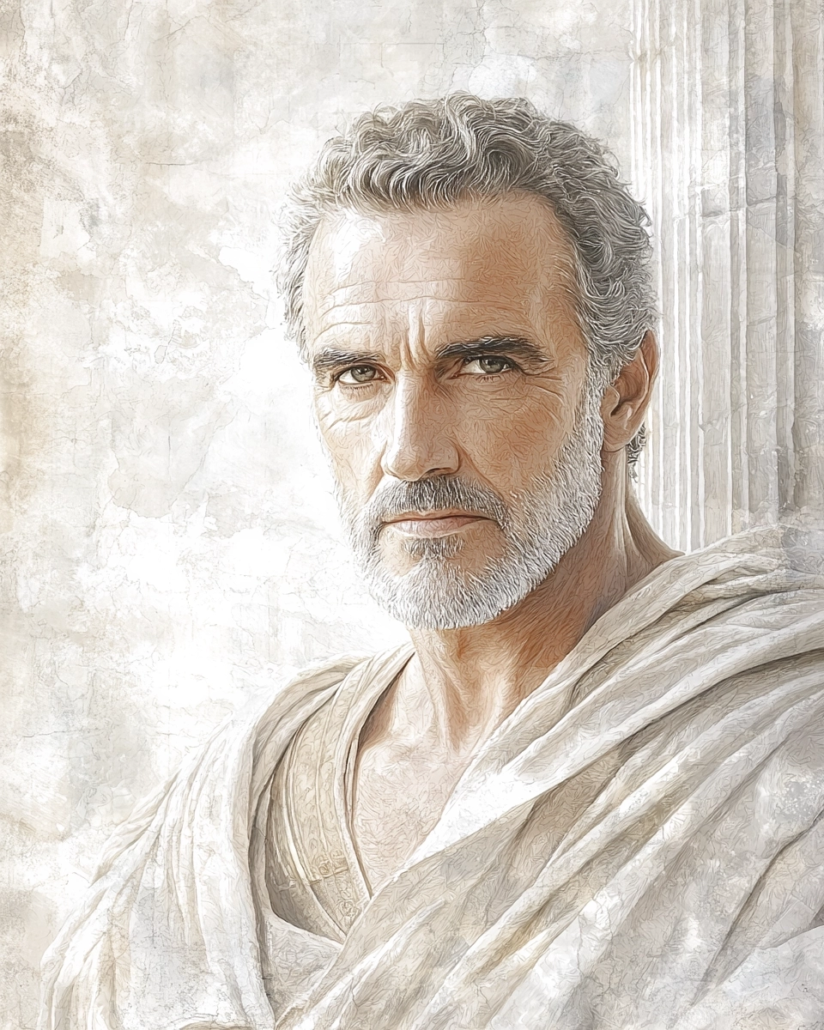
Stylized portrait – Gaius Blossius
Δ ⋮ A Hand at the Edge of the Matter
At first, one does not see a school in Gaius Blossius, but a closeness. Not the ceremonial closeness of a portrait, rather the uncomfortable closeness of a man who stands beside a political decision and does not step out of the frame in time. Cumae remains in the background, Rome presses forward; between them lies a hand that does not write, but holds.
The concrete anchor remains his friendship with Tiberius Gracchus. It makes Blossius visible, but not transparent. He does not appear as a great system builder, not as a founder, not as a teacher with a neatly sorted legacy. He stands at an edge where loyalty acts like judgment and judgment like loyalty. This is not a pleasant place for philosophy; it smells of voting, risk, and the fatigue of later judges.
When loyalty turns political, duty no longer separates cleanly from what a friend asks.
Gaius Blossius, adaptation (drawn in sense from attested teachings, not transmitted verbatim)
The sentence remains narrow and heavy. It is not well suited to ornament, because it immediately damages what one would like to keep clean: the wise person here, politics there, and between them a friendly moral pane of glass. Blossius stands precisely where that pane is missing.
Λ ⋮ Stoic Sobriety under Political Pressure
Historically, Blossius belongs to the late Roman Republic and to a Hellenistic-Roman reform context that was not a philosophical stage, but a room crowded with bodies. His active period can be grasped only narrowly, uncertainly, and indirectly. Precisely this scarcity does not make the profile empty, but brittle: a philosopher preserved almost entirely through reports by others.
His placement in the Middle Stoa (Hellenistic school phase between Zeno and the Roman imperial period) remains tied to school proximity, chronology, and profile. Antipater of Tarsus stands in the background as a Stoic reference point; Tiberius Gracchus and later Aristonicus draw the visible outline into political tension.
Blossius therefore appears less as the thinker of a closed system than as a figure through whom one can test how far a teaching reaches when the street narrows. His Stoic relevance lies precisely there: not in the work, but in the serious case of a posture that becomes publicly consequential.
The transmitted themes are accordingly spare: duty, justice, friendship, equality, transmission. None of them appears in him as a calm inscription on a tablet. Parrhēsía (frank speech under social or political risk) lies close at hand, without needing to be turned into a pose. The tone remains harder: loyalty does not become warm merely because it is described philosophically.
Blossius is therefore no comfortable proof text for the Stoa. He shows, rather, its open seam. Whoever turns him into a martyr of reason smooths too much; whoever reads him only as a dangerous adviser omits the intellectual surroundings. Between the two, a figure remains standing, one the sources do not explain but interrogate.
Π ⋮ Where the Ideal Does Not Stay Clean
The ideal image of the Stoic loves clear contours. Blossius throws dust on it. He is secured not through works, but through friction: friend, philosopher, political shadow. Precisely for that reason he does not seem smaller. Only harder to frame.
Ξ ⋮ The Sentence That Stands Too Close
In the present, Blossius does not show himself where someone speaks grandly about bearing. Rather, he appears in that narrow tone that arises when a sentence can no longer detach itself comfortably from its consequence.
A meeting ends, a message stays in the draft window, an objection is already on the tongue and still does not get a dramatic entrance. Not silence as flight; rather, language seeing its own imprint on the table.
One recognizes such moments in small shifts. “That was not my decision” becomes “I was involved.” “Someone should” becomes a dry “something remains open here.” From the large explanation, a subordinate clause falls out and carries more than the main noun. The posture lies not in noble vocabulary, but in the weight of assignment: what belongs to me, what belongs only to the noise around me, and where begins that closeness which later no one will call accidental anymore.
Where language touches involvement, evasion quickly becomes louder than a clear word.
Gaius Blossius, adaptation (drawn in sense from attested teachings, not transmitted verbatim)
Blossius is not useful here as a model. Precisely that keeps him useful. He makes visible how language under pressure loses its safe rooms. Friendship then does not sound warm, duty not clean, justice not decorative. Even a factual sentence can suddenly stand at the edge where loyalty acts like judgment and judgment like loyalty. In such cases, grammar unfortunately has no ethics department of its own.
Σ ⋮ Formulations with Dust at the Edge
Language does not always carry by clarity. Sometimes it carries because it does not conceal an impurity. An afterthought can be more honest than the thesis before it. A broken-off sentence can mark more precisely where the matter no longer goes smoothly over the lips. In Blossius, this open seam remains palpable: not as biographical ornament, but as a problem of form. Whoever stands too close to a decision speaks differently.
Stoic practice in such linguistic situations becomes less a method than a weighting. The question is not whether a formulation sounds strong. It becomes reliable when it evades less. A sentence with Synkatáthesis (assent of judgment to an impression) carries a different pressure than an elegant formula of distance. It does not merely say something about the situation. It lets one see where a judgment has entered and no longer merely waits at the door.
In this, the threads return: the hand at the edge of the matter, the missing pane of glass, the dust on the ideal image. Present-day language knows these places very well. It shows itself in official emails, in minutes, in private replies that are too polite to be harmless.
There, something sorts itself before it becomes a concept. One word moves closer, another is omitted, a third remains standing like a chair after a meeting hastily left behind.
In this reading, Blossius does not appear as a figure for answers. He remains, rather, a test of form: how much closeness a sentence can endure without beautifying itself. That sounds smaller than morality. It is only harder to fake.
Ψ ⋮ What Remains of a Closeness
Blossius does not work through a book one could open. He works through a tear in transmission. Precisely where the sources grow sparse, something appears that is unusable for convenient portraits: a closeness that is later examined, accused, narrated, and turned into an example. The friend no longer stands beside the friend. He stands before an afterworld that makes a case out of closeness.
This effect is narrow, but durable. It runs through Gracchus, through the question of political friendship, through Cicero’s boundary between personal attachment and public duty, through the later connection with Aristonicus. There it also touches the question of whether justice means only order or a different distribution of what is shared.
None of this gives Blossius a smooth shape. Transmission lays different weights upon him. At one moment philosopher, at another adviser, at another dangerous witness to the fact that thought loses its purity as soon as it remains beside a decision.
A transmitted closeness is no proof; it only shows where later judgments begin.
Gaius Blossius, adaptation (drawn in sense from attested teachings, not transmitted verbatim)
The sentence explains little. It merely draws a line, and that line is not straight. In it lies no heroic clarity, rather a hard piece of Syneídēsis (accompanying awareness of responsibility and inner examination). Not as relief, not as a celebration of loyalty. Rather as a place where language notices that it must pay for its own attachments.
The state of the sources sharpens this unrest. No writings of his own, no ordered body of teaching, no quiet legacy. Blossius remains a figure from the reports of others. That does not make him arbitrary. It makes him dependent on viewpoints that are themselves not innocent. The dust on the ideal image therefore does not come only from him. Transmission has hands, too.
Ω ⋮ An Open Edge in Memory
At the end, Blossius does not offer closure, rather an edge. His afterlife does not move like a broad current, but like a dark trace on pale stone: visible because it disturbs. The Gracchan period, political friendship, the later memory of Aristonicus — all of it remains close enough not to let the name disappear, and distant enough not to possess it securely.
Perhaps that is the true unrest of this profile. Blossius cannot be cleanly used as an example of Stoic steadfastness, but neither can he be comfortably set aside as a cautionary error. He remains suspended between registers: school and street, judgment and attachment, transmission and silence. A person known almost entirely through other people’s sentences can still have a peculiar presence. Not because the gaps are filled. But because they refuse to become decorative.
So the figure remains open. Not soft, not reconciled. More like a place after an assembly, where marks still lie in the dust and no one quite wants to say which step was decisive. Gaius Blossius does not entirely vanish from that surface. He stands where thought and closeness touch one another — and language briefly hesitates before finding a name for it.
💬 Teaching Fragments of the Stoa
Traveler: How can one tell that a sentence stands too close to a matter?
Panaetius of Rhodes: ✦ It gets shorter, and suddenly everyone listens more closely.
Traveler: What remains of a friendship when others examine it later?
Panaetius of Rhodes: ✦ Usually less warmth, but more paper.
Traveler: Why does silence sometimes seem more honest than a good explanation?
Panaetius of Rhodes: ✦ Because some explanations only spread the dust more neatly.
Traveler: Can one escape judgment after standing at the edge?
Panaetius of Rhodes: ✦ The edge is often declared the center later.
≈ Stoically reflected and inspired by Panaetius of Rhodes and the Stoa
❔ FAQ
Question: Was Blossius simply a political adviser?
Answer: That reduction is too narrow. What is transmitted above all is a closeness to political action, not an office, a program, or a securely attested plan from his own hand.
Question: Does his loyalty mean blind obedience?
Answer: The sources show a difficult attachment rather than simple submission. That is precisely why the case remains delicate: friendship, judgment, and duty cannot be cleanly pulled apart.
Question: What is the difference between closeness and guilt?
Answer: Closeness describes an attested connection; guilt requires more. With Blossius, what matters is that later transmission examines this closeness without turning it into a fully secure inner view.
Question: How does such closeness show itself in language today?
Answer: Often in small shifts: someone involved speaks more carefully, more briefly, or more exactly. Not every sober phrase is evasion; sometimes only the noise loses weight.
Question: Can Blossius be read as a model?
Answer: He is hardly suitable as a smooth model. More durable is the cautious reading of him as a border figure, one who shows how difficult bearing becomes once it touches consequences.
Stoic Profile: Gaius Blossius
Structured research facts.
1. Name and variants
Latin: Gaius Blossius, also Caius Blossius; abbreviated C. Blossius. In Valerius Maximus, the form C. Blossius Cumanus appears. The Greek form Βλόσσιος ὁ Κυμαῖος is attested in Plutarch. In English, Blossius of Cumae is customary.
2. Dates & period
Year of birth unknown; his active period certainly falls around 133 to c. 129 BCE. His death is reported after the defeat of Aristonicus and is usually placed around c. 129 BCE, but the exact date remains uncertain. Historically, he belongs to the late Roman Republic and to the Hellenistic-Roman reform context of the Gracchan period.
3. Place within the Stoa
Blossius is to be placed as a Stoically trained philosopher in the environment of the Middle Stoa. The basis for this is chiefly his connection with Antipater of Tarsus and the political-ethical role that ancient and modern sources ascribe to him in the circle of Tiberius Gracchus.
4. Historical context & role
Blossius came from Cumae in Campania and is not attested as a Roman officeholder, but as a philosopher, adviser, and friend of Tiberius Gracchus. Plutarch names him together with the rhetorician Diophanes as one of those to whom later authors attributed instigation or influence regarding Tiberius’s agrarian policy.
After the killing of Tiberius in 133 BCE, Blossius was brought before the consuls, declared his loyalty to Tiberius, and, according to Plutarch, was released. Later he went to Asia to Aristonicus; after Aristonicus’s defeat, he is said to have killed himself.
5. Central themes & teachings
✦ Duty: His transmitted posture links personal loyalty with political action.
✦ Justice: Scholarship places his role in the context of the Gracchan agrarian reform.
✦ Friendship: Cicero and Valerius Maximus treat him as a borderline case of political friendship.
✦ Equality: The later connection with Aristonicus is linked to the Heliopolis movement and ideas of social equality.
✦ Transmission: No teachings of his own survive; the profile arises from external testimonies.
6. Teachers, students, important relationships
Antipater of Tarsus is attested as a major Stoic reference figure; Plutarch describes Blossius as his close confidant in Rome and mentions philosophical writings by Antipater dedicated to Blossius. Tiberius Gracchus was his most important political relationship. Diophanes of Mytilene appears as another intellectual influence in the Gracchan environment. Students of Blossius are not securely attested.
7. Principal works
No works of Blossius himself survive, and no secure titles are attested. The only work-related report concerns not a work by Blossius himself, but philosophical writings by Antipater of Tarsus that, according to Plutarch, were dedicated to Blossius.
8. Afterlife & influence
✦ Gracchi: His memory remained closely tied to the reform politics of Tiberius Gracchus.
✦ Cicero: In De amicitia he serves as an example of the problematic boundary between friendship and duty to the state.
✦ Scholarship: Modern studies discuss him as a rare case of a politically active Stoic in the Republic.
✦ Aristonicus: His later flight to Asia connects him with the anti-Roman movement around Aristonicus.
9. Adaptations / Core thoughts
✦ Who goes with a cause is not untouched by its outcome.
✦ Friendship carries more weight when it does not remain merely private.
✦ Even without a work of one’s own, a person can leave an uncomfortable question.
✦ Justice becomes harder once it must pass through concrete decisions.
✦ What others transmit does not only preserve; it also sets accents.
✦ Some names remain because they do not allow easy classification.
Brief condensations drawn from attested teachings – not transmitted verbatim. Editorial: Stay-Stoic.
10. Comment on the state of the sources
The source situation is fragmentary: Blossius is accessible almost only through later reports in Cicero, Valerius Maximus, and Plutarch, as well as through modern reconstructions of the Gracchan period. Writings of his own, a closed doctrinal system, and secure personal dates are lacking.
Sources
- Cambridge Core – Taxing Wealth in the Just City: Cicero and the Roman Census
- Cambridge Core – Magnanimitas and the Cornelian Inheritance: A Study of Political Morality
- Encyclopaedia Britannica – Tiberius Sempronius Gracchus
- Encyclopaedia Britannica – Hellenistic Age: The coming of Rome, 225–133
- LacusCurtius – Plutarch, Life of Tiberius Gracchus
- Wikipedia (EN) – Gaius Blossius
Note
This post is an editorial text — not personal, psychological, or medical advice. For individual questions, see the disclaimer.
Stoically surprised today.