
Stay-Stoic
  • 🏛️
  • New Posts
  • Philosophy
    • Stoic foundations
    • Four cardinal virtues
      • Stoic wisdom
      • Stoic justice
      • Stoic courage
      • Stoic moderation
    • Stoicism Today
    • Stoic practices
    • Stoic Topics
  • Inspiration
    • Stoic philosophers
    • Stoic wisdoms
    • Stoic quotes
    • Symbolism & Symbols
    • Stoic Glossary
    • About Stay-Stoic
  • German
  • Click to open the search input field Click to open the search input field Search
  • Menu Menu
  • Link to X
  • Link to Instagram
  • Link to Pinterest
You are here: Home1 / Great Philosophers of Stoicism 🌟2 / Arius Didymus: Life and Stoic Wisdom 🌟
Stoicism: Wisdom and virtues such as tranquility, inspiration, and quotes from the Stoa, presented on Stay-Stoic.

Arius Didymus: A Stoic Philosopher’s Legacy 🌟

Life and Stoic Wisdom

Arius Didymus (born c. 1st century BCE – died c. 1st century CE) was a renowned Stoic philosopher and close advisor to Emperor Augustus. Known for his profound insights into ethics and politics, Arius Didymus emphasized virtue and rationality as essential to human flourishing and deeply influenced Roman leadership with his Stoic ideals.
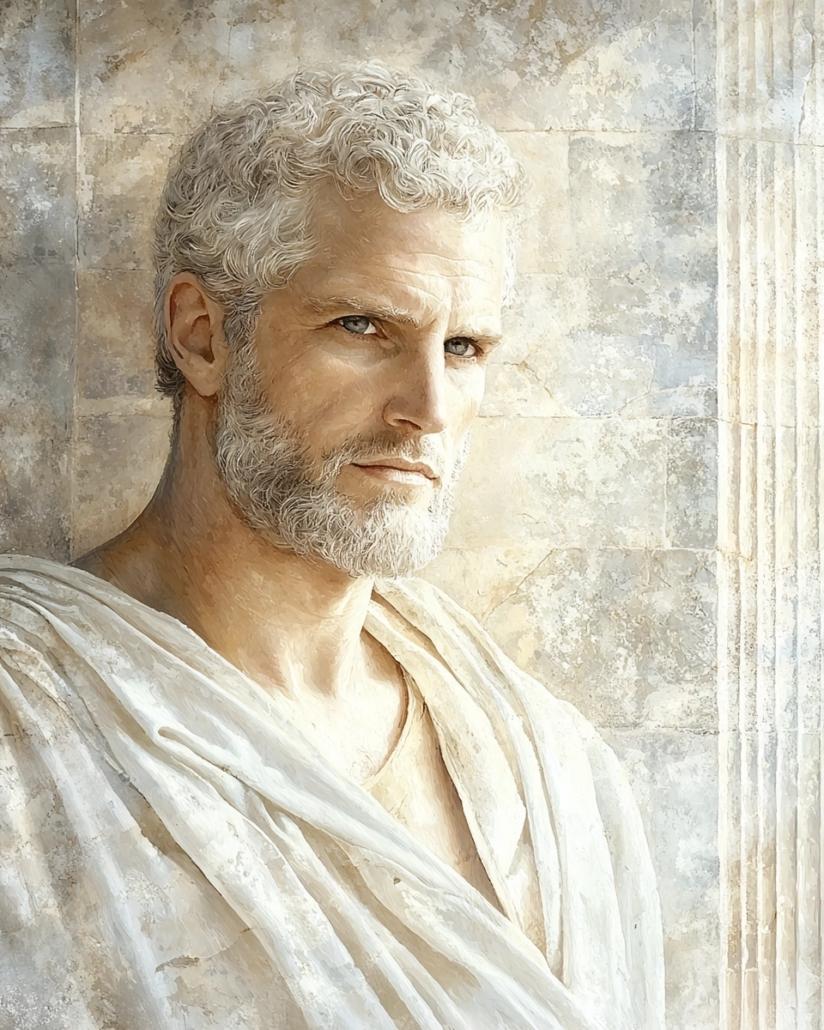
Stylized depiction of Arius Didymus, a Stoic philosopher and advisor to Augustus, known for his teachings on virtue and his role in politics. His legacy emphasizes cardinal virtues like wisdom and justice and inspires with quotes on moral leadership and the integration of philosophy into statecraft.

Historical Context and Influence

Arius Didymus worked in both Alexandria and Rome, where he became a trusted advisor to Augustus. His Stoic teachings on self-discipline, virtue, and reason provided Augustus with philosophical guidance on ethical governance. Arius was a proponent of Middle Stoicism, integrating Stoic principles with practical political wisdom to shape a stable Roman Empire. Deepen: Wikipedia

Why Are His Teachings So Valuable Today?

Arius Didymus’s focus on inner control and ethical behavior remains relevant for modern readers. His philosophy offers a timeless approach to achieving clarity, inner peace, and resilience in a fast-paced world. Arius’s principles encourage people to cultivate a sense of inner calm amid challenges, much like the wisdom found in Stoicism Today.

Key Teachings

Arius Didymus’s teachings emphasized core Stoic beliefs that shaped his influence in Roman society:

  • Virtue as the Highest Good: He held that virtue, integrity, justice, and wisdom, were essential to a meaningful life.
  • Self-Control: Arius taught that self-control over one’s desires and emotions is crucial to true freedom and inner strength.
  • Rational Thought: In advising Augustus, Arius encouraged rational decision-making grounded in the Stoic belief that reason aligns us with nature.

Legacy

  • “Arius Didymus inspired not only Augustus but also later thinkers in Roman philosophy and governance.”
  • “His commitment to rational and virtuous leadership left an enduring mark on Stoicism.”
  • “Through his teachings, Arius’s ideas continue to impact both ancient and modern ethical thought.”

Cardinal Virtues Embodied by the Philosopher

  • “Wisdom – He applied deep understanding to advise a leader on just governance.”
  • “Justice – Arius emphasized fairness and the importance of ethical rulership.”
  • “Courage – Advocated for upholding virtue, even in challenging political times.”
  • “Temperance – Modeled self-discipline, teaching restraint and moderation.”

Quotes attributed to him

“True power is found in self-restraint and virtue, not in dominion.”

“A wise leader is one who rules first over himself.”

“The greatest service to the world is to live virtuously.”

More: Stoic quotes

Continue your stoic journey: Discover the wisdom of Apollodorus of Seleucia.

Stoic Principles & Inspirations

  • Shop for Stoicism Enthusiasts
  • Recommended Books on Stoic Philosophy
  • The Four Cardinal Virtues
  • Notable Representatives of Stoic Philosophy
Back to the content:
I Arius Didymus: A Stoic Philosopher’s Legacy 🌟
II Life and Stoic Wisdom
III Historical Context and Influence
IV Why Are His Teachings So Valuable Today?
V Key Teachings
VI Legacy
VII Cardinal Virtues Embodied by the Philosopher
VIII Quotes attributed to him
IX Stoic Principles & Inspirations
  • Share on Facebook
  • Share on X
  • Share on WhatsApp
  • Share on Pinterest
  • Share on LinkedIn
  • Share on Tumblr
  • Share on Reddit
  • Link to Instagram
Search Search

Latest articles

  • Symbolic article image on Sun Tzu in everyday life, orientation instead of control, and reality as shifting terrain
    Φ ⋮ Sun Tzu in Everyday Life: Orientation, Not Controlby: Stay-Stoic
  • Atmospheric hero image for equanimity, unagitated sovereignty, and quiet presence in a culture of visible agitation
    Φ ⋮ Equanimity in an Age of Constant Agitationby: Stay-Stoic
  • Symbolic image about inner interpretation, cognitive bias, and how small events continue unfolding in the mind.
    Φ ⋮ When Interpretation Turns Events Into Storiesby: Stay-Stoic
  • Conceptual image about self-presentation, visibility, and the quiet exhaustion of constant readability.
    Φ ⋮ Self-Presentation and the Fatigue of Showingby: Stay-Stoic
  • Aging as maturity and life review, focusing on experience, inner clarity, and the yield of lived life
    Φ ⋮ Aging as the Harvest Time of Lifeby: Stay-Stoic

Legal information

· Disclaimer

· Copyright & Protection

· Data privacy statement

· Imprint

Stay-Stoic

· About Stay-Stoic

· Author Profile

· Contact

· Support

· Recommend

Stoic Reflections

· Symbolism & Symbols

· Stoic Affirmations

· Tenets of the Stoa

· The Stoic Signpost

Stores & Reading

· Store for Stoics

· Stoic Literature

· Stoic Glossary

· Read a random article

Copyright by Stay-Stoic | All Rights Reserved
  • Link to X
  • Link to Instagram
  • Link to Pinterest
Scroll to top Scroll to top Scroll to top