

Ξ ⋮ Antipater of Tarsus, or the Courtesy of Severity
Antipater of Tarsus enters the frame early with the Stoic concept of duty, though not polished to a shine, rather with a slight abrasion in the fabric. With him, reason does not feel like consolation, more like a well-lit room in which even small evasions suddenly look very busy.
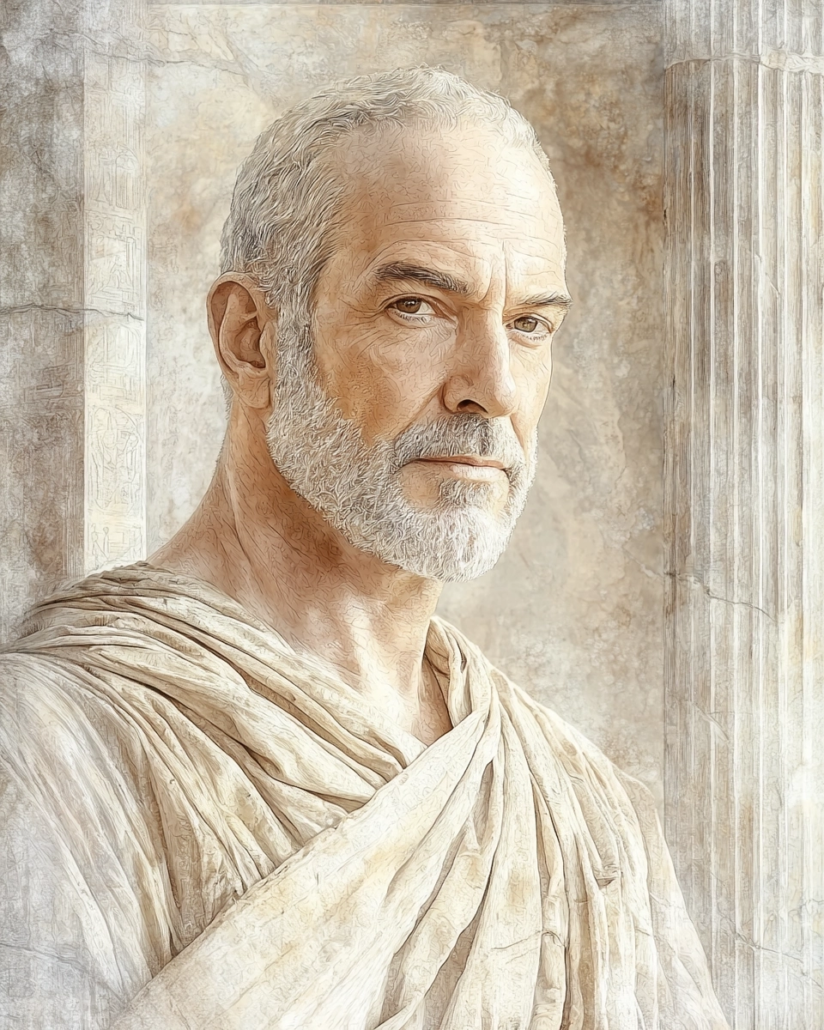
Stylized portrait – Antipater of Tarsus
Δ ⋮ A Bright Room, a Wax Tablet
You do not see a statue, more a wax tablet on a table, the wax smoothed flat, the surface still warm enough for a correction. Antipater of Tarsus has something peculiar in such inward rooms: no grand pose, no philosophical stage fog, but the quiet unfriendliness of a light that flatters nothing. It is the kind of brightness in which an objection does not seem dramatic, only disagreeably precise.
What serves advantage looks narrower once the whole matter begins to speak.
Antipater of Tarsus, adaptation (drawn from attested teachings, not literally preserved)
Λ ⋮ A School Without Comfort
Antipater belongs to the Middle Stoa, that is, to the phase in which the school no longer lives off the pathos of foundation and has not yet dissolved into later familiarity. He stands after Chrysippus and after Diogenes of Babylon, whose student he was and whom he succeeded as head of the Stoa. That transition itself has something instructive about it without becoming didactic: the school remains the same, but the tone tilts slightly. You still hear the old order, only drier now, a little more alert.
His themes are recognizably Stoic and not entirely comfortable. In ethical test cases he tightens the screw more than his teacher did; in matters of sale, debt, or advantage, disclosure is for him not a decorative virtue but part of the thing itself. Then come divination, providence, and theology — precisely those fields from which modern composure likes to step back a pace and smile with adult self-assurance. Antipater does not grant that favor. He defends divine order, takes religious practice seriously as philosophy, and at the same time opens the Stoa more distinctly to Platonic points of contact. Even his positive estimate of marriage and household life feels unsentimental, more like a sober willingness to let order count where others would rather make an impression with provocative freedom.
Perhaps that is where his real profile lies as well: not the inventor of a new stage, but the custodian of a demanding temperature. The fitting term would be Kathēkon (what is situationally fitting within rational Stoic action). In Antipater, that fittingness does not sound mild. It sounds as if someone had opened the window.
Π ⋮ A Small Departure from Philosophical Comfort
The tradition has not treated him lavishly. Of some thinkers, anecdotes remain; of others, entire books. Of Antipater, what remains strikingly often is the moment in which things become a bit more uncomfortable for everyone involved. That too is a form of afterlife — not glamorous, but properly ventilated.
Ξ ⋮ What a Sentence Carries with It
Today one probably would not recognize Antipater by watching him win a debate. More by the way a sentence is built before it enters the room. Someone says, “That may have been phrased misleadingly,” and all at once the matter itself stands a little farther away, groomed, wearing a fresh tie. Or: “That wasn’t what I meant” — a handsome after-clause that buffs the intention and treats the wording as an unfortunate incident. In such small remodelings, one sees the sort of severity that does not raise its voice in Antipater. It sits in the relation between what is said and what a sentence quietly slides out of the light.
A sentence turns disagreeable when its courtesy conceals more than its content.
Antipater of Tarsus, adaptation (drawn from attested teachings, not literally preserved)
Antipater’s present-day presence would probably lie not in forceful formulas, but in a certain reluctance to treat such shifts as neutral. Not every addition is deception, certainly. But some sentences behave as though they had nothing to do with their result. The Stoic appeal here lies not in moral harshness, but in formal awareness. Parrhēsía (frank speech with risk and inward straightness) would almost be too grand for that, almost too solemn; and yet something of it already appears in the small decision not to upholster a matter in courtesy fabric. A sober sentence can be disagreeable. Still, afterward everything at least stands where it actually stands.
Σ ⋮ The Tone Before the Statement
What is interesting, really, is that a sentence is often decided before its content is fully lying there. Not in thought, more in cadence. A word is tacked on, a verb softened, a subject diluted out of caution, and already responsibility sounds like weather. No one has lied; the room has merely been rearranged a little. Precisely here Antipater would feel disagreeably modern. For his kind of disclosure begins not only with major wrongdoing, but at the point where formulations discreetly outsource their consequences.
The quieter cases fall under this as well. One can create closeness by drawing something softly: “We all need to take a look at that.” One can build distance by neutralizing the sentence: “Some unfavorable dynamics emerged.” Such formulations sound civilized, sometimes even smart. Yet they do not always carry the weight they produce. Between intention and statement there remains a small gap, neatly crafted, technically impeccable. Antipater would probably not have made cultural criticism out of that gap. He would sooner have insisted that a sentence ought to be not merely polite, but durable — bright enough to endure its own after-clause.
And perhaps his present-day aftersound lies exactly there: not in a heroic language, but in one that dispenses with decorative excuses. No brutal directness, no cultivated asceticism of speech, only a certain aversion to convenient evaporation. In the end it is an unspectacular demand. But it changes the tone. A room with the window open remains the same room; you simply hear, all at once, what was actually said in it.
Ψ ⋮ What Remains of the Severity
Antipater of Tarsus has an odd afterlife, precisely because he does not spread himself broadly before us. Of some thinkers, a face remains; of others, an entire stock of well-ordered books. Of him, what remains is more a temperature. One remembers no grand gesture, but a standard under which formulations suddenly look less innocent. There is something dry about that. Perhaps something fair as well. And it explains why his influence is felt more in habits of thought than in a representative performance.
His transmitted sentences and attributions contribute to that, but they do not arrive on a red carpet. They stand there like narrow doorframes: brief, practical, undecorated. Even the more famous ethical cases, in which disclosure and advantage collide, leave behind no grand shine, more a sobriety one cannot quite shake off. Severity here is a form of visibility. The sentence sounds simple, almost too simple. And yet it describes with remarkable accuracy what remains graspable in Antipater: not a system in a display case, but the refusal to wrap the matter in good manners.
At times, all that remains of thought is the measure by which later voices become audible.
Antipater of Tarsus, adaptation (drawn from attested teachings, not literally preserved)
Precisely for that reason, his aftersound does not tip into monumentality. It remains mobile, a little awkward, overformed by later voices and yet not entirely obscured. What one hears of him is never only his voice. But that too belongs to his form.
Ω ⋮ After the Last After-Clause
Perhaps that is the true peculiarity of this thinker: that he reaches across from a distant school and asks not for grandeur, but for accuracy. Not that pedantic accuracy that dries everything out, but one that listens to inflection, takes the after-clause seriously, and does not simply accept the small shift between report and advantage as social dust. Thus a fragmentary figure becomes no idol, more a kind of quiet touchstone for what language does to community once it distributes responsibility or lets it evaporate under a polite expenditure of effort.
It remains open, and it likely ought to remain open. For Antipater is not fully there; he is transmitted, worked over, passed along, at times present almost only as a surface of friction. Precisely in that there is something temporal. Not everything that continues to work stands on the shelf as a finished work. Some things persist merely as sharpness in the tone, as a bright edge around a sentence, as the uncomfortable possibility that a formulation reveals more of us than it would care to. It almost feels like Mnḗmē (preserving memory as a form of intellectual continuity), living on more in the measure than in the wording. Then the room has not grown larger, only clearer. Ventilation
💬 Teaching Splinters of the Stoa
Guest: Why does his severity sound clear, not harsh
Seneca: ✦ Because it tests the advantage, not merely the tone.
Guest: Is a polite sentence already an honest reply
Seneca: ✦ Polite, yes, but the missing rest remains at fault.
Guest: Why does small concealment trouble him so much
Seneca: ✦ Because there one sees whom the sentence serves.
Guest: And if everything was said in proper form
Seneca: ✦ Proper is seldom enough when intent stays in shadow.
≈ stoically reflected and inspired by Seneca and the Stoa
Tests of Reading in Antipater of Tarsus
When a Sentence Becomes Narrower Than the Matter
With Antipater, the movement often begins not in a grand decision but in a small constriction. A sentence becomes cleaner, more polite, more skillful — and precisely in that, it becomes noticeable that it is not merely reporting, but already sorting. This kind of precision has nothing ceremonial about it. It feels more like a light that is especially thorough in exactly the wrong place.
Where Rectitude Becomes Disagreeably Exact
His profile edge lies where advantage-thinking appears not crudely, but in cultivated form. The interesting case is not open deception, but the ordered remainder left behind after a correct formulation. Antipater makes no drama out of such situations. He merely sharpens the gaze, and that is exactly where his reading becomes slightly uncomfortable.
Standards, Roles, and the Quiet Pressure of the Frame
One can imagine a situation in which duties are distributed, responsibilities named, words chosen with care. Everything appears regular. And yet something tips as soon as the standard no longer hangs on procedure, but on disclosure. Then responsibility is no longer a matter of outer form, but of the remainder a sentence intentionally leaves unlit. This is not a heroic moment. More the instant in which a room is suddenly furnished too brightly.
The Impulse to Soften and the Small Inward Assent
Nothing especially spectacular happens inwardly in Antipater either. More an inconspicuous impulse: soften the tone, reduce the advantage, distribute one’s own share a little more elegantly. The decisive moment lies not in an outburst, but in the quiet assent to that very smoothing. His severity does not sit on the podium. It sits at the point where one notices that the friendly formulation has already taken sides.
What Does Not Quite Smooth Out After Reading
Perhaps that is his real aftersound: less a doctrine than a slight friction against forms that are too good. One does not necessarily read him as a voice of greatness, more as an instance of sober imposition. And even that remains open enough not to become comfortable. For the boundary rarely runs between true and false. Quite often it lies in the small question of whom a formulation ultimately serves.
Stoic Profile: Antipater of Tarsus
Structured research facts.
1. Name and Variants
Antipater of Tarsus; in Latin usually Antipater of Tarsus or Antipater Tarsensis; in Greek Ἀντίπατρος ὁ Ταρσεύς. In scholarship he is almost always named with the place designation in order to distinguish him from other figures called Antipater.
2. Life Dates & Period
Year of birth uncertain; he likely died in 130/129 BCE. He belongs to the 2nd century BCE and thus to Hellenistic philosophy. The more exact dating of his leadership of the school can be given only approximately.
3. Place Within the Stoa
Antipater is usually assigned to the Middle Stoa, even if the periodization is not entirely uniform in scholarship. The reason lies in his position after Chrysippus and Diogenes of Babylon, and in his more clearly visible opening toward Platonic lines of connection.
4. Historical Context & Role
Antipater came from Tarsus, but was active in the philosophical center of Athens. It is attested that he was a student of Diogenes of Babylon and succeeded him as head of the Stoa. In disputes with the Academy, especially in the orbit of Carneades, he was regarded as an important Stoic respondent; ancient testimonies suggest, however, that he worked more in writing than in public debate. As head of the school, he stands at a point of transition where the Stoa defends its older doctrine while also giving it new emphasis.
5. Central Themes & Teachings
✦ Ethics: In individual cases, Antipater sharpens the duty of honest disclosure and thus often takes a stricter line than his teacher Diogenes.
✦ Divination: He wrote books on divination and defended it in Stoic terms through divine providence and world order.
✦ Theology: A characterization of God is transmitted as blessed, imperishable, and benevolent toward human beings; anthropomorphic or perishable conceptions of gods are rejected.
✦ Plato relation: In his period, a more intensive engagement of the Stoa with Plato becomes visible; Antipater is regarded here as an early important mediator.
✦ Marriage: In contrast to older Stoic provocations, he judges marriage and household life far more positively.
✦ Logic: Scholarship attributes to him a role in the systematization of later Stoic logic, though his own contributions can be grasped only fragmentarily.
6. Teachers, Students, Important Relations
The teacher-student line Diogenes of Babylon — Antipater — Panaetius is secure. That places Antipater within one of the central axes of Stoic tradition in the 2nd century BCE. His relation to Carneades is attested through school controversy, though not as a personal teaching relationship.
7. Major Works
No work survives complete. Among the attested writings are works On the Gods, On Divination in two books, probably also On Fate, On Superstition, and a work On Marriage. What survives is only later fragmentary material and indirect transmission, especially in Cicero, Plutarch, Athenaeus, and Stobaeus.
8. Afterlife & Influence
✦ School tradition: As teacher of Panaetius, Antipater reaches into the later Stoa, which was received more strongly in Roman contexts.
✦ Doctrine of duties: His stricter examples concerning deception, sale, and repayment of debt entered ancient discussions of duty through Cicero.
✦ Theology: His defense of providence and divination belongs to the building blocks of later reconstructions of Stoic philosophy of religion.
✦ Scholarship: Modern accounts often see in him a key figure at the transition from the older to the later Stoa.
9. Adaptations / Sense Thoughts
Short sense thoughts derived from attested teachings — not literally preserved.
✦ Adaptation: Rectitude often appears exactly where concealment would be useful.
✦ Adaptation: A correct sentence is not enough when it shelters advantage.
✦ Adaptation: Duty sometimes begins with the remainder one would rather leave out.
✦ Adaptation: Providence thinks on a scale larger than the comfortable moment allows.
✦ Adaptation: Order remains poor when only the wording is clean.
✦ Adaptation: Household life demands less pose than reliable form.
Read more: Explore Stoicism Today
10. Comment on the Source Situation
The source situation is very thin and almost entirely indirect. Antipater’s profile has to be reconstructed from later testimonies, short fragments, and doxographic reports; for that reason, much remains uncertain, especially regarding the scope of his works and details of his teachings.
Note
This post is an editorial text — not personal, psychological, or medical advice. For individual questions, see the disclaimer.
Stoically surprised today.