

Stay-Stoic
  • 🏛️
  • New Posts
  • Philosophy
    • Stoic foundations
    • Four cardinal virtues
      • Stoic wisdom
      • Stoic justice
      • Stoic courage
      • Stoic moderation
    • Stoicism Today
    • Stoic practices
    • Stoic Topics
  • Inspiration
    • Stoic philosophers
    • Stoic wisdoms
    • Stoic quotes
    • Symbolism & Symbols
    • Stoic Glossary
    • About Stay-Stoic
  • German
  • Click to open the search input field Click to open the search input field Search
  • Menu Menu
  • Link to X
  • Link to Instagram
  • Link to Pinterest
You are here: Home1 / Four stoic cardinal virtues 🌟2 / Stoic Wisdom – The Art of Rational Living3 / Pragmatism – Practical knowledge – Stoicism 🛠️

Pragmatism – Practical Knowledge in Stoic Wisdom 🛠️

Introduction: Pragmatism as a Core of Stoic Philosophy

Pragmatism, the application of knowledge to everyday life, is a cornerstone of Stoic philosophy. For the Stoics, true wisdom was not about abstract ideas but the ability to transform those ideas into actionable steps. It’s about living virtues like wisdom, courage, and justice in every decision, leading to a purposeful and virtuous life.
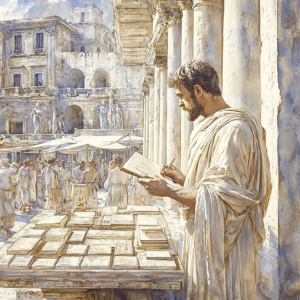
Depiction of pragmatism – practical knowledge and action in Stoicism, a key to life guidance.

Pragmatism in Stoicism: Knowledge in Action

For Stoics, practical knowledge was essential for achieving eudaimonia – the state of flourishing. Epictetus emphasized: “It’s not what happens to you, but how you react to it that matters.” This insight reminds us that sharpening our perceptions and focusing on what matters is the foundation of wise action.

Marcus Aurelius, the Stoic emperor, embodied this principle by reducing decisions to align with his role and values. His maxim, “Waste no more time arguing what a good man should be. Be one,” demonstrates how pragmatism drives actionable wisdom.

Pragmatism in Action: Examples from the Stoa

Cleanthes, the second leader of the Stoa, exemplified pragmatic living. Beginning his philosophical studies as a water carrier, he applied Stoic principles to lead a virtuous life. His example proves that philosophy is accessible to all, regardless of circumstances.

Similarly, Herillus of Carthage taught that philosophy comes alive through action, emphasizing that theory without practice is incomplete.

Pragmatism in Modern Life

Pragmatism is more relevant today than ever. Whether in work, relationships, or personal choices, the Stoic focus on practical action helps us tackle challenges effectively. Consider these examples:

  • Emotional Regulation: Use Stoic methods to replace impulsive reactions with rational thought.
  • Setting Priorities: Focus on what you can control and avoid wasting energy on the uncontrollable.
  • Building Resilience: Apply pragmatic strategies to view setbacks as opportunities for growth.

The Stoics encourage us to not merely acquire knowledge but to actively integrate it into daily life. Pragmatism is the key to leading a purposeful, action-oriented existence.

How Can You Practice Pragmatism?

Start applying your knowledge today. Reflect on how Stoic principles can guide your daily decisions. Ask yourself: “Does this action align with virtue and wisdom?” Even the smallest steps can lead to significant transformations.

Embrace the pragmatism of the Stoics to craft a deliberate and meaningful life!

Embrace open-mindedness as a Stoic tool for growth and learning.

Please Note

Stoic exercises and practices are meant to inspire, not instruct. For personal guidance, please consult an expert. Stoic Practices: Disclaimer

Books & Shop: Inspiration for Stoics

  • Recommended books on Stoicism
  • Store for stoics
  • Great Stoic Philosophers
  • Stoic Practices and Exercises
Back to the content:
I Pragmatism – Practical Knowledge in Stoic Wisdom 🛠️
II Introduction: Pragmatism as a Core of Stoic Philosophy
III Pragmatism in Stoicism: Knowledge in Action
IV Pragmatism in Action: Examples from the Stoa
V Pragmatism in Modern Life
VI How Can You Practice Pragmatism?
VII Books & Shop: Inspiration for Stoics
  • Share on Facebook
  • Share on X
  • Share on WhatsApp
  • Share on Pinterest
  • Share on LinkedIn
  • Share on Tumblr
  • Share on Reddit
  • Link to Instagram
Search Search

Latest articles

  • Symbolic article image on Sun Tzu in everyday life, orientation instead of control, and reality as shifting terrain
    Φ ⋮ Sun Tzu in Everyday Life: Orientation, Not Controlby: Stay-Stoic
  • Atmospheric hero image for equanimity, unagitated sovereignty, and quiet presence in a culture of visible agitation
    Φ ⋮ Equanimity in an Age of Constant Agitationby: Stay-Stoic
  • Symbolic image about inner interpretation, cognitive bias, and how small events continue unfolding in the mind.
    Φ ⋮ When Interpretation Turns Events Into Storiesby: Stay-Stoic
  • Conceptual image about self-presentation, visibility, and the quiet exhaustion of constant readability.
    Φ ⋮ Self-Presentation and the Fatigue of Showingby: Stay-Stoic
  • Aging as maturity and life review, focusing on experience, inner clarity, and the yield of lived life
    Φ ⋮ Aging as the Harvest Time of Lifeby: Stay-Stoic

Legal information

· Disclaimer

· Copyright & Protection

· Data privacy statement

· Imprint

Stay-Stoic

· About Stay-Stoic

· Author Profile

· Contact

· Support

· Recommend

Stoic Reflections

· Symbolism & Symbols

· Stoic Affirmations

· Tenets of the Stoa

· The Stoic Signpost

Stores & Reading

· Store for Stoics

· Stoic Literature

· Stoic Glossary

· Read a random article

Copyright by Stay-Stoic | All Rights Reserved
  • Link to X
  • Link to Instagram
  • Link to Pinterest
Scroll to top Scroll to top Scroll to top